
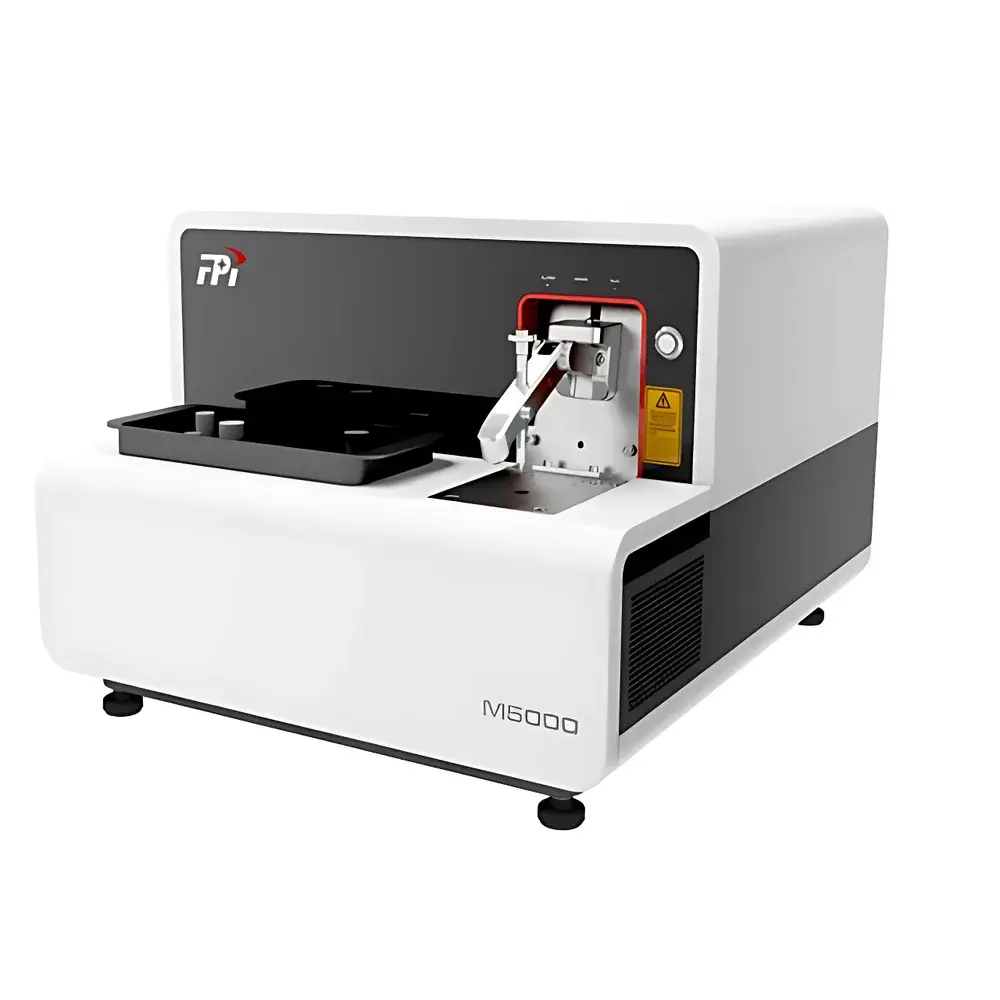
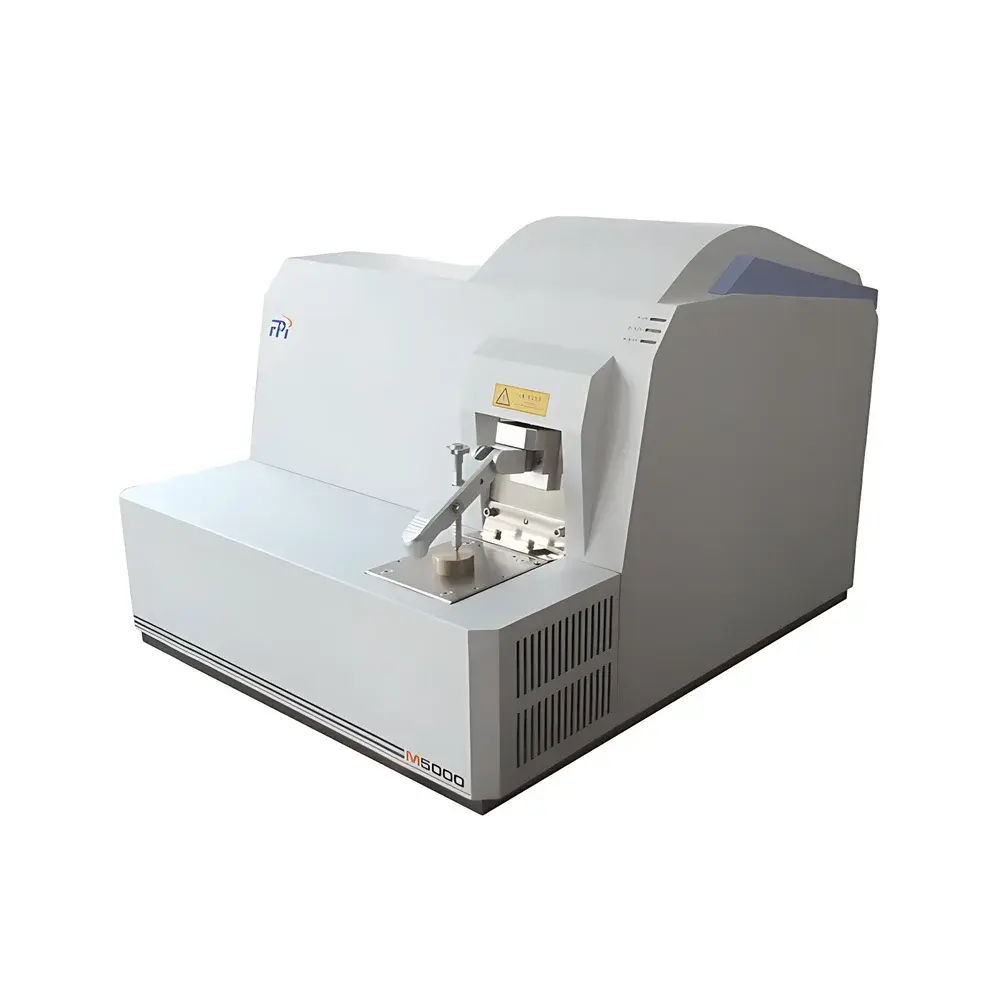
Microlink M5000 Plus Full-Spectrum Direct-Reading Arc/Spark Optical Emission Spectrometer (AES)
| Brand | Microlink / BEIJING MICHEM TECHNOLOGY LTD. |
|---|---|
| Origin | Zhejiang, China |
| Instrument Type | Benchtop |
| Excitation Source | Spark |
| Detector | Scientific-grade CMOS array (replacing legacy CCD) |
| Focal Length | 1000 mm |
| Grating Density | 3600 lines/mm |
| Wavelength Range | 140 nm – 680 nm |
| Number of Simultaneous Detection Channels | 96 |
| Optical System | Dual-chamber vacuum-UV + UV-Vis configuration |
| Structural Material | Stress-relieved die-cast aluminum optical chamber (4-stage annealing) |
| Thermal Management | Active chamber temperature stabilization with laminar purge gas flow |
| Spectral Optimization | RTMC (Real-Time Multi-Channel) calibration and drift compensation algorithm |
| Compliance | Designed to support ISO/IEC 17025 workflows, ASTM E415, ASTM E1086, ASTM E3061, and GB/T 4336–2016 methodologies |
Overview
The Microlink M5000 Plus is a benchtop full-spectrum direct-reading optical emission spectrometer (OES) engineered for high-precision quantitative elemental analysis of metallic alloys. It operates on the fundamental principle of arc/spark-induced atomic emission spectroscopy (AES): when a high-energy spark discharge excites atoms in a solid metal sample, electrons transition between quantized energy levels, emitting photons at characteristic wavelengths. These emissions are dispersed via a high-resolution Czerny-Turner optical system with a 1000 mm focal length and 3600 lines/mm holographic grating, enabling sub-nanometer spectral resolution across the 140–680 nm range—including critical vacuum ultraviolet (VUV) lines below 190 nm (e.g., C 165.7 nm, P 178.3 nm, S 180.7 nm). Unlike sequential or limited-channel spectrometers, the M5000 Plus captures the entire spectrum simultaneously using a scientific-grade CMOS detector—offering superior dynamic range, lower readout noise, and enhanced quantum efficiency in the VUV region compared to conventional CCDs. Its dual-optical-path architecture isolates the VUV spectral segment in a sealed, purged chamber, eliminating oxygen absorption and ensuring long-term stability of low-wavelength intensity calibration.
Key Features
- Dual-chamber optical design: Independent vacuum-UV and UV-Vis optical paths with continuous argon purge, enabling reliable detection of light elements (C, P, S, N, B, As) without vacuum pump maintenance.
- 4-stage stress-relieved die-cast aluminum optical chamber: Precision-machined and thermally aged to minimize micro-strain-induced wavelength drift; coupled with active temperature control (±0.05 °C stability) and laminar internal gas flow for thermal homogeneity.
- RTMC (Real-Time Multi-Channel) spectral optimization: A proprietary algorithm performing continuous background correction, peak deconvolution, and inter-element interference modeling during acquisition—reducing matrix effect dependencies and improving accuracy for complex alloys (e.g., high-Cr Ni-based superalloys, Al-Li aerospace grades).
- Full-spectrum acquisition capability: Captures >9,500 resolvable spectral lines per exposure; supports post-acquisition reprocessing with alternative analytical lines, facilitating method transfer, outlier diagnosis, and retrospective validation.
- Benchtop footprint with modular sample interface: Compatible with standardized 32-mm electrode holders and optional custom fixtures for irregular geometries (tubes, wires, small castings, coated sheets), meeting ASTM E2167 sampling requirements.
Sample Compatibility & Compliance
The M5000 Plus accepts solid conductive metallic samples conforming to ISO 11577 and ASTM E2167 surface preparation guidelines (flatness ≤ 0.05 mm, roughness Ra < 0.8 µm). It supports ferrous (steels, cast irons), non-ferrous (Al, Cu, Mg, Ti, Zn, Ni, Co alloys), and specialty materials including powder metallurgy compacts (after proper pressing/densification). All firmware and software modules are architected to support audit-ready data integrity: electronic signatures, full audit trail (user actions, parameter changes, calibration events), and secure role-based access control aligned with FDA 21 CFR Part 11 and ISO/IEC 17025 clause 7.7 requirements. Method validation reports comply with ICH Q2(R2) principles for analytical procedure verification.
Software & Data Management
Microlink SpectraSuite v5.x provides a validated, GxP-aligned environment for instrument control, spectral acquisition, quantitative calibration (univariate/multivariate), and report generation. It includes built-in libraries for over 120 certified reference materials (CRMs) from NIST, BAM, and JSS, with automated CRM matching and uncertainty propagation per ISO/IEC Guide 98-3. Raw spectral data (.spe binary format) and processed results (.csv/.xlsx) are stored with immutable metadata (timestamp, operator ID, environmental conditions, spark parameters). Integration with LIMS is supported via ASTM E1482-compliant XML export and OPC UA server interface.
Applications
The M5000 Plus delivers trace-to-major element quantification (ppm to wt%) in production QA/QC labs, R&D centers, and third-party testing facilities. Typical use cases include: rapid grade identification of incoming raw materials (scrap sorting, billet verification); low-level residual element monitoring (Sn, Pb, Bi in ultra-low-carbon steels); sulfur and phosphorus certification in pipeline steels per API 5L Annex A; carbon equivalence calculation for weldability assessment; and high-accuracy Nb/Ta ratio determination in superalloy turbine disk forgings. Its VUV sensitivity enables compliance testing for restricted substances (RoHS, ELV) in automotive castings and aerospace fasteners.
FAQ
Does the M5000 Plus require vacuum pumping for VUV analysis?
No. The VUV optical path is maintained under continuous high-purity argon purge (dew point < −60 °C), eliminating mechanical vacuum pumps and associated vibration/noise sources.
Can existing MA-8002 calibration curves be migrated to the M5000 Plus?
Yes—SpectraSuite includes backward-compatible curve translation tools with empirical correction for detector quantum efficiency differences and grating dispersion shifts.
What maintenance intervals are recommended for routine operation?
Daily: Electrode cleaning and argon purity check. Quarterly: Optical window inspection and purge line moisture trap replacement. Annually: Full spectral recalibration using NIST-traceable CRMs and RTMC model retraining.
Is remote diagnostics supported?
Yes—optional Secure Remote Access Module (SRAM) enables encrypted technician-assisted troubleshooting with session logging and screen sharing, compliant with ISO/IEC 27001 information security controls.




