
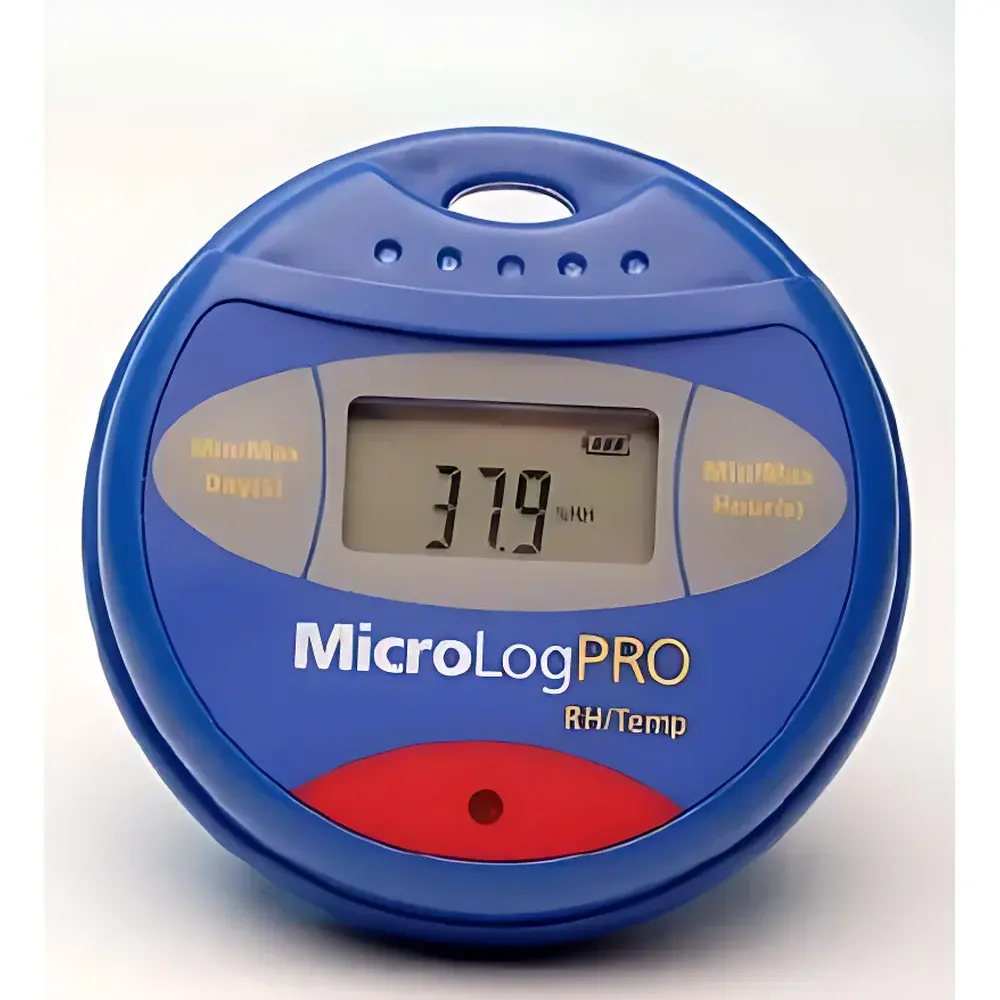
MicroLOG Pro EC750 Pocket-Sized Temperature & Humidity Data Logger
| Origin | Imported |
|---|---|
| Manufacturer Type | Authorized Distributor |
| Model | MicroLOG Pro EC750 Pocket-Sized Temperature & Humidity Data Logger |
| Temperature Range | –40 to +80 °C |
| Relative Humidity Range | 0–100 %RH |
| Temperature Accuracy | ±0.2 °C |
| RH Accuracy | ±2 %RH @ 25 °C |
| Temperature Resolution | 0.1–0.2 °C (varies by range) |
| RH Resolution | 0.1 %RH |
| Memory Capacity | 52,000 data points |
| Sampling Interval | 10 s to 2 h |
| Display | 4-digit LCD with unit indicators (°C/°F/%RH/PH/V/mA/mS/AL-H/AL-L) |
| Communication | RS-232 (19.2 kbps), USB 1.1, IrDA (compatible with HP 82240B printer) |
| Power | 3.6 V Li primary battery (½AA, 1.2 Ah) |
| Battery Life | ~2 years (typical use, no external sensors or high-frequency sampling) |
| Dimensions | Ø72 mm × 22.9 mm |
| Weight | 55 g |
| Certifications | CE, FCC |
| Software | MicroLAB 1.1 (free, Windows-compatible) |
Overview
The MicroLOG Pro EC750 is a compact, battery-powered temperature and relative humidity (RH) data logger engineered for long-term environmental monitoring in regulated and field-deployed applications. Based on high-stability capacitive RH sensing and precision thermistor-based temperature measurement, the EC750 captures and stores time-stamped environmental parameters with traceable accuracy and minimal drift. Its sealed, IP-rated enclosure ensures operational integrity in challenging environments—ranging from pharmaceutical cold-chain validation and museum climate control to agricultural microclimate studies and industrial process ambient monitoring. Designed for compliance-critical workflows, the device maintains data integrity across power cycles and supports audit-ready data export and analysis—making it suitable for GLP, GMP, and ISO 17025-aligned laboratories and quality assurance departments.
Key Features
- Non-volatile memory retains up to 52,000 timestamped readings—even during battery replacement or power interruption.
- Dual-channel internal sensing: simultaneous high-resolution measurement of temperature (±0.2 °C) and relative humidity (±2 %RH @ 25 °C).
- Configurable alarm outputs: discrete high/low threshold alerts via switch-contact output for integration into supervisory control systems.
- Multi-interface connectivity: RS-232 (19.2 kbps), USB 1.1, and IrDA (HP 82240B compatible) enable flexible data retrieval in lab, office, or field settings.
- Rugged, waterproof, and dust-resistant housing certified to CE and FCC standards—rated for continuous operation in uncontrolled environments.
- Low-power architecture delivers approximately two years of operation on a single 3.6 V lithium primary cell (½AA format, 1.2 Ah), minimizing maintenance overhead.
- Real-time LCD display shows current readings, min/max values over the last 30 days, and status indicators for alarms, battery level, and communication mode.
Sample Compatibility & Compliance
The EC750 operates autonomously without sample preparation or consumables, making it ideal for ambient air monitoring where direct exposure to the environment is required. It complies with IEC 61000-6-3 (EMC emissions) and IEC 61000-6-2 (immunity), supporting deployment in electrically noisy industrial facilities. While not intrinsically safe, its low-voltage design and non-sparking enclosure meet general-purpose safety requirements for non-hazardous locations. For regulatory documentation, the device supports 21 CFR Part 11-compliant data handling when used with validated MicroLAB 1.1 software configurations—including electronic signatures, audit trails, and user access controls. It has been deployed in ISO 14644 cleanroom monitoring, USP storage condition verification, and WHO Annex 9 cold chain validation protocols.
Software & Data Management
MicroLAB 1.1—a free Windows-based application—provides full configuration, download, visualization, and statistical analysis capabilities. Users can define sampling intervals, set alarm thresholds, and configure display units prior to deployment. Post-retrieval, data may be rendered as time-series graphs, tabular exports (CSV, Excel), or annotated charts with customizable axes, grid overlays, and dual-Y scaling. Advanced analytical functions include slope calculation, moving averages, numerical integration, standard deviation, and percentile reporting. The software supports annotation insertion, overlay of reference limits, and export of publication-ready figures (PNG, BMP, EMF). All actions are logged in an immutable audit trail, satisfying GLP/GMP record-keeping requirements.
Applications
- Pharmaceutical logistics: Continuous monitoring of temperature and humidity during transportation and warehouse storage per GDP guidelines.
- Museum and archive preservation: Long-term tracking of gallery and storage vault conditions to prevent hygrothermal degradation of artifacts.
- Food processing environments: Validation of ambient conditions in packaging lines, ripening rooms, and refrigerated holding areas.
- Agricultural research: Microclimate profiling in greenhouses, soil moisture correlation studies (with optional DT288 sensor), and post-harvest storage monitoring.
- Building commissioning: HVAC performance verification and ASHRAE 62.1 indoor air quality baseline assessment.
- Academic field studies: Portable, low-maintenance logging for ecology, atmospheric science, and materials aging experiments.
FAQ
Does the EC750 support external sensors?
Yes—the EC750 accepts analog and digital inputs via its expansion port, including PT100 temperature probes (DT252/DT253), pH electrodes (DT168), voltage/current transducers (DT140/DT139), conductivity sensors (DT279), lux meters (DT163), and volumetric soil moisture sensors (DT288).
Is calibration traceable to NIST standards?
The EC750 is supplied with a factory calibration certificate; optional NIST-traceable calibration services are available through authorized service centers.
Can data be exported directly to LIMS or ELN systems?
Yes—MicroLAB 1.1 supports CSV and Excel export formats compatible with most LIMS, ELN, and statistical analysis platforms (e.g., JMP, Minitab, Python pandas).
What is the maximum sampling frequency for continuous logging?
The shortest configurable interval is 10 seconds, yielding up to 52,000 points over ~6 days at full rate—or over 6 years at 2-hour intervals.
Is firmware upgradeable in the field?
Firmware updates are performed via RS-232 or USB using MicroLAB 1.1; version history and update logs are retained in the software’s audit trail.



