
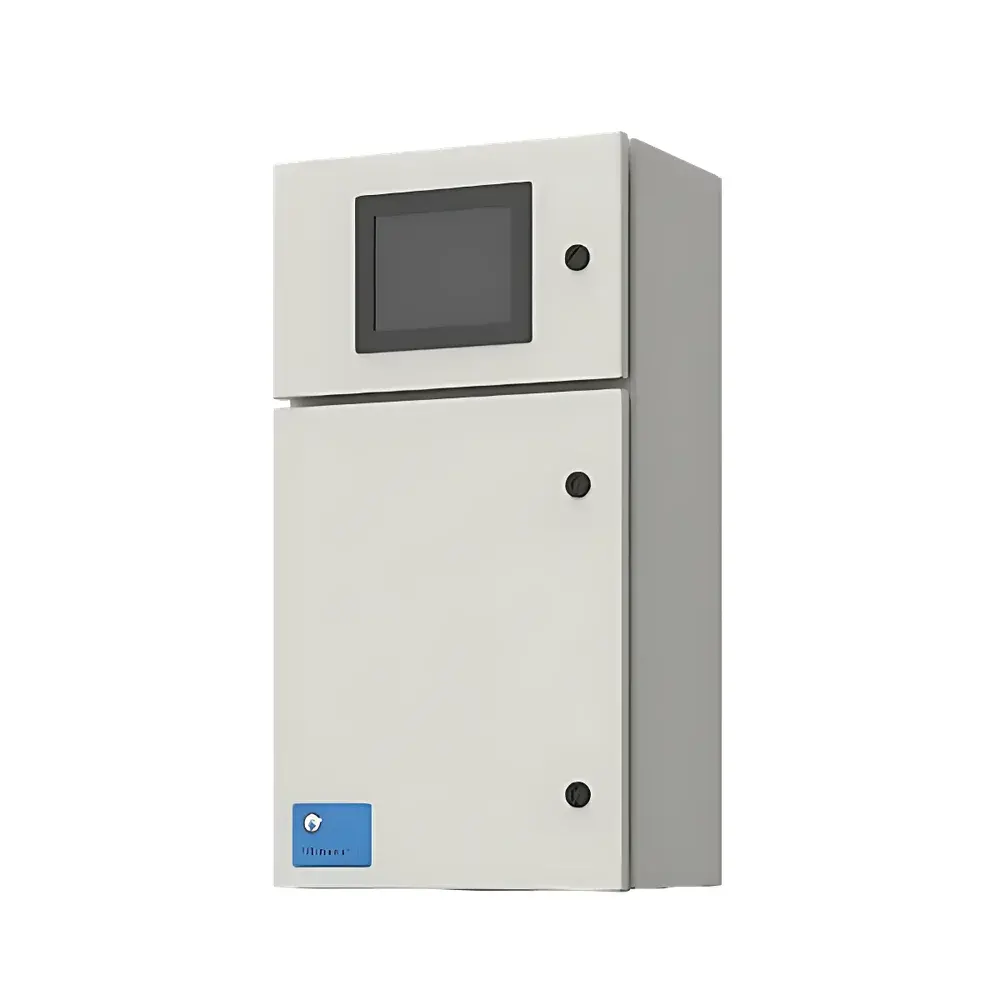
Micromac C Online Water Quality Analyzer by SYSTEA
| Brand | SYSTEA |
|---|---|
| Origin | Zhejiang, China |
| Manufacturer Type | Authorized Distributor |
| Country of Origin | China |
| Model | Micromac C |
| Pricing | Available Upon Request |
Overview
The Micromac C Online Water Quality Analyzer is a modular, multi-parameter spectrophotometric analyzer engineered for continuous, unattended monitoring of critical water quality parameters in diverse aqueous matrices. Based on validated colorimetric and photometric measurement principles—compliant with ISO 7027 (turbidity), ISO 8467 (COD), ISO 15173 (cyanide), and ASTM D1253 (residual chlorine)—the system delivers reliable, traceable data for regulatory compliance and process control. It operates via segmented flow analysis (SFA) architecture, integrating precise fluidic handling, temperature-stabilized reaction cuvettes, and dual-beam UV-Vis photometry (typically 340–900 nm) to minimize drift and enhance long-term reproducibility. Designed for deployment in harsh or remote environments, the Micromac C supports fully automated operation across fluctuating sample conditions—from low-conductivity drinking water to high-salinity seawater and chemically complex industrial effluents.
Key Features
- Multi-parameter capability: Simultaneous or sequential analysis of up to 20 parameters including TOC (via persulfate UV oxidation), BOD5 (estimated via respirometric correlation), total and free cyanide, phenols, fluoride, chloride, anionic surfactants (MBAS), sulfide, free/total chlorine, alkalinity, hardness, color, hydrazine, boron, oil & grease (by extraction-photometry), Ca2+, Mg2+, Na+, K+
- Adaptive range management: Auto-ranging with seamless switching between high/low sensitivity optical paths; single-range mode includes intelligent over-range dilution using integrated peristaltic pumps and precision dilution loops
- Real-time process visualization: Dynamic absorbance curve plotting during each measurement cycle; intuitive status dashboard showing valve/pump actuation sequence, thermal stabilization status, reagent consumption progress, and ambient/internal temperature
- Operational flexibility: Four configurable operating modes—manual (for validation), periodic (user-defined intervals), trigger-based (e.g., level or flow signal), and continuous (fixed-cycle acquisition)
- Calibration integrity: Support for 2-point linear and multi-point non-linear calibration curves; optional certified standard verification (CSA) with automatic zero/span checks at user-defined frequencies
- Remote operability: Full bidirectional RS232/RS485 Modbus RTU support; optional Ethernet (TCP/IP) with HTTP/HTTPS API for integration into SCADA or cloud-based EMS platforms; remote firmware update and diagnostic access
- Robust safety architecture: Integrated liquid-level sensors for leak detection; segregated hazardous/non-hazardous waste collection paths; power-fail recovery protocol with post-reboot thermal cooldown, system flush, and self-diagnostic initialization
Sample Compatibility & Compliance
The Micromac C accepts raw, filtered, or pre-treated samples from surface water, groundwater, municipal wastewater, industrial discharge streams, desalination plant intakes, and potable water distribution networks. Optional inline filtration (5–50 µm), pH adjustment, degassing, or UV pretreatment modules ensure matrix compatibility without manual intervention. All analytical methods implemented align with internationally recognized standards—including ISO 10530 (phosphate), ISO 6777 (ammonia), EN ISO 15921 (cyanide), and US EPA Methods 353.2 (nitrate), 4500-Cl G (chlorine), and 4500-F⁻ D (fluoride). The system meets CE marking requirements for EMC and LVD, and its data handling architecture supports audit-ready logging per GLP and GMP guidelines, including electronic signatures and 21 CFR Part 11-compliant metadata tagging when paired with SYSTEA’s optional secure software package.
Software & Data Management
Embedded firmware provides local data storage (≥30 days of 5-minute interval records) with timestamped event logs (calibrations, alarms, maintenance actions). SYSTEA’s AquaLink™ PC software enables method configuration, trend analysis, alarm threshold setting, and report generation (PDF/CSV). Data export supports OPC UA and MQTT protocols for enterprise-level integration. All measurements include embedded uncertainty estimation based on calibration history, reagent lot traceability, and environmental sensor inputs. Automatic backup to external USB or network drive ensures continuity during extended deployments.
Applications
- Regulatory compliance monitoring at wastewater treatment plant outfalls (e.g., NPDES permits)
- Early-warning systems for source water protection in river basins and reservoirs
- Process optimization in chemical, pharmaceutical, and food & beverage manufacturing
- Seawater intake monitoring for corrosion inhibitor dosing control
- Long-term groundwater quality assessment in landfill leachate plume tracking
- Drinking water safety verification in distribution networks (e.g., disinfectant residual, turbidity, nitrate)
FAQ
What sample throughput can the Micromac C achieve for a full 15-parameter cycle?
Typical cycle time ranges from 25 to 45 minutes depending on method complexity and required digestion steps; individual parameters (e.g., chloride or free chlorine) may complete in under 5 minutes.
Is the system compatible with third-party SCADA systems?
Yes—Modbus RTU over RS485 is standard; optional Modbus TCP and OPC UA gateways enable direct integration with Siemens Desigo, Honeywell Experion, or ABB Ability platforms.
How often must reagents be replaced, and how is depletion monitored?
Reagent consumption is tracked volumetrically via integrated stepper-motor-driven syringes; alerts trigger at 10% remaining volume, with optional barcode-scanned lot registration for full traceability.
Can the Micromac C operate in freezing ambient conditions?
With optional heated enclosure (−20 °C to +50 °C operating range) and glycol-based antifreeze in fluidic lines, it maintains operational stability in sub-zero outdoor installations.
Does the analyzer support method validation per ISO/IEC 17025?
Yes—the system provides raw absorbance values, calibration coefficients, environmental metadata, and audit trails required for accredited laboratory validation protocols.







