
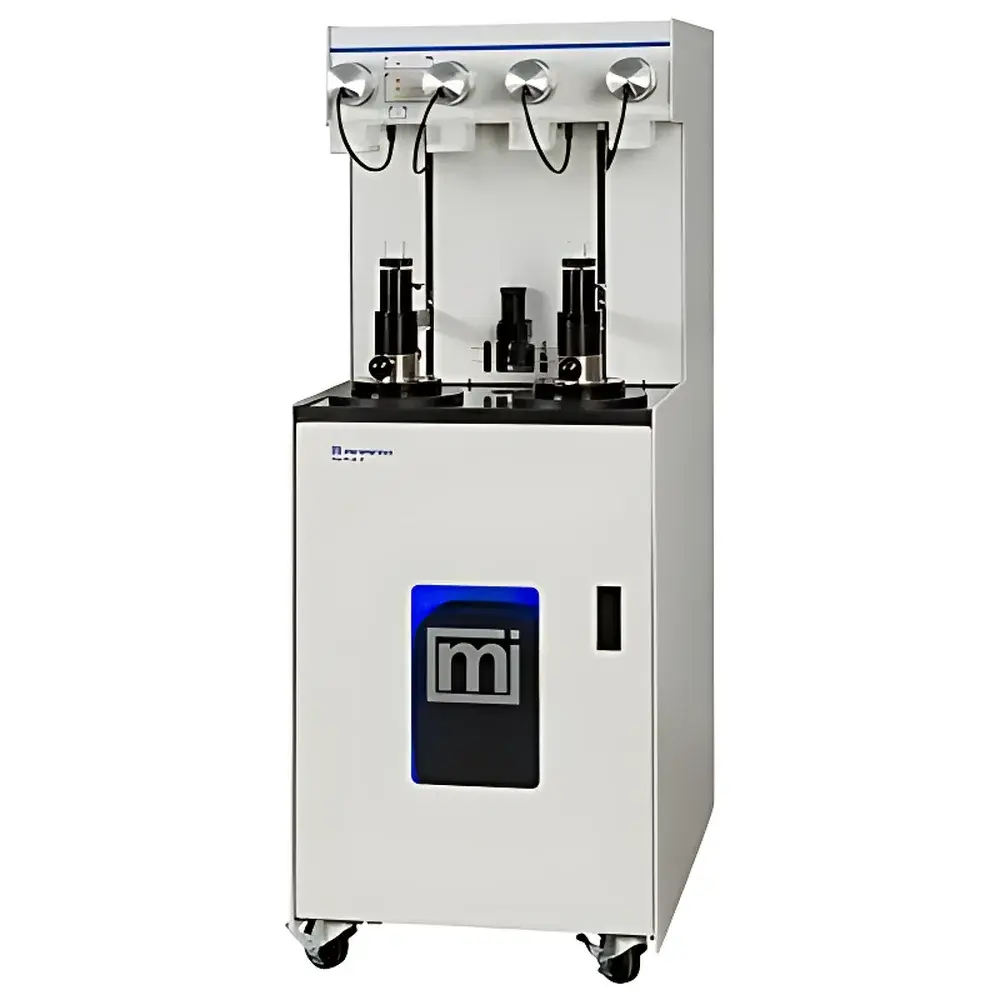
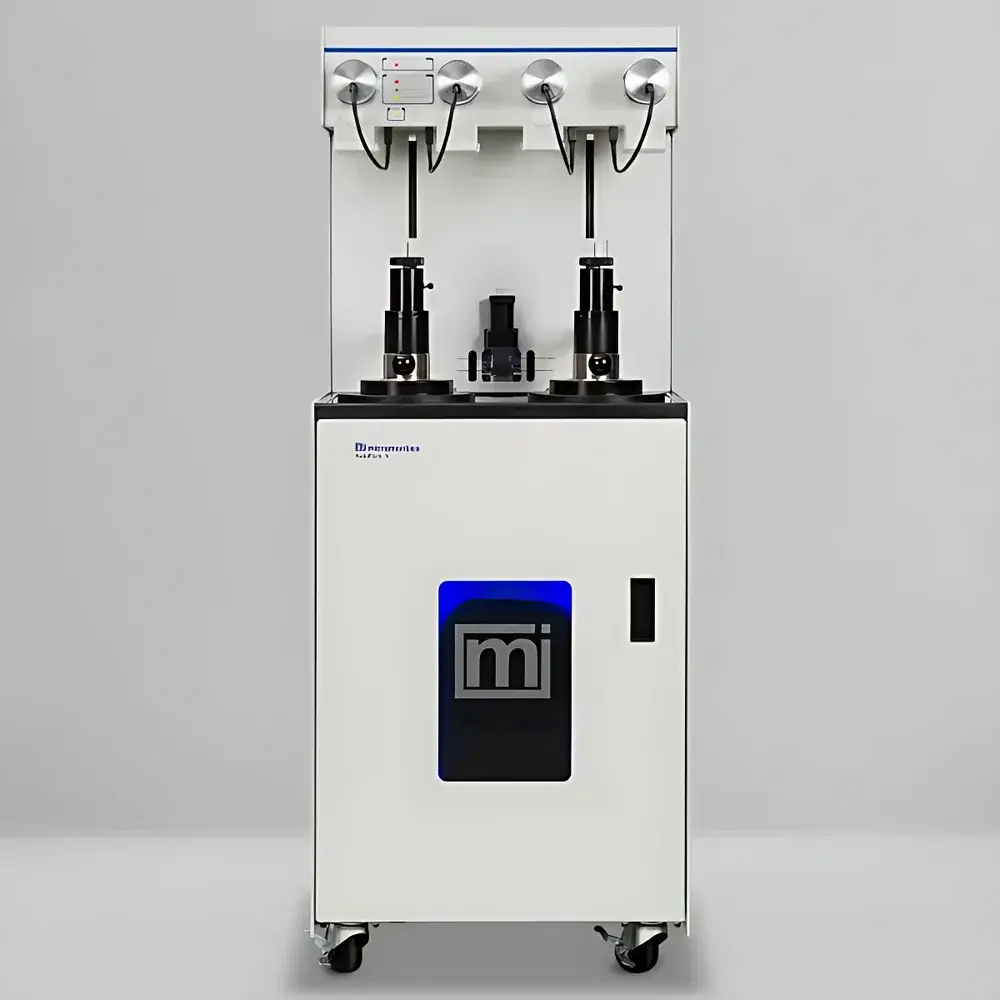
Micromeritics AutoPore V Series High-Performance Automated Mercury Intrusion Porosimeter
| Brand | Micromeritics |
|---|---|
| Origin | USA |
| Model | AutoPore V Series |
| Pore Size Range | 3 nm – 1100 µm |
| Pressure Range | 0.2 – 50 psia |
| Intrusion/Extrusion Volume Precision | < 0.1 µL |
| Compliance | ASTM D4284, D4404, D6761 |
Overview
The Micromeritics AutoPore V Series is a high-performance automated mercury intrusion porosimeter engineered for precise, reproducible characterization of porous solids across an exceptionally broad pore size distribution—from micropores (down to 3 nm) through mesopores and macropores up to 1100 µm. Based on the fundamental principle of mercury intrusion porosimetry (MIP), the instrument applies controlled, incremental pressure to force non-wetting mercury into interconnected pore networks. Pore diameters are calculated using the Washburn equation, incorporating mercury surface tension (485 mN/m) and contact angle (140°), enabling quantitative derivation of pore size distribution, total intruded volume, skeletal and envelope density, median pore diameter, and cumulative pore surface area. Unlike gas adsorption techniques limited to sub-50 nm pores, the AutoPore V uniquely bridges the analytical gap between physisorption and fluid permeability regimes—providing critical structural insight for catalysts, pharmaceutical excipients, battery electrodes, filtration media, and geological cores.
Key Features
- Ultra-wide dynamic pore size range: 3 nm to 1100 µm, validated per ASTM D4404 and ISO 15901-1 protocols.
- Dual-mode operation: Scan mode for rapid screening (≤30 min per run) and equilibrium mode for high-resolution pore network analysis with dwell-time stabilization at each pressure step.
- Enhanced operator safety architecture: Integrated mercury containment system with triple-seal sample chamber, real-time vapor pressure monitoring, automatic purge-and-flush sequence, and fail-safe interlocks compliant with OSHA Hg exposure guidelines and local chemical hygiene plans.
- Modular pressure train: 19 standardized penetrometer head configurations—including low-pressure (0.2–30 psia), high-pressure (up to 50 psia), and specialized heads for fragile or irregularly shaped samples—ensuring optimal hydraulic coupling and minimal compressibility error.
- High-precision volumetric measurement: Dual-capacitance transducer system calibrated traceably to NIST standards, delivering intrusion/extrusion volume resolution better than 0.1 µL with long-term drift <0.05 µL/24 h.
Sample Compatibility & Compliance
The AutoPore V accommodates powders, granules, monoliths, ceramics, metals, polymers, and geological specimens—provided they exhibit mechanical stability under mercury intrusion pressures and do not react chemically with elemental mercury. Sample preparation follows ASTM D4284 guidelines for degassing and evacuation prior to analysis. All data acquisition, processing, and reporting adhere to regulatory requirements for analytical instrumentation in GMP/GLP environments: full audit trail logging (user ID, timestamp, parameter changes), electronic signature support, and 21 CFR Part 11–compliant data integrity controls via optional MicroActive software configuration. Certificates of conformance are supplied for each instrument, including factory calibration records traceable to NIST SRM 1971.
Software & Data Management
MicroActive software provides intuitive workflow-driven control, real-time visualization of intrusion curves, and flexible post-run analysis. Users can reprocess raw pressure-volume data using multiple models (e.g., cylindrical, slit, ink-bottle correction) without re-running samples. Report generation supports customizable templates aligned with internal SOPs or external submission formats (e.g., FDA IND filings, journal supplementary data). Advanced scripting via embedded Python API enables automated batch processing, statistical outlier detection, and integration with LIMS or ELN platforms. All datasets are stored in vendor-neutral HDF5 format with embedded metadata (instrument ID, operator, date, method version), ensuring long-term archival integrity and FAIR data principles compliance.
Applications
- Catalyst development: Quantifying pore throat connectivity and tortuosity effects on diffusion-limited reaction kinetics.
- Pharmaceutical solid dosage forms: Correlating tablet porosity (measured at 3–50 µm) with dissolution rate and mechanical strength per USP <851>.
- Battery electrode materials: Assessing calendered electrode pore collapse and binder redistribution under compression cycles.
- Filtration membrane validation: Verifying maximum pore size (MPPS) and log-reduction value (LRV) correlations for sterilizing-grade membranes.
- Geological reservoir characterization: Differentiating primary intergranular porosity from secondary fracture networks in shale and carbonate cores.
FAQ
What pore size range is physically accessible with mercury intrusion porosimetry?
Mercury intrusion is applicable from ~3 nm (corresponding to ~50 MPa or ~7250 psi) up to macroscopic voids (~1100 µm at near-atmospheric pressure), bounded by instrument pressure limits and mercury’s inherent wetting behavior on solid surfaces.
How does the AutoPore V ensure data comparability across laboratories?
All instruments undergo factory calibration against certified reference materials (e.g., NIST SRM 1971 glass microspheres); method templates enforce consistent degassing protocols, pressure ramp rates, and contact angle assumptions—enabling inter-laboratory reproducibility per ISO 5725-2.
Can the system analyze moisture-sensitive or air-reactive samples?
Yes—optional inert-gas purged glovebox integration allows loading and evacuation of hygroscopic or pyrophoric samples without atmospheric exposure, maintaining sample integrity throughout analysis.
Is user training and method validation support available?
Micromeritics offers on-site installation qualification (IQ), operational qualification (OQ), and performance qualification (PQ) services, plus application-specific method development workshops accredited by the International Union of Pure and Applied Chemistry (IUPAC) Working Party on Adsorption and Porosimetry.



