
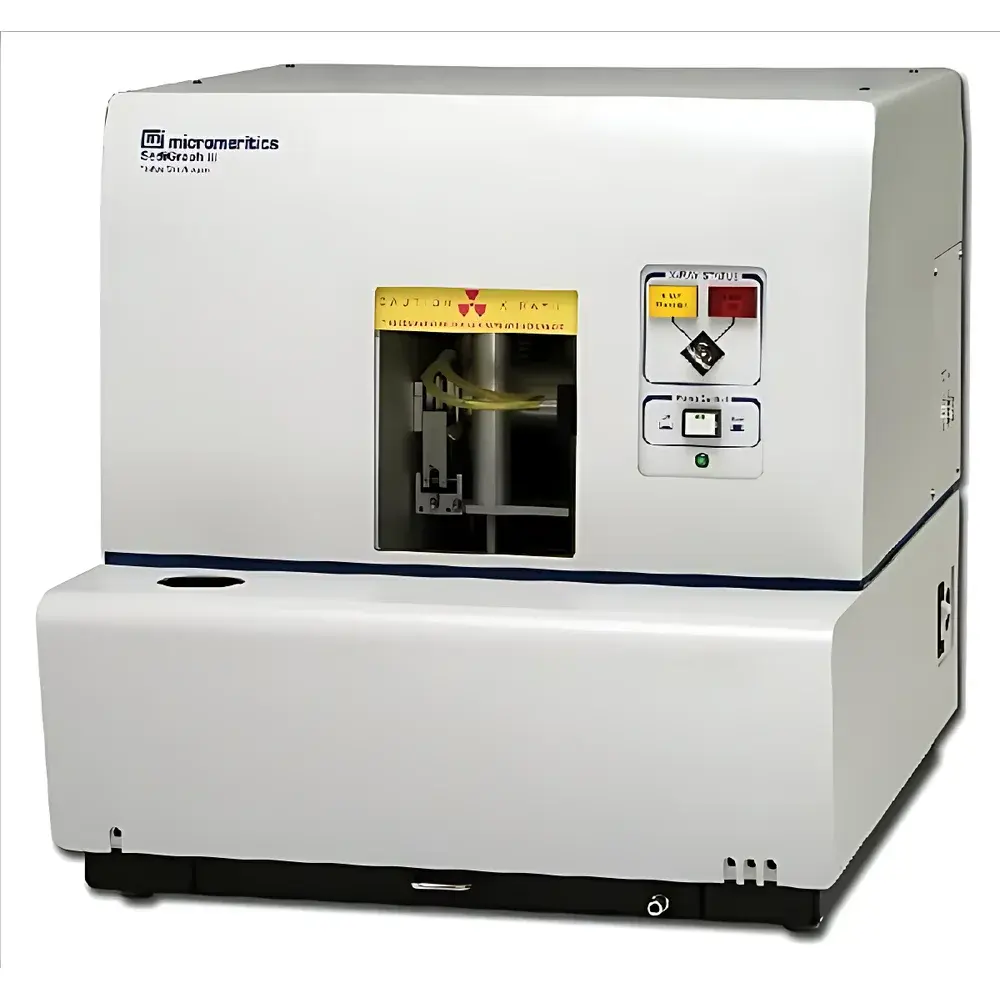
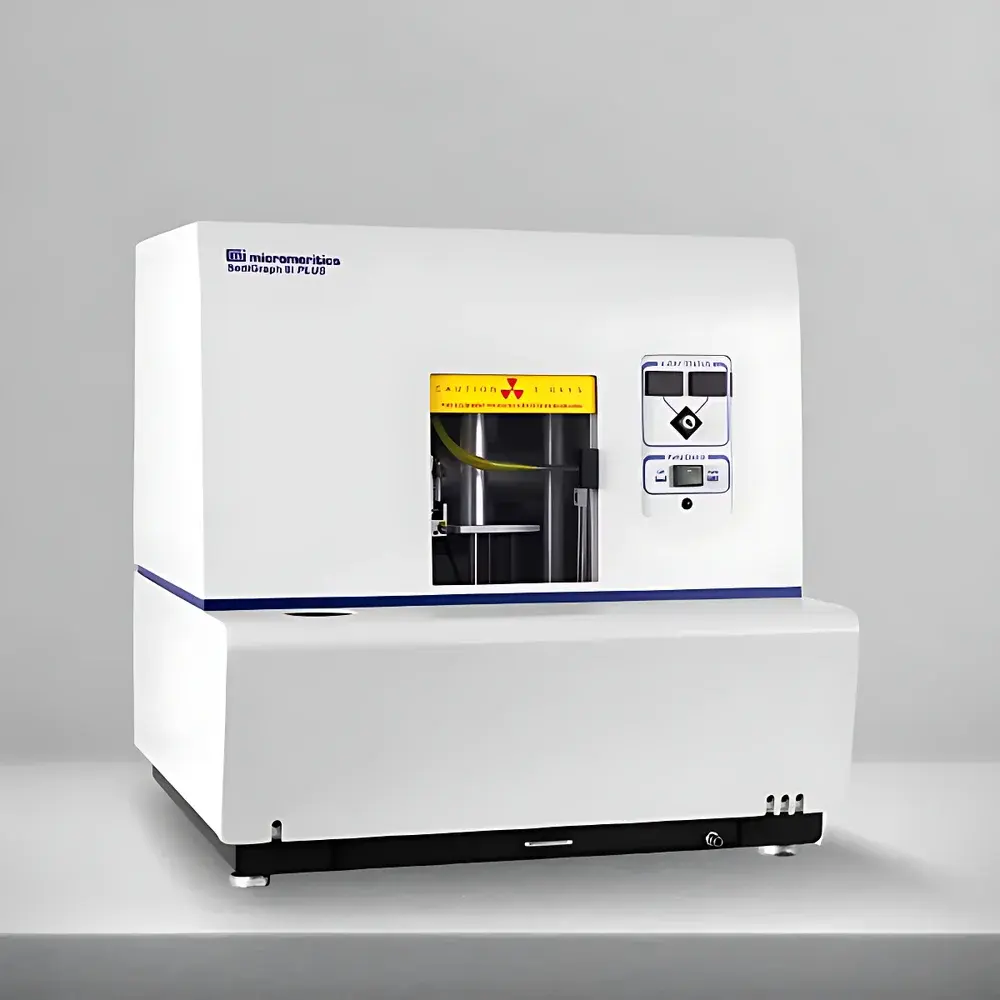
Micromeritics SediGraph III Plus Automated X-ray Sedimentation Particle Size Analyzer
| Brand | Micromeritics |
|---|---|
| Origin | USA |
| Model | SediGraph III Plus |
| Measurement Principle | X-ray sedimentation |
| Measurement Range | 0.1–300 µm |
| Repeatability | < 1% RSD |
| Accuracy | < 1% error vs. NIST-traceable standards |
| Analysis Time | 3–15 minutes per sample |
| Sample Volume | 50 mL dispersion |
| Compliance | ISO 13317-3, ASTM B761, ASTM C28 (Advanced Ceramics) |
| Automation | Unattended analysis of up to 18 samples |
| Optional Integration | MasterTech Auto-sampler for process monitoring and cloud data export |
Overview
The Micromeritics SediGraph III Plus is an automated X-ray sedimentation particle size analyzer engineered for high-precision, mass-based particle sizing of heterogeneous powders and suspensions across the 0.1–300 µm range. Unlike optical or laser-based techniques, it operates on the fundamental principle of gravitational sedimentation coupled with real-time X-ray absorption detection—directly quantifying particle mass concentration as a function of settling velocity. This enables true volumetric-to-mass conversion without reliance on optical scattering assumptions or refractive index corrections. Based on Stokes’ law, the instrument calculates equivalent spherical diameter by measuring the terminal settling rate of particles in a calibrated dispersing liquid (e.g., isopropanol or kerosene), under controlled temperature and viscosity conditions. Its design reflects over four decades of refinement in sedimentation methodology, making it a benchmark reference instrument in quality control laboratories, advanced materials R&D, and regulatory-compliant environments where traceability, reproducibility, and method robustness are critical.
Key Features
- Direct mass-concentration detection via low-energy X-ray attenuation—eliminates density-dependent assumptions inherent in light-scattering methods
- High-resolution sedimentation column with precision temperature stabilization (±0.1 °C) and programmable fluid viscosity compensation
- Automated sample introduction and dispersion conditioning, supporting up to 18 sequential analyses without operator intervention
- Integrated Windows-based software with intuitive point-and-click interface, customizable report templates, and drag-and-drop graph editing
- Comprehensive statistical output including D10, D50, D90, span, specific surface area (SSA), and cumulative/differential distribution curves
- Full audit trail and electronic signature support compliant with FDA 21 CFR Part 11 requirements when configured with validated software modules
- Optional MasterTech auto-sampler for continuous in-line or at-line monitoring, enabling integration into MES/SCADA systems and secure cloud-based data synchronization
Sample Compatibility & Compliance
The SediGraph III Plus accommodates a broad spectrum of particulate materials—including metal oxides, ceramics, pharmaceutical excipients, catalysts, pigments, and geological sediments—provided they exhibit sufficient density contrast with the dispersant and remain stable during sedimentation. It supports both aqueous and non-aqueous dispersions, with compatibility verified for common media such as isopropanol, kerosene, and xylene. All analytical protocols adhere to internationally recognized standards: ISO 13317-3 (determination of particle size distribution by X-ray sedimentation), ASTM B761 (for metal powders), and ASTM C28 (for advanced ceramic powders). Method validation documentation, including linearity, limit of quantitation (LOQ), and inter-laboratory reproducibility data, is available upon request to support GLP/GMP audits.
Software & Data Management
The instrument runs on a dedicated Windows 10 IoT Enterprise platform with Micromeritics’ proprietary SediGraph Software Suite. The software provides full method scripting capability, allowing users to define dispersion time, ultrasonication parameters, settling delay, scan resolution, and post-acquisition smoothing algorithms. Raw X-ray absorption profiles are stored in vendor-neutral ASCII format; processed results export seamlessly to CSV, PDF, XML, or Excel. Built-in database management supports hierarchical sample naming, metadata tagging (operator ID, lot number, environmental conditions), and version-controlled method archiving. For regulated environments, optional 21 CFR Part 11 compliance packages include role-based access control, electronic signatures, and immutable audit logs with timestamped user actions.
Applications
- Quality assurance of battery cathode/anode materials (e.g., LiCoO₂, graphite) where primary particle size governs electrochemical performance
- Characterization of ceramic green bodies and sintered components to correlate particle size distribution with green strength and final density
- Pharmaceutical solid dosage development—monitoring micronized API agglomeration behavior and excipient blend uniformity
- Geotechnical soil classification per ASTM D422, leveraging the instrument’s ability to resolve fine silt and clay fractions (<2 µm) with mass-based accuracy
- Industrial catalyst evaluation, where pore structure and active surface area are inferred from particle size statistics and SSA calculations
- Regulatory submission support for FDA, EMA, or PMDA filings requiring ISO/ASTM-aligned particle characterization data
FAQ
How does X-ray sedimentation differ from laser diffraction in terms of accuracy for fine particles?
X-ray sedimentation directly measures mass concentration versus settling velocity, providing inherently higher sensitivity below 1 µm and eliminating Mie theory dependencies. Laser diffraction assumes spherical morphology and known optical properties—introducing systematic bias for irregular or dense particles.
Can the SediGraph III Plus analyze nanoparticles below 0.1 µm?
No—the lower detection limit is constrained by Brownian motion dominance and signal-to-noise limitations in the X-ray absorption measurement; sub-100 nm analysis requires complementary techniques such as TEM or NTA.
Is method transfer possible between older SediGraph models and the III Plus?
Yes—legacy SediGraph II and III methods are fully compatible; the III Plus maintains identical column geometry, X-ray source calibration, and sedimentation physics, ensuring seamless historical data continuity.
What maintenance is required for long-term operational stability?
Annual X-ray source output verification and column bore inspection are recommended; no consumables beyond standard dispersants and filtration media are required. The sealed X-ray tube has a rated lifetime exceeding 10,000 hours.
Does the system support remote diagnostics or service access?
Yes—when connected to a secure corporate network, Micromeritics Field Service Engineers can initiate encrypted remote sessions for troubleshooting, firmware updates, and performance validation—subject to user authorization and IT policy compliance.



