
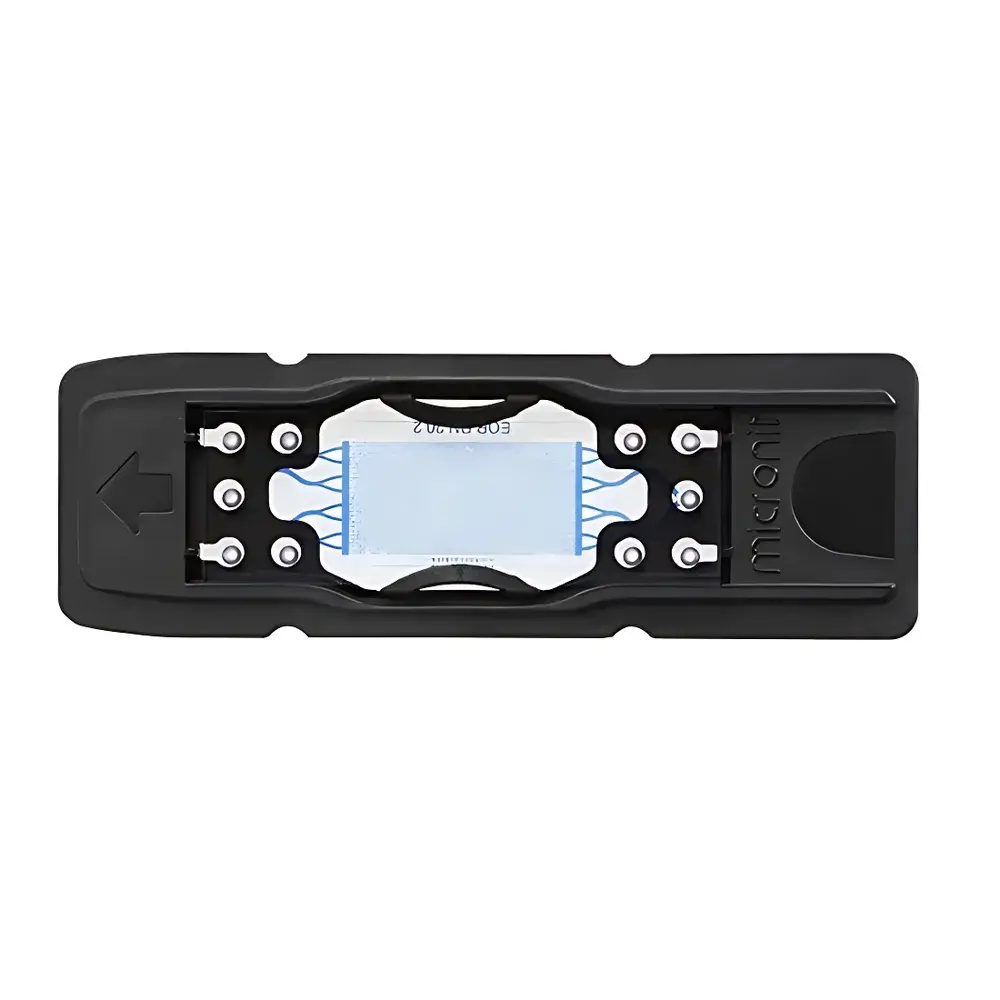
Micronit EOR Microfluidic Chip for Enhanced Oil Recovery
| Brand | Micronit |
|---|---|
| Origin | Netherlands |
| Chip Material | Borosilicate Glass |
| Chip Dimensions | 45 mm × 15 mm × 1800 µm |
| Channel Width | 50 µm |
| Channel Height | 20 µm |
| Internal Volume | 5.0–5.7 µL |
| Inlet/Outlet Count | 1 each |
| Structural Variants | Regular, Random, and Rock-Mimicking (Geologically Representative) |
| Application Domain | Core-scale Fluid Flow Simulation in Porous Media |
Overview
The Micronit EOR Microfluidic Chip is a precision-engineered lab-on-a-chip platform designed specifically for fundamental and applied research in enhanced oil recovery (EOR). Built on borosilicate glass using high-fidelity microfabrication techniques, the chip replicates key geometric and topological features of natural reservoir rock at the pore scale—enabling controlled, optically accessible experimentation under representative pressure, saturation, and interfacial conditions. Its operational principle relies on microscale fluid dynamics governed by Darcy–Brinkman–Stokes equations, with laminar flow regimes (Re < 10) ensuring direct correlation between chip-scale observations and core-flood or field-scale behavior. Unlike macroscopic core flooding apparatuses, this platform permits real-time, high-resolution visualization of multiphase displacement (e.g., water–oil–surfactant systems), capillary trapping, wettability alteration, and residual saturation evolution—critical parameters in thermal, chemical (polymer/surfactant), and microbial EOR screening.
Key Features
- Borosilicate glass substrate offering exceptional optical clarity (transmission >90% from 300–2500 nm), chemical inertness against hydrocarbons, acids, and alkalis, and thermal stability up to 500 °C—ensuring compatibility with high-temperature EOR simulations and post-experiment cleaning protocols.
- Three structurally distinct chip variants: (1) Regular lattice architecture for systematic parametric studies of pore geometry effects; (2) Stochastically generated random networks validated against statistical descriptors of sandstone porosity distributions; and (3) High-fidelity rock-mimicking design derived from µCT reconstructions of actual reservoir cores—preserving tortuosity, coordination number, and throat-to-body aspect ratios.
- Standardized footprint (45 mm × 15 mm × 1800 µm) and integrated single inlet/outlet ports enable seamless integration with commercial microfluidic control systems (e.g., Fluigent, Elveflow) and custom-built pressure-driven or syringe-pump setups.
- Consistent microchannel cross-section (50 µm width × 20 µm height) ensures reproducible hydraulic resistance and enables quantitative calibration of relative permeability curves via simultaneous pressure-drop and imaging-based saturation tracking.
- Manufactured in an ISO 14644-1 Class 5 cleanroom environment; each chip undergoes helium leak testing and surface energy characterization (contact angle hysteresis <3°) prior to shipment.
Sample Compatibility & Compliance
The EOR chip supports a wide range of working fluids—including brines (up to 20 wt% NaCl), crude oils (API gravity 15–40), polymer solutions (HPAM, xanthan), surfactant micellar systems, and CO₂-saturated aqueous phases—without observable leaching or swelling. Surface treatment options (e.g., silanization for oil-wet or plasma oxidation for water-wet conditions) are available upon request to replicate native reservoir wettability states. The device complies with ASTM D6988 (standard test method for measuring interfacial tension) and ISO 10472-1 (microfluidic device nomenclature and performance reporting). While not a medical device, its fabrication documentation adheres to GLP-aligned traceability standards, including lot-specific certificates of conformance, dimensional inspection reports, and batch-level optical interferometry validation data.
Software & Data Management
The chip operates independently of proprietary software but is fully compatible with industry-standard image acquisition and analysis pipelines. Users commonly integrate it with high-speed microscopy (e.g., Keyence VHX, Olympus IX83) coupled to open-source or commercial tools such as ImageJ/Fiji (with Pore-Cor or BoneJ plugins), MATLAB-based pore-network modeling suites (e.g., SNOW, PoreSpy), or commercial reservoir simulators (CMG, tNavigator) via exported saturation maps and time-resolved pressure data. All chips ship with a digital twin metadata file (JSON schema) containing exact channel topology coordinates, lithographic mask version, and calibration coefficients—enabling traceable digital replication and cross-laboratory benchmarking. Audit trails for experimental runs can be maintained in accordance with FDA 21 CFR Part 11 requirements when paired with compliant LIMS or ELN platforms.
Applications
- Pore-Scale Mechanistic Studies: Quantifying snap-off, ganglion mobilization, and capillary number thresholds during water-alternating-gas (WAG) injection.
- Chemical EOR Screening: Evaluating surfactant adsorption kinetics, emulsion stability, and phase behavior under reservoir-relevant salinity and temperature gradients.
- Microbial EOR Modeling: Monitoring biofilm growth dynamics, metabolite diffusion, and bioclogging effects in confined porous geometries.
- CO₂ Sequestration Research: Visualizing supercritical CO₂–brine displacement patterns and residual trapping efficiency in heterogeneous media.
- Upscaling Validation: Providing ground-truth datasets for calibrating pore-network models and validating lattice-Boltzmann simulations.
FAQ
Can these chips be reused after experiments involving heavy crude or asphaltene deposition?
Yes—provided rigorous post-run cleaning is performed using sequential solvent flushes (toluene → acetone → isopropanol), followed by oxygen plasma treatment (100 W, 5 min) to restore hydrophilicity and remove organic residues. Reusability is confirmed via baseline pressure-drop reproducibility (<±2% deviation across ≥5 cycles).
Is custom chip design available for specific reservoir rock types?
Yes—Micronit offers collaborative co-design services leveraging customer-provided µCT datasets. Lead time for prototype fabrication is typically 8–12 weeks, including mask design, wafer processing, and functional validation.
What mounting hardware is required for pressure-sealed operation?
The chips are compatible with standard PDMS gasket-based clamping fixtures (e.g., Dolomite Microfluidics Chip Holder Series) or custom CNC-machined stainless-steel manifolds rated to 10 MPa. Detailed torque specifications and sealing interface drawings are provided in the technical manual.
Do you provide application support for image analysis workflow setup?
Micronit’s technical team offers remote consultation and pre-configured Fiji/ImageJ macros for saturation quantification, front velocity tracking, and pore occupancy mapping—available under NDA upon project initiation.
Are there regulatory restrictions on shipping these chips outside the EU?
No export licenses are required; the chips contain no controlled substances or dual-use components. They are shipped globally under standard commercial terms (Incoterms® 2020 CPT).




