
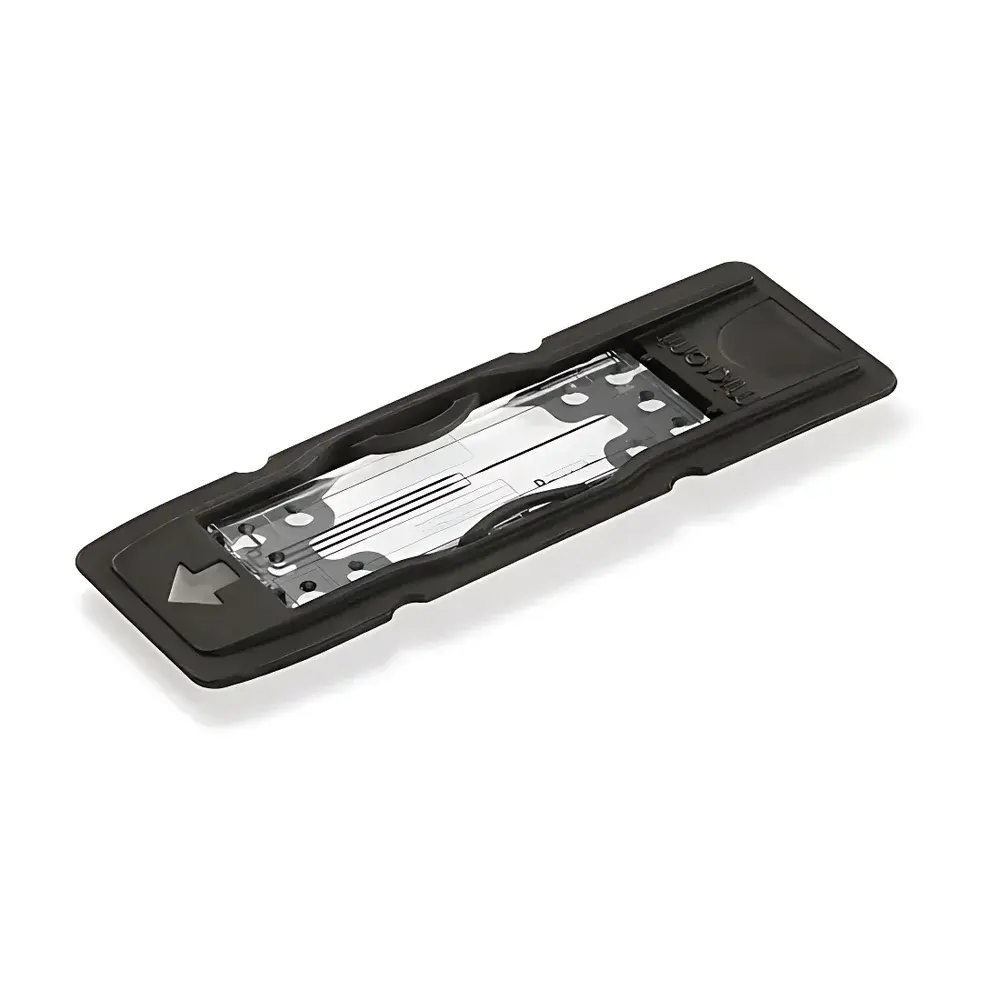
Micronit FF_DROP_75 Microfluidic Droplet Generation Chip
| Brand | Micronit |
|---|---|
| Origin | Netherlands |
| Model | FF_DROP_75, FF_DROP_50, FF_DROP_10, FF_DROP_SC_5, FF_DROP_SC_10, FF_DROP_SC_50 |
| Chip Type | Droplet Generation Chip |
| Substrate Material | Borosilicate Glass |
| Chip Dimensions | 45 mm × 15 mm (top-connect) or 15 mm × 15 mm (side-connect) |
| Chip Thickness | 1800 µm (top-connect) / 1400 µm (side-connect) |
| Nozzle Diameter | 5–75 µm |
| Channel Height | 17–125 µm |
| Internal Volume | 0.09–4.3 µL |
| Inlets | 2–3 |
| Outlets | 1 |
Overview
The Micronit FF_DROP series microfluidic droplet generation chips are precision-engineered glass-based platforms designed for controlled, high-reproducibility formation of monodisperse aqueous or organic droplets in microfluidic systems. Based on the hydrodynamic flow-focusing principle, these chips utilize precisely fabricated microchannels and nozzles to confine and shear a dispersed phase into uniform droplets within a continuous phase—enabling deterministic control over droplet size, frequency, and stability. Unlike bulk emulsification methods, microfluidic droplet generation delivers exceptional coefficient of variation (CV < 3%) across millions of droplets, making it indispensable for quantitative single-cell encapsulation, compartmentalized enzymatic assays, and formulation screening in regulated environments.
Key Features
- Monolithic borosilicate glass construction ensures chemical inertness, optical clarity (UV-Vis transmission >90%), thermal stability (up to 120°C), and compatibility with plasma bonding and surface functionalization.
- Multiple architectures available: top-connect flow-focusing (FF_DROP_x), side-connect flow-focusing (FF_DROP_SC_x), T-junction, and step-emulsification variants—each optimized for specific phase ratios, throughput, and droplet size ranges.
- Standardized nozzle diameters (5 µm, 10 µm, 50 µm, 75 µm) enable predictable droplet sizing: e.g., a 75 µm nozzle generates droplets between 65–140 µm in diameter under typical oil/water flow conditions (Qdispersed/Qcontinuous ≈ 0.1–0.3).
- Integrated inlet/outlet ports conform to standard 1/4″-28 UNF threading, enabling direct coupling with PEEK or stainless-steel tubing and commercial microfluidic pressure controllers (e.g., Fluigent, Elveflow).
- Surface-treated versions support both oil-in-water (O/W) and water-in-oil (W/O) emulsification without surfactant dependency—critical for sensitive biological payloads such as live cells or labile proteins.
- Batch-to-batch reproducibility validated per ISO 13485-aligned manufacturing protocols; each chip undergoes post-fabrication inspection via automated optical metrology and leak testing at 5 bar.
Sample Compatibility & Compliance
Micronit droplet chips accommodate aqueous buffers (PBS, Tris-HCl), cell suspensions (including primary hematopoietic cells and organoids), polymer precursors (e.g., PEG-DA, alginate), and low-viscosity oils (e.g., HFE-7500, silicone oil). All glass substrates meet USP Class VI biocompatibility requirements and are certified free of endotoxins (<0.03 EU/mL). Device integration supports GLP-compliant workflows: chips are compatible with traceable calibration standards (NIST-traceable microparticle suspensions), and their geometry is documented in CAD files (STEP, IGES) for audit-ready system validation. While not standalone medical devices, they serve as critical components in FDA-submitted analytical procedures for mRNA-LNP encapsulation efficiency assessment (per ICH Q5A) and vaccine adjuvant screening (aligned with WHO TRS 1015 Annex 6).
Software & Data Management
These passive chips require no embedded electronics or firmware. Integration with third-party acquisition systems (e.g., NI LabVIEW, MATLAB Image Acquisition Toolbox, or open-source Python libraries like OpenCV and scikit-image) enables real-time droplet counting, size distribution analysis (via brightfield or fluorescence imaging), and synchronization with syringe pump triggers. For regulated labs, raw image sequences and metadata (timestamp, flow rates, temperature) can be archived in compliant formats (TIFF + JSON sidecar) meeting 21 CFR Part 11 requirements when deployed on validated computing infrastructure. Micronit provides full dimensional specifications and channel cross-section profiles in machine-readable format for computational fluid dynamics (CFD) modeling (ANSYS Fluent, COMSOL Multiphysics).
Applications
- Drug Delivery Development: High-throughput screening of lipid nanoparticle (LNP) formulations for mRNA therapeutics, including encapsulation efficiency and polydispersity index (PDI) quantification.
- Single-Cell Omics: Encapsulation of individual mammalian cells with barcoded beads for scRNA-seq library preparation (e.g., Drop-seq, inDrop protocols).
- Digital Enzymology: Partitioning of enzyme variants with fluorogenic substrates to quantify kinetic parameters (kcat, KM) at the single-molecule level.
- Materials Synthesis: Controlled generation of microgels, Janus particles, and porous silica microparticles via droplet-based templating and in-droplet polymerization.
- Diagnostic Assay Development: Compartmentalized immunoassays using droplet-stabilized antigen-antibody binding, enabling digital ELISA sensitivity enhancement (>100× vs. plate-based).
FAQ
What surface treatments are available for O/W vs. W/O operation?
Micronit applies either hydrophilic (oxygen plasma + silane grafting) or hydrophobic (fluoroalkylsilane) coatings post-fabrication—each qualified for ≥50 h continuous operation without dewetting.
Can these chips be reused?
No—they are designed for single-use to ensure sterility, prevent cross-contamination, and maintain dimensional fidelity; reuse may induce channel fouling or nozzle erosion affecting droplet monodispersity.
Which pressure controllers are recommended for stable droplet generation?
Fluigent MFCS-EZ (±0.002 bar resolution) and Elveflow OB1 (100 mbar full scale) are validated for sub-µL/min flow control with CV < 1% across all FF_DROP models.
Is custom geometry design supported?
Yes—Micronit offers custom mask design and pilot fabrication services under NDA, with lead times of 6–8 weeks and minimum order quantities starting at 25 units.
Do chips include alignment features for microscope integration?
All top-connect chips feature etched fiducial markers (20 µm crosshair) and standardized mounting notches compatible with Thorlabs and Sutter XY stages for rapid optical alignment.




