
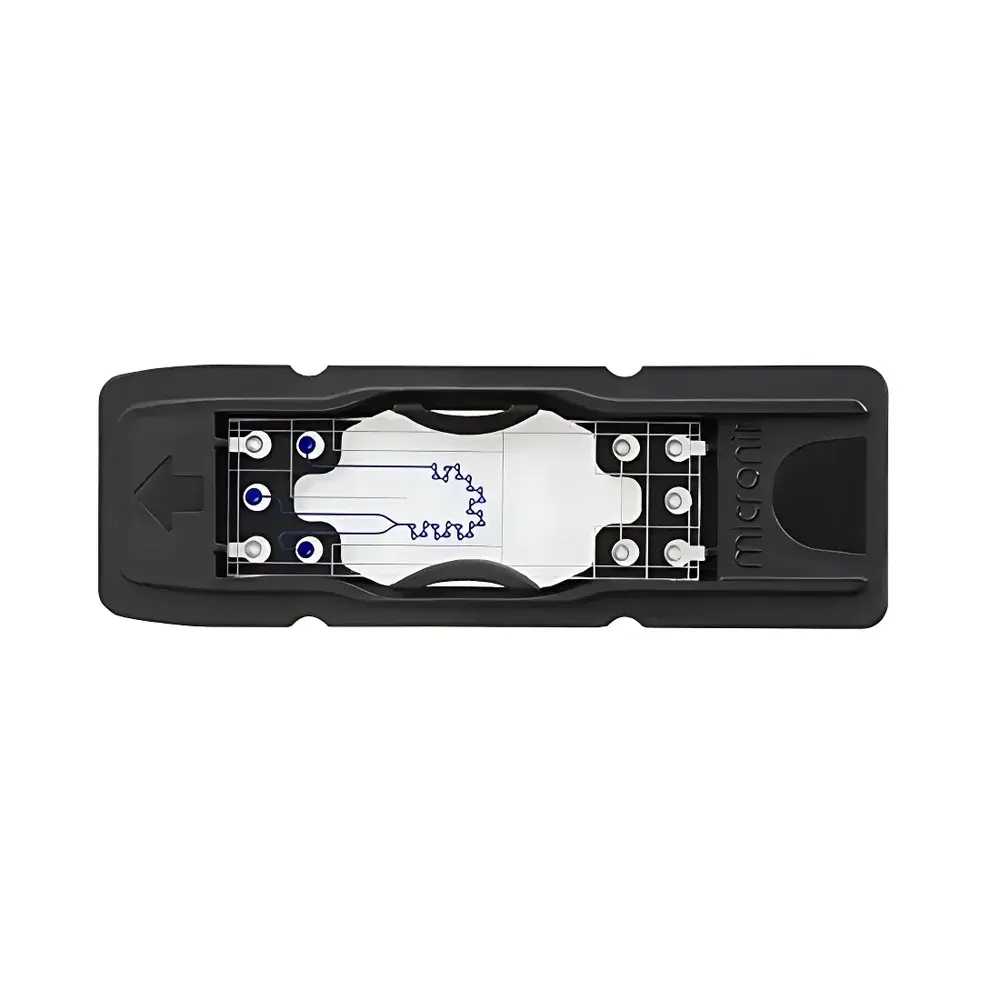
Micronit Teardrop-Structured Microfluidic Mixing Chip
| Brand | Micronit |
|---|---|
| Origin | Netherlands |
| Chip Material | Borosilicate Glass |
| Chip Dimensions | 45 mm × 15 mm |
| Chip Thickness | 1800 µm |
| Channel Width | 240 µm |
| Channel Height | 150 µm |
| Internal Volume | 2 µL |
| Inlets | 2 |
| Outlets | 2 |
| Mixer Architecture | Teardrop-shaped passive mixing structures |
| Compliance | ISO 13485–compatible manufacturing environment |
Overview
The Micronit Teardrop-Structured Microfluidic Mixing Chip is a precision-engineered passive microfluidic device designed for rapid, diffusion-dominated mixing in low-Reynolds-number (Re < 100) laminar flow regimes. Fabricated from high-purity borosilicate glass using deep reactive ion etching (DRIE) and anodic bonding, the chip integrates teardrop-shaped geometric perturbations into its microchannel architecture to induce controlled fluid folding—enhancing interfacial contact area without requiring external actuation or moving parts. This design leverages chaotic advection principles at the microscale, enabling efficient homogenization within millisecond timescales and sub-microliter volumes. The chip is optimized for integration into automated life science workflows including point-of-care diagnostics, enzymatic reaction screening, nanoparticle synthesis, and single-cell assay platforms where reagent compatibility, optical clarity, chemical inertness, and batch-to-batch reproducibility are critical.
Key Features
- Passive, valveless mixing: No external pumps, actuators, or power sources required—mixing driven solely by hydrodynamic design and molecular diffusion.
- Borosilicate glass substrate: Offers exceptional optical transparency (UV–VIS), thermal stability (up to 500 °C), resistance to organic solvents and strong acids/bases, and minimal autofluorescence—ideal for fluorescence-based detection and real-time imaging.
- High-fidelity microfabrication: Micronit’s proprietary DRIE process achieves sub-5 µm feature resolution and vertical sidewalls with <1° taper, ensuring precise channel cross-section control (240 µm width × 150 µm height) and consistent internal volume (2 µL).
- Robust sealing interface: Flat, polished surface and standardized 45 mm × 15 mm footprint enable reliable bonding to PDMS gaskets or metal clamping fixtures compliant with ISO/IEC 17025-aligned microfluidic test systems.
- Low clogging susceptibility: Teardrop geometry avoids sharp corners and stagnation zones; smooth channel transitions minimize particle accumulation—validated with suspensions up to 5 µm diameter under continuous flow at 1–100 µL/min.
Sample Compatibility & Compliance
This chip supports aqueous buffers, cell lysates, polymer solutions (e.g., PEG, dextran), and low-viscosity organic-aqueous mixtures. It is compatible with standard microfluidic tubing (ID 100–500 µm) and commercial syringe pump systems (e.g., Harvard Apparatus PHD Ultra, Fluigent Flow-EZ). Micronit manufactures all chips in an ISO 13485-certified facility; while the chip itself is not a medical device, its production traceability, material certification (DIN ISO 3585), and cleanroom handling (ISO Class 7) support GLP-compliant experimental protocols. The borosilicate glass composition meets USP and Ph. Eur. 3.2.1 requirements for pharmaceutical-grade labware.
Software & Data Management
As a passive hardware component, the chip does not require embedded firmware or driver software. However, it is fully interoperable with industry-standard microfluidic control ecosystems—including Elveflow Smart Interface, NI LabVIEW-based flow controllers, and open-source Python libraries (e.g., pySerial, microfluidics). When paired with high-speed microscopy or inline UV-Vis spectrophotometers, time-resolved mixing efficiency can be quantified via image analysis (e.g., Fiji/ImageJ with TrackMate or custom MATLAB scripts) or absorbance kinetics. Audit trails for chip lot numbers, calibration certificates, and fabrication date are provided digitally per shipment to support 21 CFR Part 11–aligned data integrity frameworks.
Applications
- Real-time kinetic studies of protein–ligand binding and enzyme catalysis under precisely controlled stoichiometry and residence time.
- Microscale synthesis of liposomes, polymeric nanoparticles, and metal–organic frameworks (MOFs) with narrow size distribution (PDI < 0.1).
- Single-cell stimulation assays requiring rapid (<100 ms) delivery of multiple stimuli (e.g., calcium ionophores + inhibitors) without cross-contamination.
- Integration into multi-layer organ-on-chip platforms where laminar interfacing between epithelial and endothelial compartments demands predictable mixing gradients.
- Calibration reference for micro-PIV (particle image velocimetry) and μ-PTV (particle tracking velocimetry) validation in academic and regulatory testing labs.
FAQ
Is this chip compatible with high-pressure applications?
Yes—borosilicate glass construction supports burst pressures exceeding 100 bar when properly sealed with compatible gasket materials and clamping force ≥ 2.5 kN.
Can I reuse the chip after cleaning?
Reusable only under strictly controlled conditions: rinse sequentially with 70% ethanol, deionized water, and nitrogen purge; avoid ultrasonication or alkaline cleaners that may etch glass surfaces over repeated cycles.
What surface treatments are available?
Standard chips feature native hydroxyl-terminated glass; silanization (e.g., PEG-silane, amino-silane) or plasma oxidation can be applied pre-delivery upon request for specific wetting or biofunctionalization needs.
Do you provide mounting fixtures?
Yes—Micronit offers standardized stainless-steel chip holders with integrated fluidic ports and alignment pins (part number MH-4515-G), compatible with most commercial microfluidic stages and inverted microscopes.
How is batch consistency ensured?
Each production lot undergoes metrological verification via white-light interferometry and micro-CT scanning; dimensional deviation across 50 units remains within ±1.2 µm (3σ) for critical channel dimensions.
Related Products




