
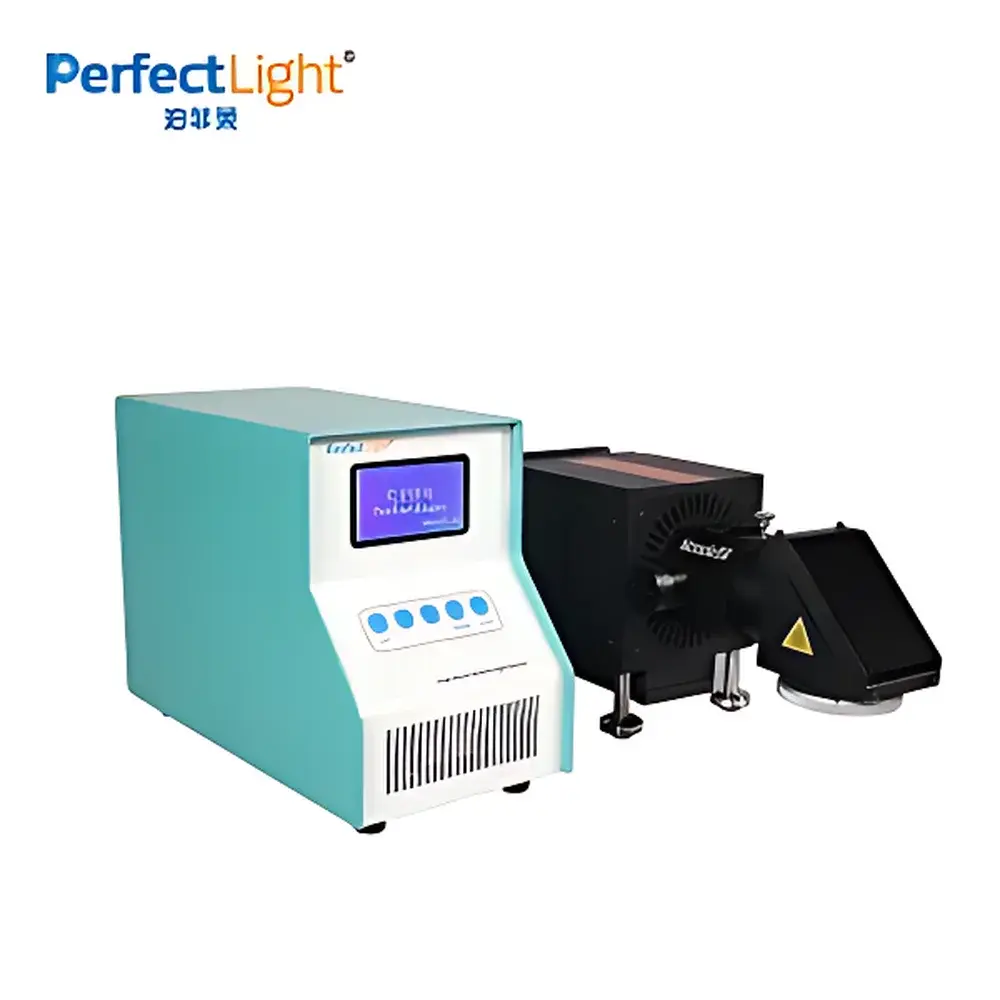
Microsolar 300 Xenon Light Source
| Brand | PerfectLight (Pufei Lai) |
|---|---|
| Origin | Beijing, China |
| Model | Microsolar 300 |
| Light Source Type | Xenon Arc Lamp |
| Illumination Mode | External Irradiation |
| Total Optical Power | 50 W (Visible: 19.6 W, UV: 2.6 W) |
| Spectral Range | 320–780 nm (extendable to 2500 nm with optional optics) |
| Beam Divergence | Avg. 6° |
| Spot Diameter | 30–60 mm at working distance |
| Long-Term Stability | ≤±3% over 8 h (optical feedback controlled) |
| Lamp Lifetime | >1000 h (under standard photocatalytic operating conditions) |
| Lamp Power | 300 W (adjustable 150–300 W) |
| Operating Current | 21 A |
| Power Supply Ripple | 200 mVp-p |
| Control Modes | Constant-Current (Programmed) & Constant-Irradiance (Optically Feedback-Controlled) |
| Cooling | Hybrid Cu/Al heatsink with axial airflow, thermal sensor monitoring, and post-shutdown fan delay |
| Safety | Low-voltage lamp–power supply interface, overcurrent/overload cutoff, fan-failure protection |
| Patent | CN201320740323.5 (integrated xenon lamp thermal management) |
Overview
The Microsolar 300 Xenon Light Source is a high-stability, externally irradiating optical instrument engineered for quantitative photochemical and photoelectrochemical research. It employs a 300 W ceramic-envelope xenon arc lamp—selected for its close spectral match to AM1.5G solar irradiance—and integrates advanced optical feedback control to deliver reproducible irradiance across extended experimental durations. Unlike conventional constant-current-only sources, the Microsolar 300 implements dual operational modes: programmable constant-current output (ensuring stable electrical input) and closed-loop constant-irradiance mode (using real-time photodiode-based optical feedback to dynamically adjust lamp drive current and maintain user-defined irradiance setpoints). This architecture enables rigorous compliance with ISO 9001-aligned laboratory practices and supports traceable, inter-laboratory comparable photoreactor studies—particularly where irradiance uniformity, temporal stability, and spectral fidelity are critical, such as in long-duration photocatalytic water splitting or PEC device evaluation.
Key Features
- Dual-control architecture: Independent selection between constant-current (programmed) and constant-irradiance (optically regulated) operation modes.
- Real-time optical feedback system: Integrated silicon photodiode sensor continuously monitors relative irradiance; microprocessor-driven correction maintains ≤±3% irradiance deviation over 8-hour continuous operation.
- Thermal management system: Patented hybrid copper-aluminum heatsink (CN201320740323.5) with axial airflow design, temperature-sensor-triggered fan control, and 2-minute post-shutdown cooling delay ensures thermal stability and extends lamp service life beyond 1000 hours under nominal load.
- Flexible illumination geometry: Light output axis rotates 360°, supporting both horizontal and vertical external irradiation configurations—ideal for integration with custom gas-phase reactors, liquid-phase slurry cells, or solid-state photoelectrode test stations.
- Digital human-machine interface: Backlit LCD panel displays real-time relative irradiance (% of reference), cumulative lamp operating time, and programmable timer status—enabling GLP-compliant experiment logging without external instrumentation.
- Electrical safety architecture: Lamp–power unit connection uses low-voltage cabling (no high-voltage transmission), coupled with hardware-level overcurrent cutoff, fan-failure shutdown, and ripple-suppressed power delivery (200 mVp-p).
Sample Compatibility & Compliance
The Microsolar 300 is compatible with heterogeneous photocatalysts (e.g., TiO₂, g-C₃N₄, perovskites), photoelectrodes (BiVO₄, Fe₂O₃, Si-based tandem absorbers), and gas-phase or liquid-phase reaction systems requiring broadband or spectrally filtered excitation. Its 320–780 nm native output—extendable into NIR (up to 2500 nm) via optional quartz-transmissive optics—supports ASTM E927-22-compliant solar simulator auxiliary use and ISO/IEC 17025 method validation workflows. The system meets general requirements for laboratory-grade light sources under IEC 61000-6-3 (EMC emissions) and UL 61010-1 (electrical safety). While not certified as a Class AAA solar simulator per IEC 60904-9, its optical feedback loop and spectral stability enable rigorous internal calibration against NIST-traceable reference detectors—facilitating data submission for peer-reviewed journals requiring irradiance uncertainty reporting.
Software & Data Management
The Microsolar 300 operates as a standalone instrument with no proprietary software dependency. All operational parameters—including irradiance setpoint, timer duration, and mode selection—are configured directly via front-panel controls. Relative irradiance values and lamp runtime are logged locally on the LCD display and may be manually recorded for audit trails. For laboratories implementing electronic lab notebooks (ELNs) or LIMS integration, analog voltage outputs (0–5 V DC proportional to relative irradiance) and TTL-compatible trigger signals are available via rear-panel BNC ports—enabling synchronization with data acquisition systems compliant with FDA 21 CFR Part 11 (when paired with validated third-party DAQ software). No cloud connectivity or firmware updates are provided; all control logic resides in hardened microcontroller firmware meeting IEC 62443-3-3 SL1 cybersecurity baseline requirements for laboratory equipment.
Applications
- Photocatalytic overall water splitting and H₂/O₂ evolution kinetics (≥8 h continuous irradiation with <±3% irradiance drift).
- Photoelectrochemical (PEC) cell characterization under simulated solar illumination, including IPCE and J–V curve acquisition.
- Gas-phase photocatalytic degradation of VOCs (formaldehyde, NOₓ, SOₓ) and liquid-phase decolorization of organic dyes (methylene blue, rhodamine B) under controlled irradiance.
- Spectral response analysis using interchangeable bandpass, longpass, and shortpass filters—enabling action spectrum derivation and quantum yield determination per ISO 10678:2010.
- Long-term stability testing of emerging photoactive materials (e.g., MOFs, covalent organic frameworks) under accelerated irradiation stress.
- Atmospheric simulation experiments requiring UV-enhanced spectra (down to 320 nm) or near-infrared extension (via optional CaF₂ or quartz optics).
FAQ
What is the spectral output range of the Microsolar 300, and can it be extended beyond visible light?
The native emission spans 320–780 nm. With appropriate fused silica or CaF₂ optical components and IR-transmissive filters, usable output extends to 2500 nm.
Does the system support automated irradiance calibration against a reference detector?
Yes—the analog 0–5 V output is linearly proportional to relative irradiance and may be correlated with NIST-traceable photodiode calibrations during method qualification.
Is the lamp replaceable by the end user, and what is the expected lifetime under typical photocatalytic conditions?
The 300 W ceramic xenon lamp is field-replaceable; rated lifetime exceeds 1000 hours when operated within specified current and thermal limits.
Can the Microsolar 300 be integrated into an automated reactor platform with external TTL triggering?
Yes—TTL-compatible start/stop and status signals are accessible via rear-panel BNC connectors for synchronization with pump controllers, gas analyzers, or potentiostats.
What safety certifications does the instrument meet?
It complies with IEC 61000-6-3 (EMC) and UL 61010-1 (safety); full CE marking requires site-specific risk assessment per EN 61326-1.




