
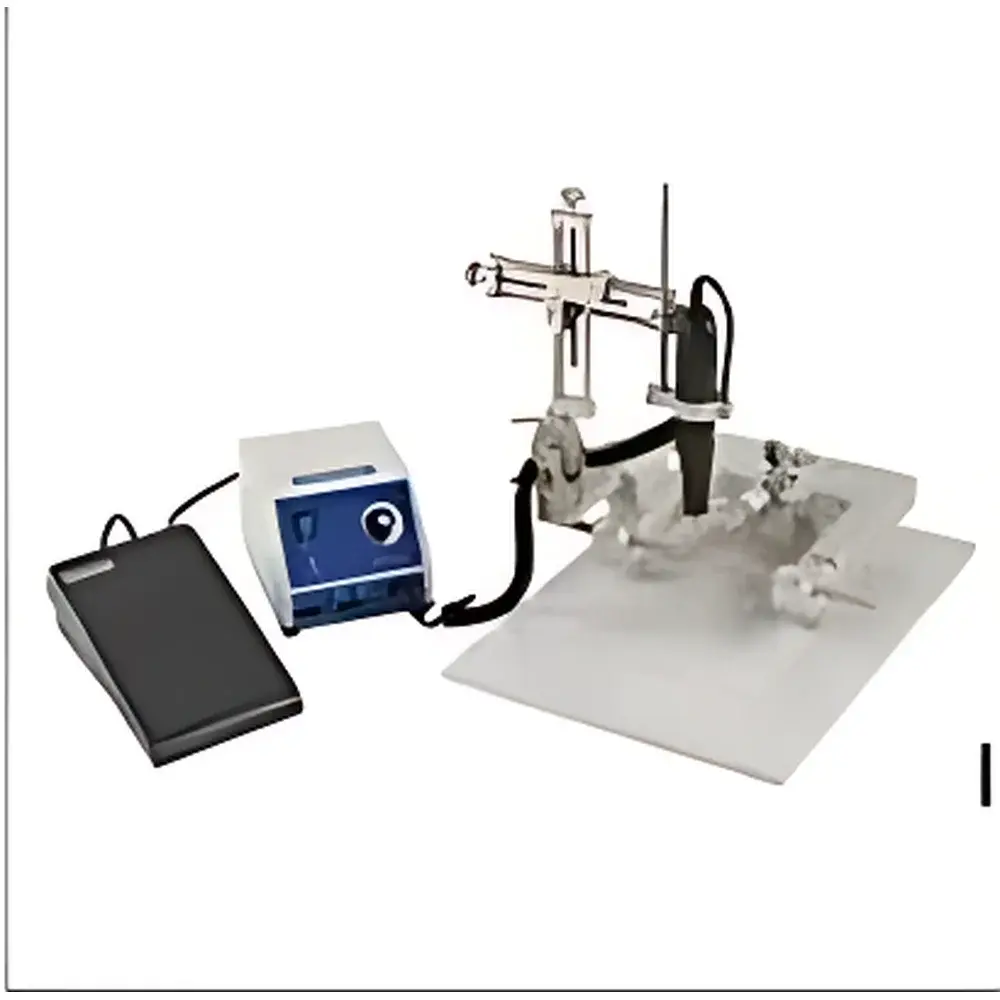
MicroStep Craniotome System
| Origin | USA |
|---|---|
| Manufacturer Type | Authorized Distributor |
| Import Status | Imported |
| Model | MicroStep Craniotome System |
| Pricing | Available Upon Request |
| Max Speed | 35,000 rpm |
| Motor Torque | High-torque brushless DC |
| Noise Level | <45 dB(A) at 30 cm |
| Vibration Damping | Active isolation mount integrated |
| Control Options | Manual trigger + footswitch |
| Stall Detection | Audible & visual alarm |
| Drill Bit Compatibility | Nine standard tungsten carbide bits (0.019", 0.027", 0.031", 0.039", 0.047", 0.055", 0.063", 0.071", 0.083") |
| Wireless Handpiece | Rechargeable Li-ion battery (8 h runtime), 14,400 rpm, carbide-shafted tips (0.6 mm, 0.8 mm, 1.0 mm, 1.2 mm, 1.6 mm) |
| Optional Accessory | Part #58610V58609 Drill Bit Kit (sold separately) |
Overview
The MicroStep Craniotome System is a precision-engineered, high-speed microsurgical instrument designed specifically for craniotomy and delicate bone ablation in small laboratory animals—including neonatal rats, adult mice, and other rodent models with thin calvarial bone. Operating on the principle of controlled rotary ablation, the system delivers consistent material removal rates while minimizing thermal necrosis, mechanical stress, and unintended tissue displacement. Its core architecture integrates a brushless DC motor with active vibration damping and low-acoustic-emission engineering—critical for maintaining stereotactic accuracy during intracranial procedures performed under anesthesia or in awake-behaving paradigms. Unlike conventional dental drills or generic rotary tools, the MicroStep platform is calibrated for neuroanatomical fidelity: rotational stability is maintained across the full 0–35,000 rpm range, enabling fine-grained control over cut depth, surface finish, and burr engagement angle—parameters directly impacting postoperative recovery, histological integrity, and electrophysiological signal quality.
Key Features
- High-torque, low-noise brushless DC motor delivering stable torque output up to 35,000 rpm with acoustic emission <45 dB(A) at 30 cm—reducing auditory stress in adjacent behavioral testing zones.
- Bi-directional rotation control allows optimized cutting geometry for different bone densities and drill bit geometries, enhancing burr longevity and procedural repeatability.
- Ergonomic handpiece design validated per ISO 11228-3 (manual handling of tools), featuring balanced weight distribution and textured grip surfaces to reduce operator hand fatigue during extended stereotaxic sessions.
- Integrated stall detection circuitry triggers simultaneous audible tone and LED warning upon excessive load—preventing motor overheating, bit fracture, or unintended cortical penetration.
- Wireless rechargeable handpiece (Li-ion, 8-hour continuous operation) eliminates cable entanglement risks in multi-axis stereotaxic rigs and supports sterile field compliance via quick-detach sterilizable sleeves.
- Interchangeable tungsten carbide drill bits (nine standardized diameters from 0.019″ to 0.083″) and dedicated hard-metal shafted tips (0.6–1.6 mm) ensure compatibility with both calvarial thinning and precise trephine drilling protocols.
Sample Compatibility & Compliance
The MicroStep Craniotome System is validated for use with murine and neonatal rat skull preparations, including P0–P21 developmental stages where cranial bone mineralization remains incomplete. It is routinely employed in conjunction with commercial stereotaxic frames (e.g., David Kopf, Stoelting, Neurostar) and compatible with standard stereotaxic atlases (Franklin & Paxinos, Paxinos & Watson). All mechanical components comply with IEC 61000-6-2 (immunity) and IEC 61000-6-3 (emissions) for laboratory electromagnetic environments. The system supports GLP-compliant documentation workflows through optional timestamped usage logs when paired with third-party data acquisition modules.
Software & Data Management
While the base MicroStep Craniotome operates as a stand-alone analog-controlled device, its footswitch interface and motor status signals are compatible with TTL-triggered recording systems (e.g., Spike2, MATLAB Data Acquisition Toolbox, National Instruments DAQmx). Optional firmware upgrades enable RPM telemetry output via analog voltage (0–5 V = 0–35,000 rpm) for real-time speed logging and correlation with video tracking or electrophysiology timestamps. No proprietary software installation is required; configuration and calibration remain hardware-based to ensure regulatory traceability in FDA-regulated preclinical studies.
Applications
- Calvarial thinning for chronic cranial window implantation in two-photon imaging studies.
- Precision trephination for electrode array insertion (e.g., silicon probes, tetrodes) with minimal dural tear incidence.
- Skull cap removal in optogenetic fiber optic cannula implantation protocols requiring sub-millimeter margin control.
- Dental enamel or mandibular bone ablation in orofacial pain and trigeminal neuralgia models.
- Ex vivo bone sample preparation for micro-CT scanning and histomorphometric analysis.
FAQ
Is the MicroStep Craniotome System compatible with stereotaxic frames from major vendors?
Yes—the handpiece mount and footswitch interface are mechanically and electrically agnostic; integration with Kopf, Stoelting, and Neurostar frames requires only standard ¼”-20 threaded adapters and 5 V DC trigger lines.
What sterilization methods are approved for the handpiece and drill bits?
Drill bits are autoclavable (134°C, 3 bar, 18 min); the wireless handpiece housing is rated IP54 and may be disinfected using 70% isopropyl alcohol wipes—ethanol or bleach solutions are not recommended.
Does the system meet requirements for GLP or GCP-regulated preclinical studies?
Yes—its analog control architecture, absence of embedded firmware, and deterministic motor response support audit-ready validation protocols; full traceability documentation is available upon request.
Can RPM be externally monitored during live surgery?
Yes—via optional analog tachometer output (0–5 V linear scaling), enabling synchronization with video capture, LFP/MEA recordings, or behavioral event markers.
Is technical support available for protocol optimization in specific animal models?
Yes—application engineers provide peer-reviewed protocol consultation, including burr selection matrices, speed/duration thresholds for P7 vs. adult mouse calvaria, and thermal profiling reports upon request.
Related Products





