
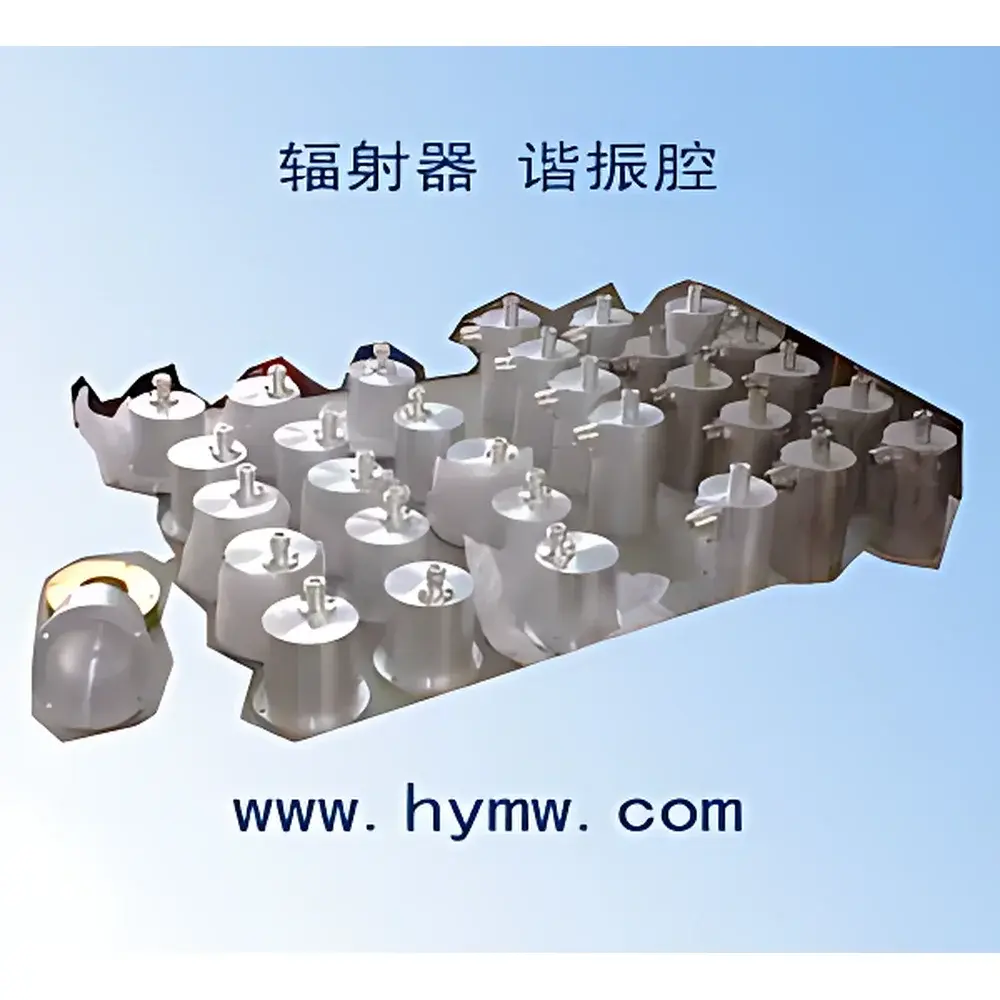
Microwave Coaxial Resonator Cavity
| Brand | Huiyan |
|---|---|
| Origin | Jiangsu, China |
| Manufacturer Type | Authorized Distributor |
| Origin Category | Domestic (PRC) |
| Material | Oxygen-Free Copper or Copper Alloy, Fully Silver-Plated Critical Components |
Overview
The Microwave Coaxial Resonator Cavity is a precision electromagnetic component engineered for high-Q resonant applications in microwave frequency bands (typically 1–40 GHz, depending on dimensional design). It operates on the principle of coaxial-mode standing-wave resonance, where electromagnetic energy is confined between an inner conductor and outer cylindrical shield, forming well-defined transverse electromagnetic (TEM) or higher-order hybrid modes. Unlike waveguide cavities or dielectric resonators, coaxial resonators offer superior mode purity, low insertion loss, and excellent thermal stability—making them ideal for use in frequency-stabilized oscillators, narrowband filters, Q-factor metrology systems, and calibration standards in RF/microwave laboratories. This cavity is fabricated from oxygen-free copper (OFHC) or high-conductivity copper alloy to minimize resistive losses, with all critical internal surfaces—including inner conductor, outer wall, and end plates—electrolytically silver-plated to enhance surface conductivity and reduce skin-effect attenuation.
Key Features
- High-conductivity base material: OFHC copper or Cu–Zn/Cu–Sn alloy selected per application-specific thermal expansion and mechanical rigidity requirements
- Uniform electrolytic silver plating (≥3 µm thickness) on all resonant surfaces to achieve surface resistivity < 2.5 µΩ·cm at 10 GHz
- Hermetically sealable flange interface (standardized CF-35 or SMA-female feedthrough compatible) for vacuum or inert-gas environments
- Modular tuning mechanism: integrated capacitive screw or axial-length adjustment for fine resonance frequency control (±0.5% typical tuning range)
- Thermally stable mechanical design with coefficient of thermal expansion matched between inner/outer conductors to minimize frequency drift (< 10 ppm/°C)
- No active electronics—passive architecture ensures long-term calibration stability and immunity to EMI-induced bias shift
Sample Compatibility & Compliance
This resonator cavity is designed for integration into test benches supporting vector network analyzers (VNAs), spectrum analyzers, and phase-noise measurement systems. It accommodates standard coaxial input/output interfaces (SMA, K, or 2.92 mm) and supports both transmission (S21) and reflection (S11) characterization modes. The cavity complies with fundamental electromagnetic safety practices outlined in IEC 61000-4-3 (radiated RF immunity) and meets mechanical robustness requirements per MIL-STD-810G for vibration and thermal shock. While not certified as a medical or aerospace-grade component, its fabrication adheres to ISO 9001–certified quality control protocols during plating, machining, and leak testing. Traceable dimensional verification (CMM-certified) and surface roughness validation (Ra < 0.2 µm post-plating) are available upon request for metrology-critical deployments.
Software & Data Management
As a passive RF component, the cavity requires no embedded firmware or proprietary software. Resonance characterization is performed using industry-standard VNA platforms (Keysight PNA, Rohde & Schwarz ZVA, Anritsu MS46522B) with calibration kits traceable to NIST or NPL standards. Measurement data—including S-parameter sweeps, Q-factor extraction (via 3-dB bandwidth or decay-time methods), and temperature-dependent frequency shift profiling—can be exported in Touchstone (.s2p), CSV, or MATLAB-compatible formats. For automated test systems, SCPI command scripting enables integration into LabVIEW, Python (using PyVISA), or MATLAB-based calibration workflows. Audit-ready documentation—including plating thickness reports, dimensional inspection records, and raw resonance sweep data—can be archived in accordance with GLP-compliant data integrity frameworks (ALCOA+ principles).
Applications
- Reference cavity for oscillator phase-noise reduction in L/S/C-band radar local oscillators
- Q-factor benchmarking tool in materials characterization labs evaluating low-loss dielectrics and superconducting thin films
- Calibration standard for VNA error correction models (e.g., TRL/LRM) in millimeter-wave packaging development
- Resonant element in microwave sensors for permittivity and loss-tangent measurement of liquid or powdered samples
- Stabilization core in atomic clock microwave interrogation cavities (when coupled with appropriate magnetic shielding and temperature control)
- Education and research platforms for microwave engineering courses covering cavity perturbation theory and modal analysis
FAQ
What frequency range is supported by this coaxial resonator cavity?
The operational band depends on physical dimensions and mode order; standard configurations cover 2–18 GHz (fundamental TEM mode), with custom designs extending to 40 GHz (higher-order TE/TM modes). A full modal analysis report is provided with each unit.
Is silver plating mandatory—or can gold or nickel plating be substituted?
Silver is specified for optimal RF conductivity at microwave frequencies; gold plating is available for corrosion-sensitive environments but incurs ~15% higher insertion loss. Nickel underplating may be used for adhesion enhancement but is not applied to resonant surfaces.
Can the cavity be evacuated or operated under nitrogen purge?
Yes—the standard flange interface supports UHV-compatible sealing (CF-35 or ConFlat); optional quartz viewports and feedthroughs for temperature or field probes are available.
Do you provide S-parameter simulation files (HFSS/CST) for integration into system-level EM models?
Upon request and NDA execution, CST Studio Suite or Ansys HFSS project files—including material assignments, mesh settings, and port definitions—are supplied for co-simulation with adjacent circuitry.
What is the typical delivery lead time for a custom-tuned cavity?
Standard units ship within 4–6 weeks; custom frequency tuning, non-standard flanges, or multi-cavity arrays require 10–14 weeks from drawing approval and deposit receipt.



