
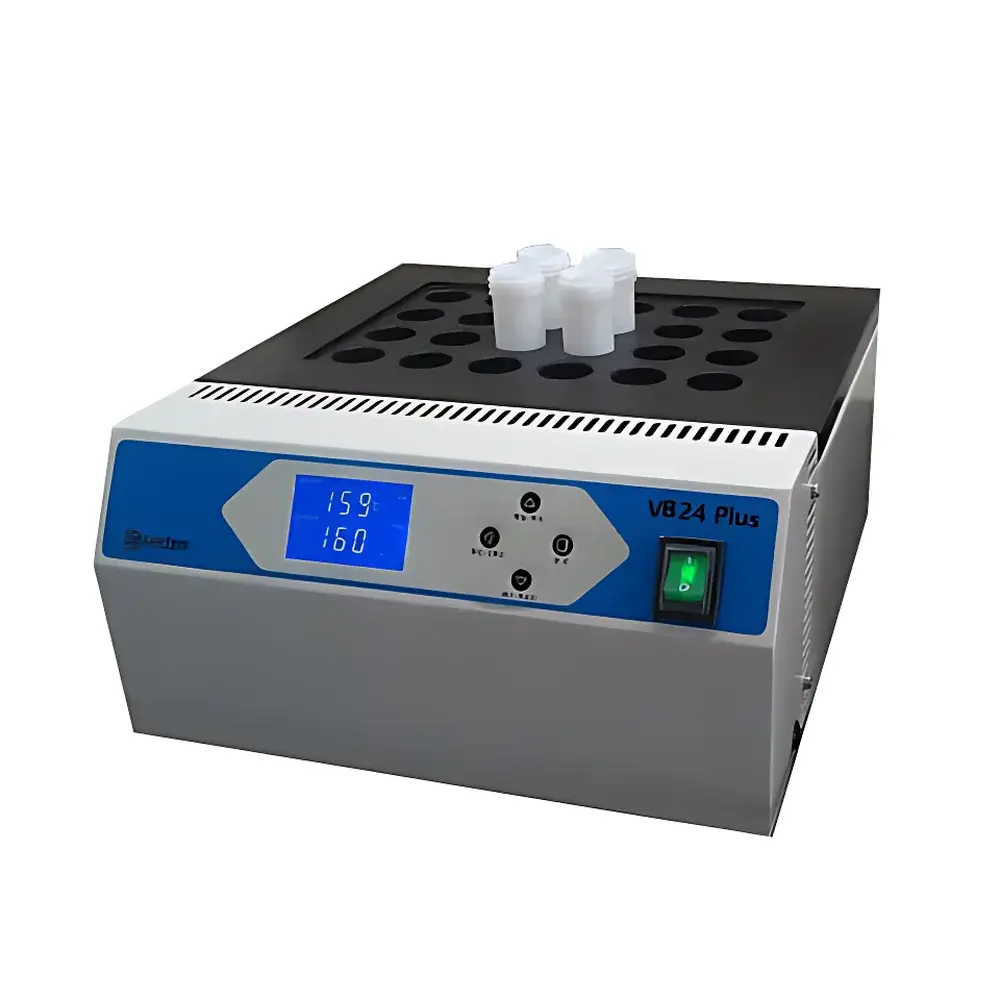
Microwave Digestion Acid Evaporation System LabTech VB15, VB24PLUS, VB24UP, VB48UP, VB51
| Brand | LabTech |
|---|---|
| Origin | Beijing, China |
| Manufacturer Type | Direct Manufacturer |
| Country of Origin | China |
| Models | VB15, VB24PLUS, VB24UP, VB48UP, VB51 |
| Pricing | Available Upon Request |
Overview
The LabTech Microwave Digestion Acid Evaporation System (VB Series) is a precision-engineered benchtop instrument designed for controlled, uniform, and residue-free acid removal following microwave-assisted acid digestion. Unlike conventional hotplate or sand bath evaporation methods, the VB Series employs a combination of programmable PTFE-coated aluminum heating blocks, optimized airflow management, and intelligent thermal feedback control to achieve rapid, reproducible concentration and dry-down of digested samples. The system operates on the principle of conductive + convective heat transfer under precisely regulated temperature profiles—ensuring minimal analyte loss, reduced risk of cross-contamination, and compliance with method requirements for trace metal analysis by Atomic Absorption Spectroscopy (AAS), Inductively Coupled Plasma Mass Spectrometry (ICP-MS), and Inductively Coupled Plasma Atomic Emission Spectroscopy (ICP-AES). Its architecture supports both open-vessel digestion workflows and post-digestion sample conditioning in accordance with EPA Method 3050B, ISO 11885, and ASTM D5682.
Key Features
- High-Uniformity Heating Architecture: Aluminum heating blocks with proprietary PTFE coating ensure thermal stability across all sample positions; inter-well temperature variation ≤ ±1 °C at 100 °C — critical for quantitative recovery of volatile elements (e.g., As, Se, Hg).
- Energy-Efficient Operation: Integrated thermal insulation and dynamic power modulation reduce energy consumption by >50% compared to standard ceramic hotplates or oil baths under equivalent throughput conditions.
- Scalable Throughput Options: Five model variants accommodate varying laboratory workloads — VB15 (15-position), VB24PLUS & VB24UP (24-position with enhanced temperature ramping), VB48UP (48-position high-capacity), and VB51 (51-position ultra-high-throughput configuration).
- Programmable Timed Evaporation: Digital timer with 1-minute resolution enables unattended operation up to 99 hours and 59 minutes; automatic shutdown prevents over-evaporation and sample charring.
- Chemical Resistance & Safety Compliance: All wetted surfaces are constructed from PTFE-coated aluminum and borosilicate glass components; unit meets IEC 61010-1 safety standards for laboratory electrical equipment and includes overtemperature protection and ground-fault circuit interruption (GFCI).
Sample Compatibility & Compliance
The VB Series accommodates standard digestion vessels including 50 mL and 100 mL Teflon®-lined PFA, quartz, and borosilicate glass tubes used in microwave digestion systems (e.g., CEM MARS 6, Anton Paar Multiwave PRO, Milestone ETHOS UP). It supports acidic matrices containing HNO₃, HCl, HF, H₂O₂, and aqua regia at concentrations up to 10% v/v. Instrument validation documentation aligns with GLP and GMP environments, supporting audit readiness for FDA 21 CFR Part 11–compliant data integrity protocols when paired with LabTech’s optional LIMS-integrated software module. The system is routinely deployed in laboratories accredited to ISO/IEC 17025 for environmental testing (e.g., soil, sludge, wastewater), food safety (heavy metals in cereals, seafood, infant formula), and pharmaceutical impurity profiling (ICH Q2(R2)-guided method validation).
Software & Data Management
While the base VB Series operates via front-panel digital interface, LabTech offers optional connectivity through the LabTech ControlSuite™ software platform (v3.2+). This Windows-based application enables remote monitoring, real-time temperature logging, event-triggered alerts (e.g., deviation >±0.5 °C), and export of time-stamped CSV files compliant with ALCOA+ principles. Audit trail functionality records user ID, parameter changes, start/stop timestamps, and calibration events — fulfilling traceability requirements for regulatory submissions to USP , EU Pharmacopoeia 2.4.20, and CNAS-CL01:2018.
Applications
- Environmental Analysis: Residue removal from EPA 6020B digests prior to ICP-MS analysis of Cd, Pb, Cr(VI), and U in drinking water and sediment.
- Food & Agriculture: Final concentration step after microwave digestion of rice flour (AOAC 999.10) and spinach (ISO 17294-2) for multi-element QA/QC.
- Pharmaceuticals: Acid removal from API digests prior to elemental impurity screening per ICH Q3D guidelines.
- Clinical & Biological Research: Processing of tissue homogenates and serum samples following HNO₃/H₂O₂ digestion for Zn, Cu, Fe quantification by GF-AAS.
- Geochemical Testing: High-throughput evaporation of rock and ore digests (USGS CRPG protocols) using VB48UP/VB51 configurations.
FAQ
Can the VB Series be used with hydrofluoric acid (HF)?
Yes — all models support HF-containing digestates when used with PFA or quartz vessels; however, direct contact between HF and aluminum block surfaces must be avoided. LabTech recommends use of PTFE sleeves and strict adherence to vessel compatibility charts.
Is calibration certificate included with shipment?
Each unit ships with a factory-verified temperature calibration report traceable to NIM (National Institute of Metrology, China); optional UKAS-accredited calibration is available upon request.
What maintenance is required for long-term accuracy?
Annual verification of block temperature uniformity and timer accuracy is recommended; cleaning with 10% nitric acid followed by deionized water rinse preserves PTFE surface integrity.
Does the system meet CE marking requirements?
Yes — all VB Series instruments comply with EU Directive 2014/30/EU (EMC) and 2014/35/EU (LVD), bearing CE marking and accompanied by Declaration of Conformity.
Can multiple VB units be synchronized for batch processing?
Not natively — each unit operates independently. However, LabTech ControlSuite™ allows centralized status monitoring and coordinated scheduling across up to 16 networked devices via Ethernet TCP/IP.



