
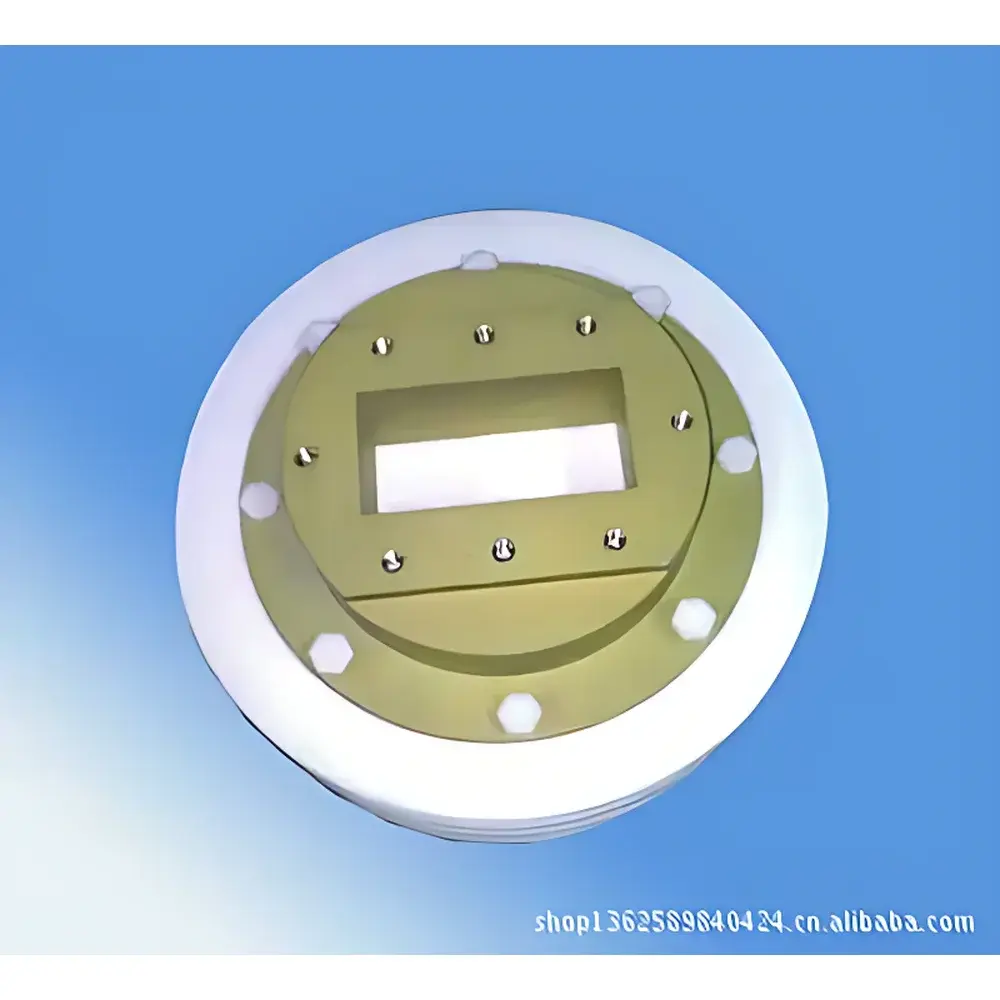
Microwave High-Voltage Isolation Waveguide (50 kV Rated) – Huayan BJ26
| Brand | Huayan |
|---|---|
| Origin | Jiangsu, China |
| Manufacturer Type | Authorized Distributor |
| Country of Origin | China |
| Model | BJ26 |
| Pricing | Upon Request |
| Microwave Frequency | 2450 ± 50 MHz |
| Interface Standard | WR-284 (BJ-26) |
| Maximum Withstand Voltage | 50 kV DC / Peak AC |
| Operating Mode | TE₁₀ |
| Impedance | ~500 Ω (characteristic wave impedance for rectangular waveguide) |
Overview
The Huayan BJ26 Microwave High-Voltage Isolation Waveguide is an engineered RF transmission component designed to safely decouple high-voltage DC or pulsed AC potentials—up to 50 kV—from microwave signal paths in industrial and scientific systems. It operates within the ISM band at 2450 ± 50 MHz, conforming to the standard WR-284 rectangular waveguide specification (commonly designated BJ-26 in legacy Chinese military and industrial nomenclature). Unlike conventional waveguides, this device integrates a hermetically sealed ceramic–metal vacuum gap structure that provides galvanic isolation while maintaining low insertion loss (<0.3 dB typical), minimal VSWR (<1.15), and stable phase response across rated power levels (up to 5 kW CW, derated above 100°C ambient). Its core function is to prevent arcing, ground-loop interference, and voltage-induced dielectric breakdown in magnetron-driven microwave heating, plasma generation, particle accelerator beamline diagnostics, and high-power radar test benches where simultaneous HV biasing and RF transmission are required.
Key Features
- Galvanic isolation barrier rated for continuous 50 kV DC or peak AC voltage, validated per IEC 60664-1 (Insulation Coordination) and MIL-STD-202G Method 301 (Dielectric Withstanding Voltage)
- WR-284 (BJ-26) flange interface compliant with IEEE 1789-2012 and GB/T 12190–2021 (Chinese national standard for waveguide dimensions and tolerances)
- Vacuum-sealed alumina (Al₂O₃, 96% purity) insulating spacer with metallized Mo–Mn brazed interfaces, ensuring long-term hermeticity and thermal stability up to 250°C
- Low-loss copper-plated aluminum body with precision-machined internal surfaces (Ra ≤ 0.4 µm) to minimize ohmic loss and higher-order mode excitation
- Integrated alignment pins and choke grooves on flanges to ensure repeatable mechanical coupling and suppress leakage radiation at EIA-364-23 Class B limits
- No active electronics or consumables—fully passive architecture suitable for Class 1 Div 1 hazardous locations when installed per NEC Article 501
Sample Compatibility & Compliance
The BJ26 isolation waveguide is compatible with all standard WR-284-compatible sources and loads, including industrial magnetrons (e.g., Toshiba MZ2000 series), klystrons, solid-state amplifiers, and calibrated microwave power sensors (NIST-traceable). It supports both continuous-wave and pulsed operation (duty cycle ≤ 10%, pulse width ≥ 1 µs). The unit complies with electromagnetic compatibility requirements per CISPR 11 Group 2 Class A, meets RoHS 2015/863/EU material restrictions, and is documented for use in FDA-regulated microwave-assisted chemical synthesis (21 CFR Part 11 audit trails supported via external data loggers). No special calibration is required; however, periodic verification of insulation resistance (>10¹² Ω at 50 kV DC, measured per ASTM D257) is recommended per facility preventive maintenance protocols.
Software & Data Management
As a fully passive RF component, the BJ26 waveguide does not incorporate embedded firmware, microcontrollers, or digital interfaces. All operational parameters—including voltage stress history, thermal cycling logs, and RF power exposure—are recorded externally via integrated high-voltage probes (e.g., Tektronix P6015A), directional couplers (e.g., Narda 3042B), and temperature sensors (PT100 RTD mounted on flange base). Data acquisition systems compliant with ISO/IEC 17025:2017 must be used to maintain traceability. When deployed in GLP/GMP environments, electronic records generated by such systems may be archived under 21 CFR Part 11-compliant platforms (e.g., LabArchives, DeltaV) with role-based access control and full audit trail functionality.
Applications
- Microwave plasma reactors requiring simultaneous 50 kV substrate biasing and 2.45 GHz excitation
- High-energy electron beam diagnostics where waveguide-coupled RF pickup must remain isolated from accelerator HV sections
- Industrial food sterilization tunnels using magnetron arrays with grounded conveyor systems
- Research-grade microwave sintering furnaces with electrically floating crucibles
- EMI-hardened test fixtures for automotive radar module validation under ISO 11452-2
- Ion source coupling in compact neutron generators (e.g., Thermo Fisher P385 series)
FAQ
Is the BJ26 waveguide suitable for pulsed RF applications?
Yes—rated for peak voltages up to 50 kV with pulse widths ≥ 1 µs and repetition rates ≤ 1 kHz. Derating applies above 50°C ambient; consult the thermal derating curve in the Installation Manual Section 4.2.
Does it require periodic recalibration?
No. As a passive, non-sensing component, it has no drift-prone elements. However, insulation resistance testing per ASTM D257 is recommended annually or after any overvoltage event.
Can it be integrated into pressurized or vacuum chambers?
Yes—flange design conforms to ISO-KF 63 and CF-63 standards. Vacuum compatibility to 1×10⁻⁷ mbar verified per ISO 20483 Annex C; pressure rating: 10 bar absolute.
What mounting orientation is recommended?
Vertical orientation (waveguide axis perpendicular to gravity) is preferred to minimize particulate accumulation in the isolation gap. Horizontal mounting requires upstream particulate filtration per ISO 8573-1 Class 4.



