
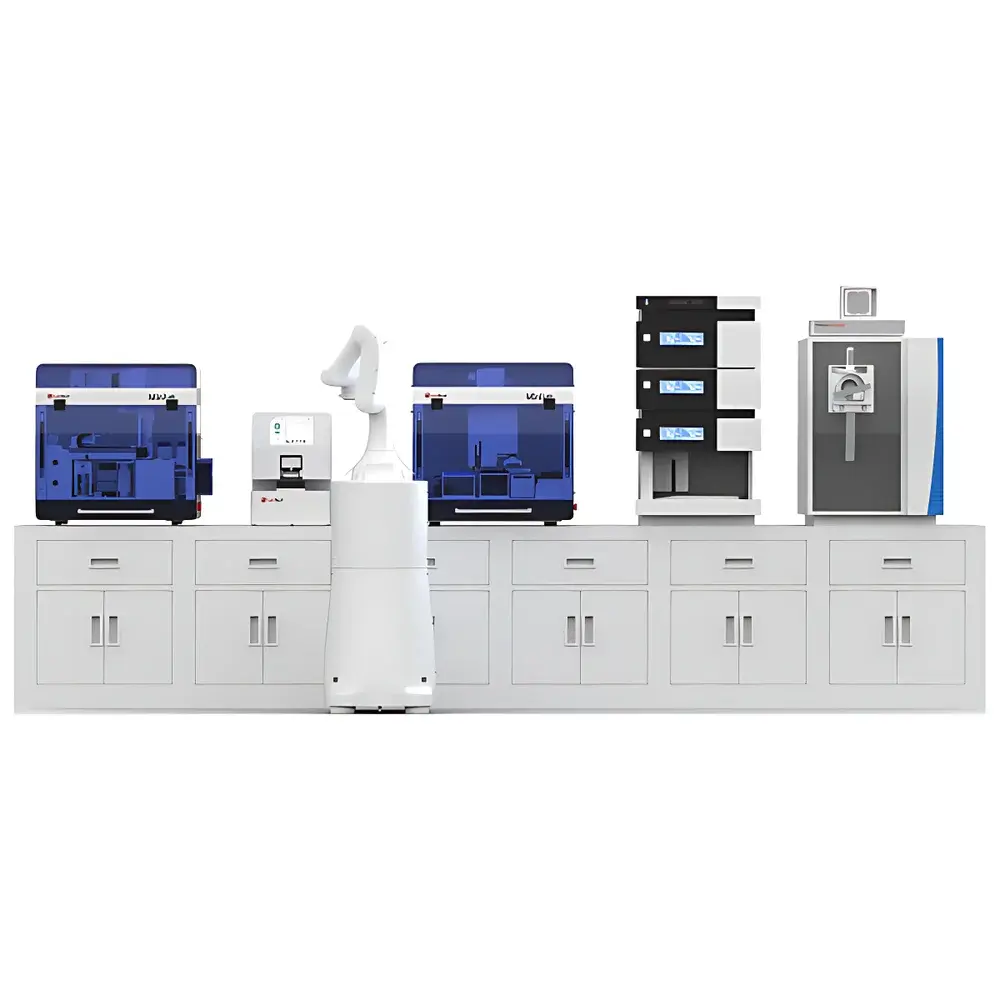
MidiLab9000-Marker Omics Sample Preparation and Analysis System
| Brand | LabTech |
|---|---|
| Origin | Beijing, China |
| Manufacturer Type | Original Equipment Manufacturer (OEM) |
| Product Category | Domestic |
| Model | MidiLab9000-Marker |
| Pricing | Available upon Request |
Overview
The MidiLab9000-Marker Omics Sample Preparation and Analysis System is an integrated, modular automation platform engineered for high-throughput, reproducible protein extraction, enzymatic digestion, cleanup, and LC-MS-ready sample generation in proteomics and translational biomarker discovery workflows. Built on a core architecture combining membrane-based filtration/drying, precision robotic micro-punching of dried spots, and controlled enzymatic cleavage—this system bridges the gap between raw biological specimens (e.g., plasma, tissue lysates, cell pellets, FFPE sections) and quantitative mass spectrometry analysis. Unlike standalone purification units, the MidiLab9000-Marker implements a closed, traceable process chain where each physical operation—from liquid handling to solid-phase processing—is synchronized with metadata capture and LIMS integration, ensuring full auditability under GLP/GMP-aligned laboratory practices.
Key Features
- Modular functional units supporting end-to-end workflow flexibility: sample aliquoting, immunoaffinity enrichment, precise volumetric dispensing (±1 µL accuracy), orbital shaking (200–1500 rpm), thermally controlled incubation (4–95 °C), light-sensitive reaction modules (LED-shielded chambers), on-cartridge trypsin/Lys-C digestion, organic solvent-compatible precipitation, centrifugal ultrafiltration, desalting via C18 or HILIC cartridges, and gradient elution.
- Astation intelligent autosampler with active temperature control (4–40 °C) and dual-mode plate recognition—supports 96-well, 384-well, and custom-format microplates; integrates dynamic stack scheduling algorithms to minimize idle time during multi-batch LC-MS runs.
- AI-driven robotics platform integrating AGV navigation (SLAM-based laser LiDAR mapping) and a 6-axis collaborative manipulator with machine vision-guided calibration (sub-50 µm positional repeatability); enables seamless handoff between modules without manual intervention.
- Native compatibility with major commercial LC-MS platforms—including Thermo Fisher Orbitrap, Sciex TripleTOF, Waters SYNAPT, and Agilent 6550 Q-TOF—via standardized API interfaces and vendor-agnostic method export protocols (e.g., .csv, .xml, .mzML).
- Robust mechanical design compliant with ISO 13849-1 (PL d, Category 3) safety architecture; all fluidic paths use PEEK and chemically inert elastomers suitable for acidic/basic mobile phases and chaotropic reagents.
Sample Compatibility & Compliance
The system accommodates diverse biospecimen types: human/animal plasma/serum (EDTA/heparin), PBMC lysates, formalin-fixed paraffin-embedded (FFPE) tissue digests, exosome preparations, and microbial cell extracts. All wet chemistry modules operate within validated ranges per CLSI EP26-A and ISO 15197:2013 principles for analytical bias control. Data integrity adheres to FDA 21 CFR Part 11 requirements through electronic signatures, immutable audit trails, role-based access control (RBAC), and automatic timestamping of every hardware event and software action. Full compliance documentation—including IQ/OQ/PQ templates and risk assessment reports (per ISO 14971)—is provided with installation qualification.
Software & Data Management
The embedded LabTech OmniLink™ software suite provides unified orchestration of hardware modules, real-time status monitoring, and bidirectional synchronization with enterprise LIMS (e.g., Thermo Fisher SampleManager, LabVantage, STARLIMS). It supports structured metadata tagging (using PSI-MI 3.2 and MIAPE-compliant ontologies), automated QC flagging (e.g., pressure deviation >15%, digestion time drift >±2 min), and export of FAIR-compliant datasets (Findable, Accessible, Interoperable, Reusable). Raw data files are automatically annotated with instrument configuration, reagent lot numbers, operator ID, and environmental logs (temperature/humidity), enabling full forensic traceability across multi-site collaborations.
Applications
- Discovery and verification of disease-associated protein biomarkers in longitudinal cohort studies.
- Post-translational modification (PTM) profiling—including phosphorylation, ubiquitination, and glycosylation—requiring stringent contamination control and reproducible digestion efficiency.
- Targeted proteomics assay development (e.g., PRM, SRM) with integrated internal standard spiking and calibration curve generation.
- Biopharmaceutical characterization: host-cell protein (HCP) identification, product-related impurity mapping, and stability-indicating degradation analysis.
- Single-cell proteomics sample prep scaling via nanoliter-scale fractionation and amplification-compatible cleanup protocols.
FAQ
Is the MidiLab9000-Marker compatible with non-LabTech LC-MS systems?
Yes—the system communicates via open-standard protocols (RS-232, TCP/IP, and OPC UA) and supports vendor-neutral method import/export formats.
What level of validation support is included?
Comprehensive IQ/OQ documentation, user requirement specification (URS) alignment reports, and GxP-ready test scripts for performance qualification are delivered with the system.
Can the robotic platform be expanded with additional modules post-installation?
Yes—all hardware interfaces follow LabTech’s Modular Integration Bus (MIB) specification, enabling field-upgradable addition of modules such as microfluidic fraction collectors or MALDI target loaders.
Does the software support multi-user collaboration across geographically distributed labs?
Yes—OmniLink™ includes centralized license management, encrypted cloud-synced project repositories, and version-controlled protocol libraries accessible via secure SSO authentication.
How is carryover contamination mitigated during high-sensitivity proteomics workflows?
The system employs sequential solvent rinsing (acetonitrile/water/formic acid), UV-C sterilization cycles between batches, and real-time pressure/flow monitoring to detect channel blockages or seal degradation.




