
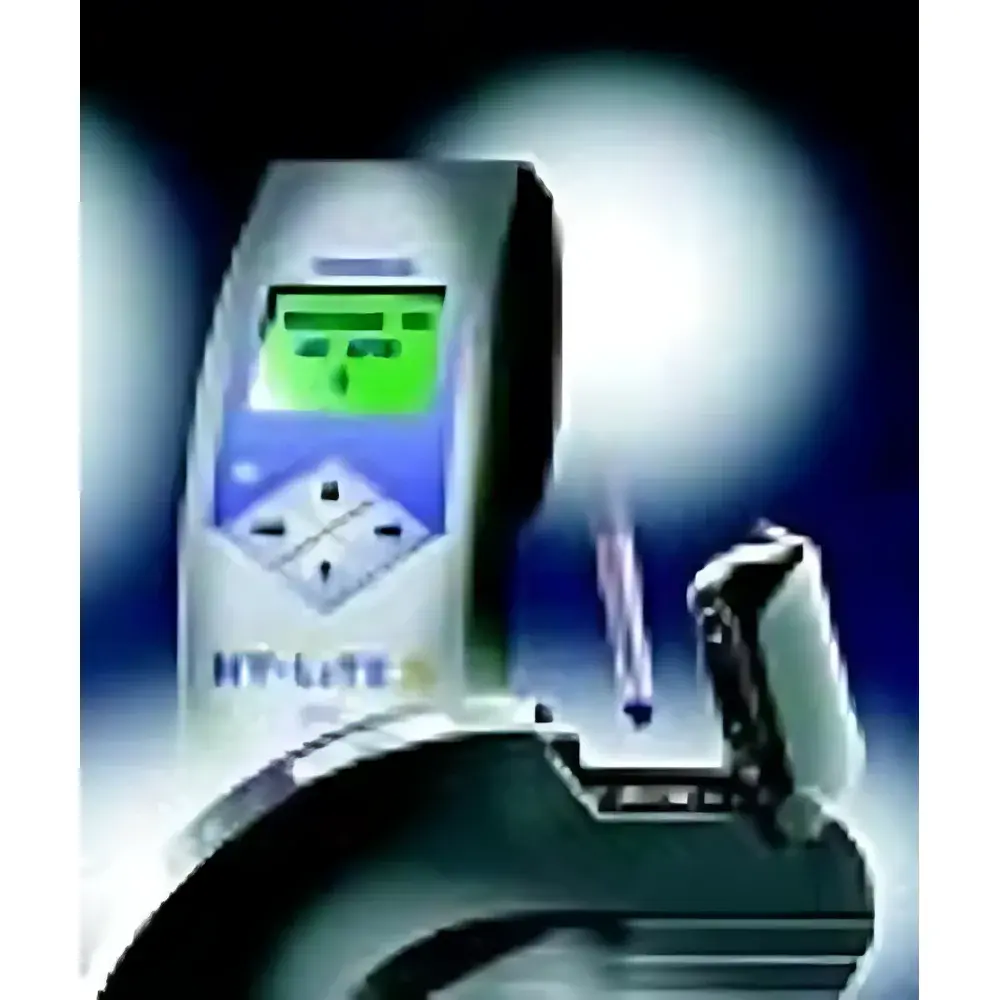
Millipore® HY-lite ATP Bioluminescence Hygiene Monitoring System
| Brand | Millipore |
|---|---|
| Origin | Germany |
| Model | HY-lite |
| Portability | Handheld, Battery-Powered |
| Detection Principle | Firefly Luciferase–Mediated Bioluminescence |
| Measurement Range | 0.01–999.9 RLU (Relative Light Units) |
| Response Time | ≤60 seconds |
| Data Storage Capacity | 2,000 test records |
| Interface | USB 2.0 for PC connectivity |
| Optional Peripherals | Integrated thermal printer module, surface swab pens, liquid sampling pens, jet fuel test kits, free ATP assay pens, ATP calibration standards (0.0 ng/mL) |
| Compliance | Designed for ISO 22000, HACCP, and GMP-aligned hygiene verification workflows |
Overview
The Millipore® HY-lite ATP Bioluminescence Hygiene Monitoring System is a field-deployable, quantitative luminometer engineered for rapid, on-site assessment of biological contamination via adenosine triphosphate (ATP) detection. It operates on the well-established firefly luciferase–luciferin bioluminescent reaction: in the presence of molecular oxygen and magnesium ions, luciferase catalyzes the oxidation of luciferin using ATP as an energy substrate, emitting photons at λ ≈ 560 nm. The intensity of emitted light—measured in Relative Light Units (RLU)—is directly proportional to ATP concentration. Since viable microorganisms, residual organic matter, and cellular debris retain quantifiable ATP pools, the HY-lite delivers a composite indicator of total bioburden—not limited to culturable microbes alone. This principle enables objective, culture-independent verification of cleaning efficacy across food processing lines, pharmaceutical cleanrooms, clinical surfaces, aviation fuel systems, and water-handling infrastructure. Unlike plate-count or PCR-based methods requiring incubation or nucleic acid extraction, the HY-lite provides actionable data within one minute, supporting real-time decision-making at critical control points.
Key Features
- Sub-60-second measurement cycle with automated reaction initiation and RLU integration
- Integrated self-diagnostic routine upon power-on, verifying photomultiplier tube (PMT) sensitivity, LED excitation stability, and battery voltage integrity
- Onboard temperature compensation algorithm (10–40 °C operating range) correcting for enzyme kinetics drift without external calibration
- Dual-mode operation: direct surface swab analysis using HY-lite Sampling Pens or liquid-phase quantification with HY-lite Liquid Pens
- Nonvolatile memory storing up to 2,000 timestamped results with operator ID, location tag, and RLU/ATP conversion metadata
- USB 2.0 interface compliant with Windows 10/11 and macOS 12+ for secure data export; optional thermal printer module supports GLP-compliant hardcopy generation with audit trail headers
Sample Compatibility & Compliance
The HY-lite platform accommodates diverse sample matrices through application-specific consumables: HY-lite Surface Control Pens for stainless steel, plastic, or ceramic surfaces; HY-lite Liquid Pens for rinse water, CIP solutions, or beverage intermediates; HY-lite Jet A Fuel Test Kits featuring solvent-tolerant reagent formulations validated per ASTM D7462 for microbial contamination screening in aviation turbine fuels; and HY-lite Free ATP Pens optimized for low-molecular-weight ATP quantification in enzymatic or fermentation broths. All assays comply with ISO 21528-2:2017 (microbial hygiene monitoring), FDA Guidance for Industry on Environmental Monitoring (2022), and EU Annex 1 requirements for viable/non-viable particle control. Instrument firmware supports 21 CFR Part 11–compliant user authentication, electronic signatures, and immutable audit logs when paired with validated software.
Software & Data Management
Data acquisition and reporting are managed via Millipore’s HY-connect Desktop Suite—a validated desktop application enabling batch report generation, trend analysis (e.g., Shewhart control charts), pass/fail threshold configuration per zone or process step, and CSV/PDF export with embedded digital signatures. The system enforces role-based access control (RBAC), session timeouts, and encrypted local database storage. Audit trails record all user actions—including result deletion, parameter modification, and calibration events—with timestamps traceable to NIST-traceable time sources. For enterprise integration, RESTful API endpoints support bidirectional synchronization with LIMS platforms (e.g., LabWare, STARLIMS) and MES systems under IEC 62443-3-3 security protocols.
Applications
- Food & Beverage: Verification of sanitation after CIP/SIP cycles on fillers, conveyors, and mixing tanks; validation of allergen removal protocols
- Pharmaceuticals: Monitoring of Grade A/B isolator surfaces, lyophilizer chambers, and component contact zones pre-sterilization
- Healthcare: Rapid assessment of high-touch surfaces (IV poles, bed rails, endoscope handles) between patient turnovers
- Aviation: Detection of microbial growth in jet fuel storage tanks and distribution lines per DEF STAN 91-91
- Water Treatment: Screening of biofilm formation potential in distribution networks and membrane filtration units
FAQ
What is the detection limit for ATP in the HY-lite system?
The system reliably detects ≥0.01 RLU, corresponding to ~1–10 femtograms of ATP depending on assay format and environmental conditions.
Can the HY-lite distinguish between microbial ATP and non-microbial ATP?
No—it measures total ATP. However, validated protocols (e.g., ATP + DNase treatment or differential extraction) enable semi-quantitative estimation of microbial contribution when required.
Is calibration required before each use?
No daily calibration is needed; the instrument performs automatic optical zeroing and gain stabilization during startup. Annual performance verification against certified ATP standards (e.g., HY-lite ATP Standard 0.0 ng/mL) is recommended.
How is data integrity ensured during transfer to a corporate network?
All USB transfers utilize AES-256 encryption; exported files include SHA-256 checksums and digital watermarks linking results to instrument serial number and firmware revision.
Does the system support multi-language UI?
Yes—interface language (English, German, French, Spanish, Chinese, Japanese) is configurable via firmware update without hardware modification.







