
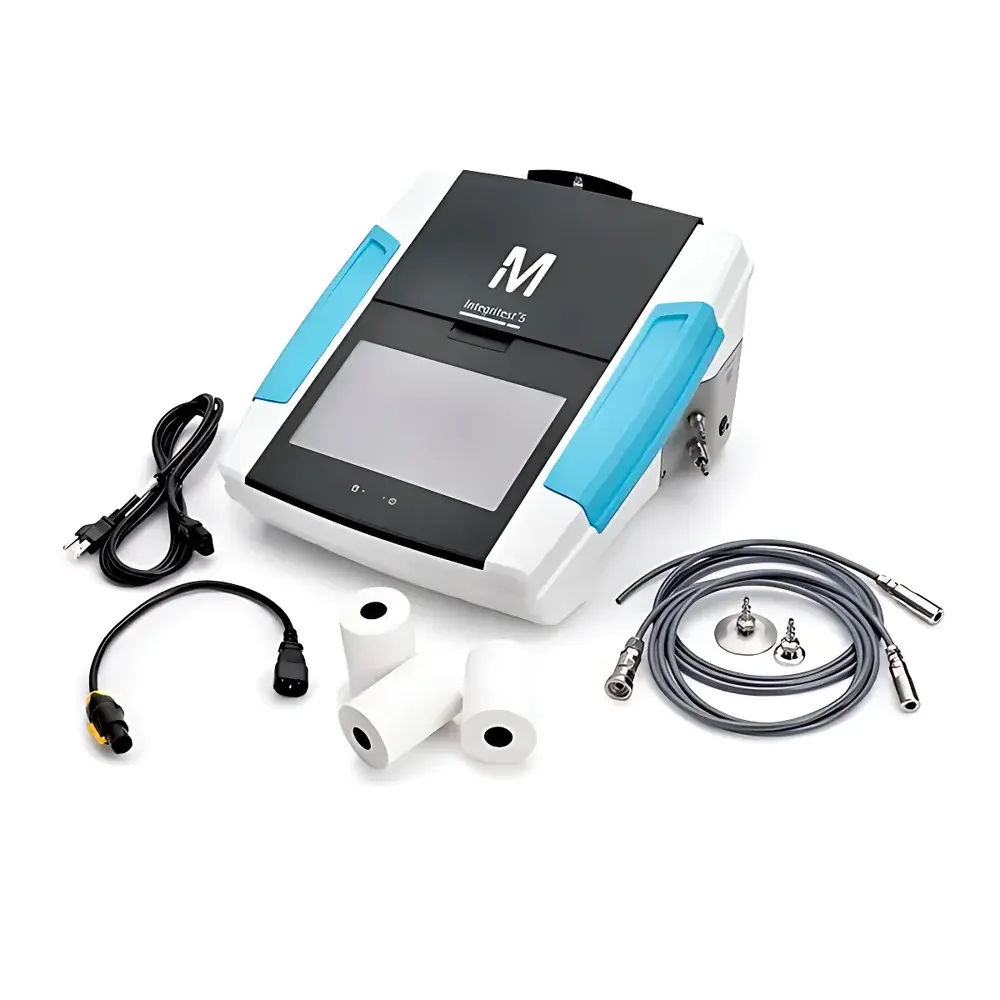
Millipore Integritytest® 5 Filter Integrity Tester
| Brand | Millipore |
|---|---|
| Origin | USA |
| Model | Integritytest® 5 |
| Compliance | FDA 21 CFR Part 11, GMP |
| Ingress Protection | IP54 |
| Connectivity | Wi-Fi, Bluetooth, 1 Gbps Ethernet, USB, Barcode Scanner, Thermal Printer |
| Software Architecture | Network-synchronized multi-unit management platform |
| User Access Control | Multi-level role-based authentication with audit trail |
| Signature Options | Single- or dual-stage electronic/manual signature |
| Test Automation | Predefined sequence execution, automated self-calibration and system verification |
| Data Management | Centralized encrypted storage with automatic backup |
| Display & Interface | Graphical touchscreen with contextual step-by-step guidance |
| Modular Hardware | Cleanable, replaceable sleeve interface modules |
Overview
The Millipore Integritytest® 5 Filter Integrity Tester is an engineered solution for deterministic, regulatory-compliant integrity testing of hydrophilic and hydrophobic membrane filters, cartridge filters, and process equipment used in biopharmaceutical manufacturing, sterile drug production, and aseptic processing environments. Based on the established principles of non-destructive pressure decay, forward flow, and diffusion testing—aligned with ASTM F838-22, ISO 13408-2, and USP —the Integritytest® 5 delivers repeatable, traceable, and auditable results across diverse filter configurations and process scales. Its compact, field-deployable form factor supports both lab-based qualification and at-line validation during manufacturing campaigns, ensuring continuity between development, tech transfer, and commercial operations.
Key Features
- IP54-rated enclosure for robust operation in controlled but non-classified environments—including cleanroom anterooms and utility corridors.
- Automated system self-verification protocol executed prior to each test sequence, confirming sensor stability, pneumatic integrity, and pressure transducer linearity per internal diagnostic routines.
- Intuitive graphical user interface with context-sensitive prompts, real-time status visualization (e.g., pressure ramp rate, decay slope, flow stabilization), and guided workflow navigation—minimizing operator dependency and training overhead.
- Modular sleeve interface design: chemically resistant, autoclavable, and field-replaceable—eliminating cross-contamination risk between filter types and reducing maintenance downtime.
- Integrated thermal printer with configurable report templates, enabling immediate hard-copy documentation compliant with ALCOA+ data integrity principles.
- Network-native architecture supporting synchronized configuration, user permissions, and test method libraries across multiple Integritytest® 5 units via centralized server or cloud-managed deployment.
Sample Compatibility & Compliance
The Integritytest® 5 accommodates standard industry filter formats—including 10-inch, 20-inch, and 30-inch cartridges; disk filters up to 47 mm and 90 mm; and capsule filters with Luer-lock, Tri-Clamp®, or flanged connections. It supports all major integrity test methods: bubble point, diffusive flow (forward flow), pressure hold, and water intrusion for hydrophobic membranes. The system is fully aligned with current Good Manufacturing Practice (cGMP) requirements and incorporates built-in controls to satisfy FDA 21 CFR Part 11 compliance, including electronic signature enforcement, immutable audit trails with timestamped operator actions, and role-based access control (RBAC) with granular permission sets for administrators, analysts, and reviewers.
Software & Data Management
The embedded Integrity Manager™ software provides full lifecycle data governance—from test definition and execution to archival and retrieval. All test parameters, raw sensor outputs, pass/fail determinations, and operator metadata are stored in encrypted binary format with SHA-256 hashing. Data export options include PDF reports with digital signatures, CSV datasets for statistical process control (SPC) analysis, and XML files compatible with LIMS and MES integration. System backups are performed automatically to network-attached storage (NAS) or designated secure servers, preserving historical configurations, user profiles, and validated test protocols without manual intervention.
Applications
- Pre-use post-sterilization integrity verification of sterilizing-grade filters in bioreactor harvest, buffer preparation, and final fill lines.
- Post-use integrity assessment for filter reuse validation under defined cleaning and sanitization cycles.
- Filter qualification support during vendor evaluation, filter selection studies, and comparability assessments following process changes.
- Technical transfer documentation generation across global manufacturing sites using synchronized method libraries and version-controlled configurations.
- Regulatory submission support through complete, inspectable electronic records meeting EMA Annex 11 and PIC/S PI 011-3 expectations.
FAQ
Does the Integritytest® 5 support validation per IQ/OQ/PQ protocols?
Yes—the system ships with a comprehensive Validation Support Package (VSP), including URS templates, FAT/SAT checklists, and pre-written OQ test scripts aligned with ISO/IEC 17025 and ASTM E2500-13.
Can test methods be locked to prevent unauthorized modification?
Absolutely—method libraries can be digitally signed and set to read-only mode by system administrators; any attempted edit triggers an audit-trail entry and requires elevated credentials.
Is remote monitoring or troubleshooting supported?
Remote diagnostics are enabled via secure TLS-encrypted VNC sessions initiated only after explicit user authorization; no persistent external access is configured by default.
What calibration standards does the system require?
The Integritytest® 5 performs automatic zero and span verification using internal reference pressure sources traceable to NIST standards; external calibration is recommended annually per ISO/IEC 17025-accredited providers.
How is data migration handled during system upgrades?
All user-defined content—including test protocols, reports, and audit logs—is preserved during firmware updates via atomic database transaction rollback mechanisms and pre-update snapshot backups.




