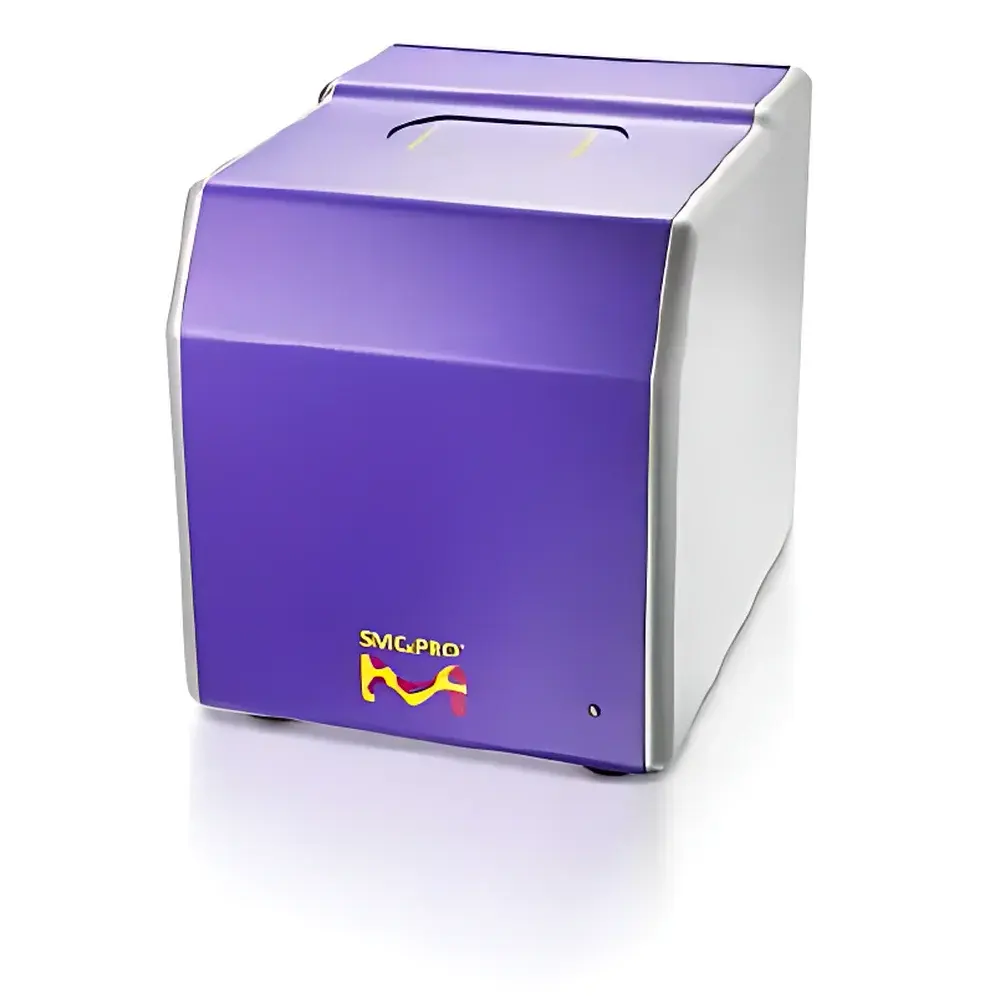
Millipore® SMCxPRO™ Single Molecule Immunoassay Analyzer
| Brand | Millipore |
|---|---|
| Origin | USA |
| Model | SMCxPRO™ |
| Compliance | CE-IVD, FDA-cleared for RUO and clinical research use |
| Detection Principle | Digital immunoassay with magnetic bead-based single-molecule counting |
| Sensitivity | Sub-fg/mL (e.g., TNF-α: 0.1 pg/mL |
| IL-2 | 0.2 pg/mL |
| cTnI | 0.4 pg/mL) |
| Dynamic Range | >4 logs (up to 5–6 logs depending on analyte and assay configuration) |
| Sample Throughput | Up to 96 samples per run |
| Sample Types | Human serum, plasma, CSF, saliva, cell culture supernatant |
| Antibody Pairs Validated | >600 pre-qualified matched pairs |
| Software | SMCxPRO™ Control & Analysis Suite v3.2 (21 CFR Part 11 compliant audit trail, user role management, electronic signature support) |
Overview
The Millipore® SMCxPRO™ Single Molecule Immunoassay Analyzer is an advanced digital immunoassay platform engineered for ultra-sensitive, quantitative detection of low-abundance protein biomarkers in complex biological matrices. Leveraging proprietary Single Molecule Counting (SMC™) technology, the system combines magnetic bead-based immunocapture with enzymatic signal amplification and high-resolution fluorescence imaging to resolve individual immunocomplexes at the single-molecule level. Unlike conventional ELISA or chemiluminescent platforms—limited by ensemble averaging and assay noise floor—the SMCxPRO™ achieves true digital resolution, enabling reliable quantification across sub-femtogram-per-milliliter (fg/mL) concentrations. This capability is critical for translational research, longitudinal biomarker monitoring, and early-phase therapeutic development where minute concentration differences correlate with physiological state, disease progression, or treatment response.
Key Features
- Sub-fg/mL analytical sensitivity: Validated detection limits of 0.1 pg/mL for TNF-α, 0.2 pg/mL for IL-2, and 0.4 pg/mL for cardiac troponin I—enabling measurement of endogenous baseline levels previously undetectable by standard immunoassays.
- Digital quantification architecture: Each detected fluorescent event corresponds to a single captured analyte molecule, eliminating analog signal compression and providing absolute molecule counts per volume.
- Wide dynamic range (>4 logs): Simultaneous quantification from basal expression to acute-phase elevation within a single assay run—essential for cytokine storm monitoring and pharmacodynamic profiling.
- Magnetic bead-based reaction format: Optimized surface chemistry and incubation kinetics ensure high capture efficiency, low non-specific binding, and robust reproducibility across sample types including serum, EDTA plasma, and cerebrospinal fluid.
- Pre-qualified antibody ecosystem: Over 600 rigorously validated matched antibody pairs available for immediate deployment—reducing assay development time and ensuring cross-lot consistency.
- Integrated thermal control and automated fluidics: Precise temperature regulation (±0.3°C) and closed-tube reagent handling minimize evaporation, carryover, and operator variability.
Sample Compatibility & Compliance
The SMCxPRO™ analyzer supports native, minimally processed human biofluids without dilution or pre-enrichment in most applications. It has been verified for use with serum, lithium heparin and EDTA plasma, CSF, saliva, and clarified cell culture supernatants. All assays comply with ISO 13485:2016 quality management standards. The instrument’s software suite meets FDA 21 CFR Part 11 requirements for electronic records and signatures—including full audit trail logging, user access controls, and versioned method storage. While marketed primarily for research use only (RUO), selected SMC™ assays have received FDA clearance and CE-IVD marking for clinical investigation in neurodegenerative, cardiovascular, and immunological indications.
Software & Data Management
The SMCxPRO™ Control & Analysis Suite (v3.2) provides end-to-end workflow management—from instrument calibration and run scheduling to raw image processing, digital event classification, and concentration interpolation using five-parameter logistic (5PL) curve fitting. Raw data files (.smcbin) are stored with embedded metadata (operator ID, timestamp, instrument serial number, calibration status). The software supports batch processing, inter-run normalization, and export to LIMS-compatible formats (CSV, SDTM, Annotated PDF). Audit trails record all user actions—including parameter changes, result overrides, and report generation—with immutable timestamps and digital signatures. Optional integration with enterprise data lakes via RESTful API enables centralized biomarker trend analysis across multi-site studies.
Applications
- Cardiovascular biomarker redefinition: Enables population-level mapping of cTnI baseline expression (median ~1.5 pg/mL), revealing prognostic stratification independent of acute myocardial injury—supporting early risk assessment in asymptomatic cohorts.
- Preclinical Alzheimer’s detection: Facilitates ultrasensitive quantification of VILIP-1 and phosphorylated tau isoforms in CSF, supporting identification of individuals in the preclinical AD phase up to 15 years before symptom onset.
- Immunomodulatory drug development: Captures full IL-13 pharmacodynamic profiles in asthma trials, resolving baseline-to-peak shifts exceeding 100-fold while maintaining precision below 10% CV at <1 pg/mL.
- Therapeutic protein immunogenicity assessment: Detects anti-drug antibodies (ADAs) and cytokine release syndrome (CRS) markers (e.g., IFN-γ, IL-6, IL-8) at physiologically relevant concentrations—critical for PK/PD modeling and safety margin estimation.
- Longitudinal cohort studies: Supports biobank-scale analysis with minimal sample consumption (≤50 µL per assay), preserving precious specimens for multiplexed downstream validation.
FAQ
What distinguishes SMC™ technology from digital ELISA or SIMOA?
SMC™ employs a unique magnetic bead immobilization strategy coupled with confocal optical sectioning and temporal gating to suppress background fluorescence—achieving lower limits of detection and higher specificity than alternative digital immunoassay platforms.
Can the SMCxPRO™ be used for Good Laboratory Practice (GLP) studies?
Yes—the instrument and software are designed to meet GLP requirements for traceability, calibration verification, and data integrity; full validation packages and IQ/OQ documentation are available upon request.
Is assay customization supported?
Users may develop custom assays using Millipore’s open-bead coupling kits and third-party antibodies; however, only pre-qualified antibody pairs are guaranteed to meet stated sensitivity and reproducibility specifications.
How is calibration maintained across long-term deployments?
The system performs daily optical self-calibration using integrated reference beads and includes quarterly hardware diagnostics; NIST-traceable calibrators are supplied with each assay kit.
What sample preparation is required prior to analysis?
Most liquid biopsies require only centrifugation and aliquoting; no enrichment, depletion, or derivatization steps are needed—minimizing pre-analytical variability and processing time.
Related Products