
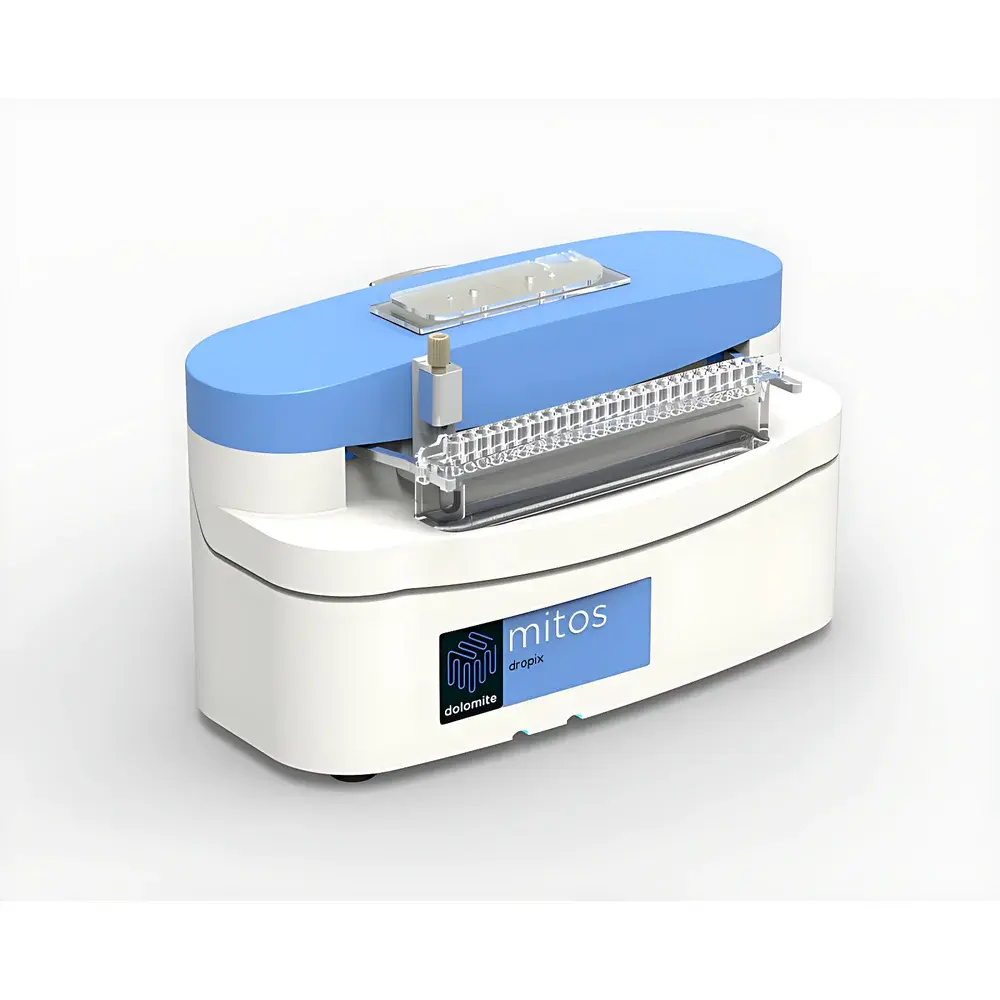
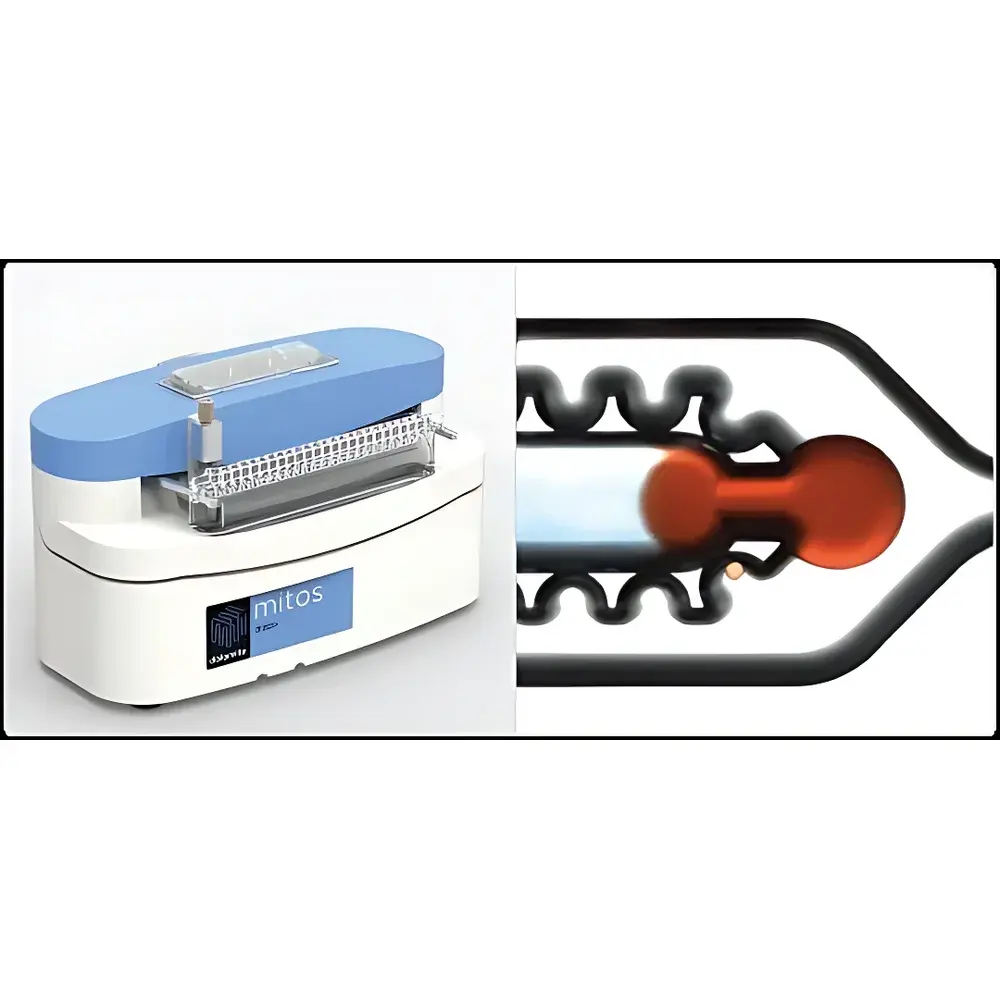
Mitos Dropix Droplet Merging System by Dolomite
| Brand | Dolomite |
|---|---|
| Origin | United Kingdom |
| Model | Mitos Dropix |
| Type | Microfluidic Droplet Coalescence Platform |
| Application Domain | Life Sciences, Synthetic Biology, High-Throughput Screening |
Overview
The Mitos Dropix Droplet Merging System by Dolomite is a precision-engineered microfluidic platform designed for controlled, programmable coalescence of monodisperse aqueous droplets in oil-phase carriers. Built upon Dolomite’s proprietary Mitos microfluidic technology, the system leverages hydrodynamic focusing and electric-field-assisted droplet actuation to achieve deterministic merging events with sub-second temporal resolution and spatial reproducibility at the nanoliter scale. Unlike passive merging methods reliant on channel geometry or surfactant destabilization, Dropix employs integrated electrode arrays and real-time impedance monitoring to trigger fusion only upon user-defined criteria—enabling true digital control over reaction compartmentalization and temporal sequencing. This architecture supports both single-step and cascaded merging protocols, making it suitable for applications demanding multi-stage biochemical processing within isolated microreactors.
Key Features
- Programmable droplet coalescence via integrated microelectrodes and closed-loop impedance sensing
- Support for droplet volumes ranging from 10 nL to >500 nL, with high monodispersity (CV < 3%)
- Modular design compatible with standard Mitos microfluidic chips (e.g., D200, D400 series) and third-party glass/PDMS substrates
- Real-time monitoring of droplet generation, transport, and fusion status via onboard optical detection and analog signal output
- Temperature-controlled operation (10–40 °C) with optional Peltier-based chip holder for thermally sensitive assays
- Firmware-upgradable controller supporting custom sequence scripting via Python API and LabVIEW drivers
Sample Compatibility & Compliance
The Mitos Dropix system accommodates a broad range of biologically relevant samples, including mammalian cell suspensions (up to 1×10⁶ cells/mL), protein solutions (0.1–10 mg/mL), enzymatic reaction mixtures, and organic-aqueous biphasic systems used in combinatorial synthesis. It operates with common fluorinated oils (e.g., HFE-7500, FC-40) and biocompatible surfactants (e.g., DM-45, Pico-Surf™). The platform complies with CE marking requirements for laboratory equipment and meets electromagnetic compatibility (EMC) standards per EN 61326-1. While not certified as medical device hardware, its architecture supports GLP-aligned workflows when paired with validated SOPs and audit-trail-enabled software configurations. All fluidic interfaces use ISO 8535-1 compliant Luer-lock connectors and chemically resistant fluoropolymer tubing.
Software & Data Management
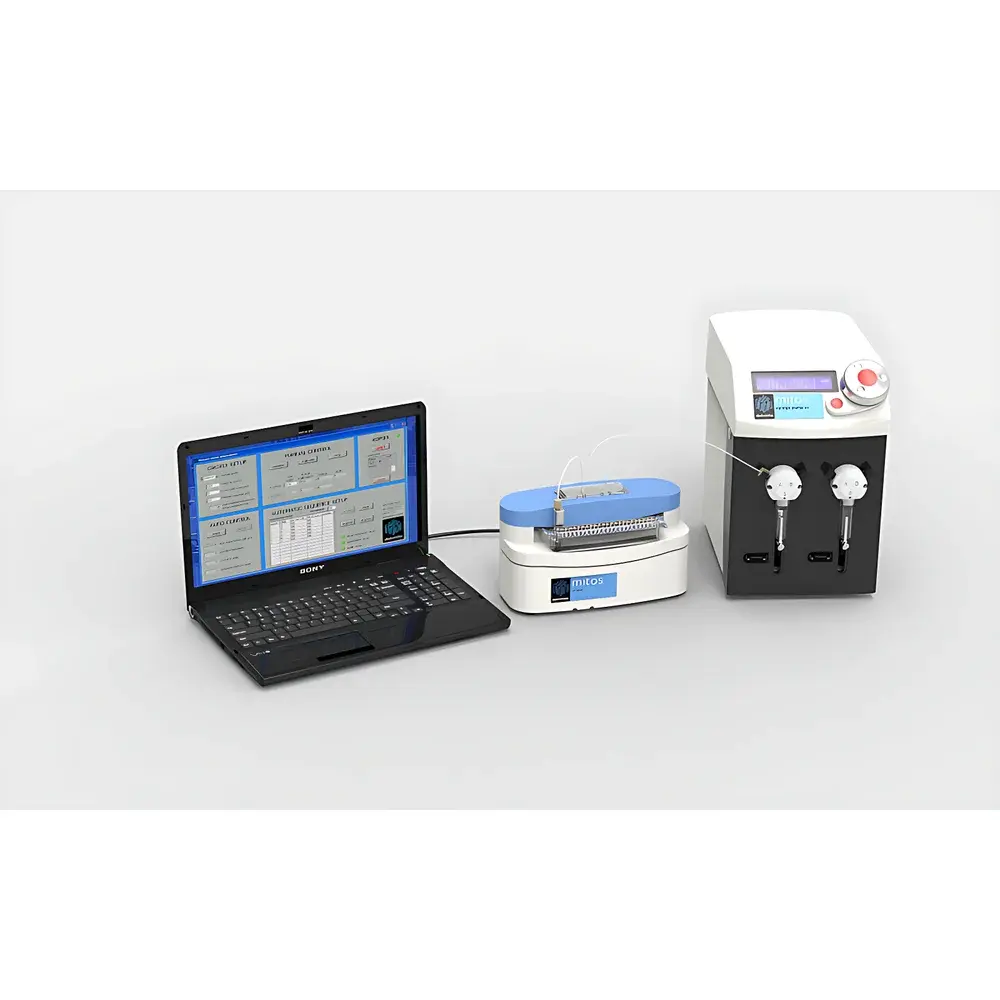
Dropix is operated through Dolomite’s Mitos Control Suite—a Windows-based application offering graphical sequence builder, live parameter visualization, and event-triggered logging. Each merging event is timestamped and associated with raw impedance waveforms, pressure traces, and optical frame captures (when coupled with optional CMOS imaging module). Export formats include CSV, HDF5, and JSON, enabling integration into LIMS environments and downstream analysis pipelines (e.g., Python/Pandas, MATLAB). The software supports 21 CFR Part 11-compliant configurations—including electronic signatures, role-based access control, and immutable audit trails—when deployed on domain-joined workstations with validated IT infrastructure. Raw data retention policies can be configured per project, aligning with institutional data governance frameworks.
Applications
- Single-cell phenotyping: Merging droplets containing individual cells with reagent-loaded carriers for on-chip lysis, barcoding, and mRNA capture
- Protein crystallization screening: Sequential addition of precipitant gradients to nucleation droplets under controlled supersaturation conditions
- Directed enzyme evolution: Compartmentalized in vitro translation followed by activity-based selection via fluorogenic substrate merging
- Multi-step organic synthesis: Spatially resolved coupling, cyclization, and functionalization reactions across serially fused nanoreactors
- Diagnostic assay development: Integration of sample prep, amplification, and detection steps within merged droplets for point-of-care biomarker quantification
FAQ
What types of microfluidic chips are compatible with the Mitos Dropix system?
The system is optimized for Dolomite’s Mitos D-series chips (D200, D400, D600), but also supports custom-designed glass, silicon, or PDMS chips with standard 1/4″-28 UNF threaded ports and integrated electrode pads.
Can the Dropix system be integrated with fluorescence-activated droplet sorting (FADS)?
Yes—its TTL-compatible trigger outputs synchronize seamlessly with commercial FADS platforms (e.g., Berkeley Lights Beacon, Sphere Fluidics iQ), enabling post-merge sorting based on merged-droplet fluorescence or scattering signatures.
Is remote operation supported?
Remote access is enabled via secure RDP or VNC connections to the host PC; however, real-time control requires low-latency network conditions (<10 ms round-trip) to maintain synchronization fidelity.
Does Dolomite provide application-specific chip design services?
Yes—Dolomite’s Applications Engineering team offers collaborative chip prototyping, including layout optimization, surface chemistry consultation, and performance validation under defined assay conditions.



