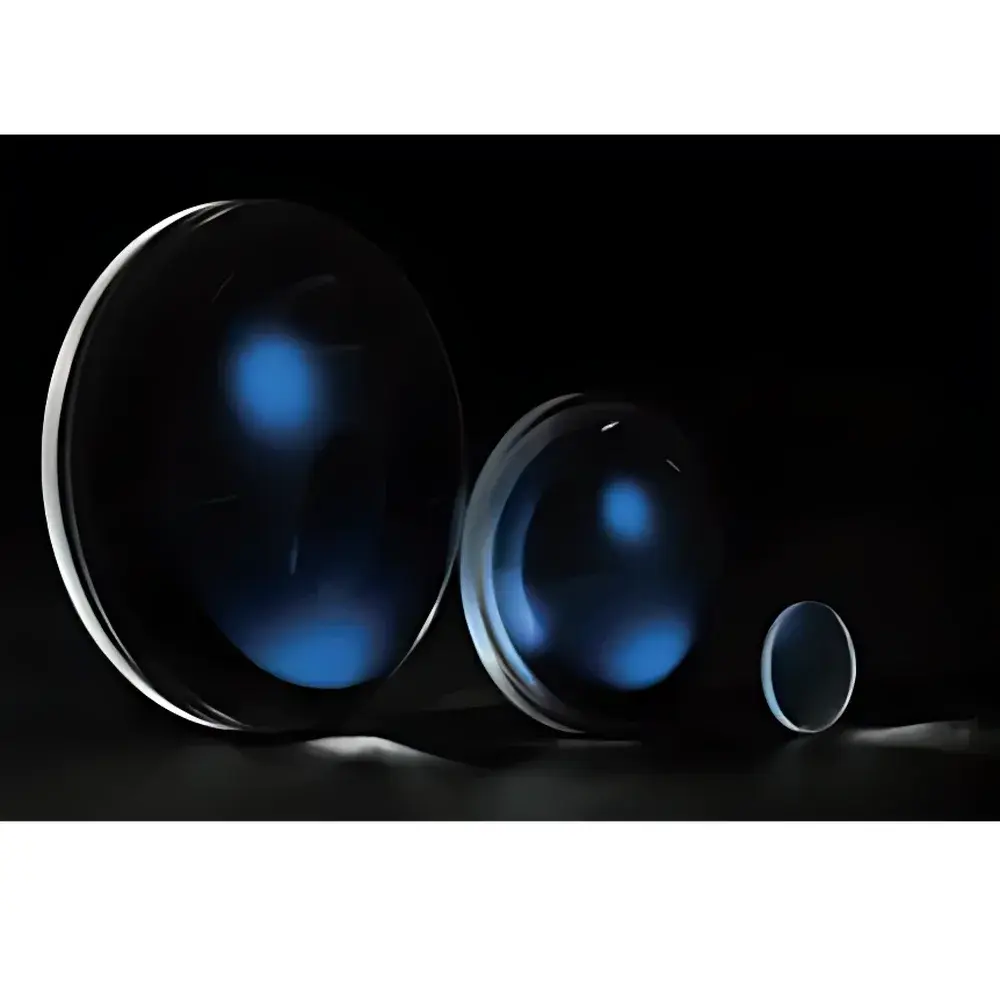
MiXran Meg1005 UV-Fused Silica Plano-Convex Lens
| Brand | MiXran |
|---|---|
| Origin | Beijing, China |
| Model | Meg1005 |
| Component Category | Optical Element |
| Coating Options | Uncoated or UV Broadband AR (250–400 nm) |
| Material | Synthetic Fused Silica (SiO₂) |
| Design Wavelength | 355 nm (typical for UV laser applications) |
| Surface Quality | 20–10 scratch-dig |
| Surface Flatness (Plano side) | λ/4 @ 633 nm |
| Surface Accuracy (Convex side) | λ/2 @ 633 nm |
| Clear Aperture | ≥90% of diameter |
| Damage Threshold | >5 J/cm² @ 355 nm, 10 ns, 20 Hz |
Overview
The MiXran Meg1005 is a precision-engineered plano-convex lens fabricated from high-purity synthetic fused silica (SiO₂), optimized for demanding ultraviolet (UV) optical systems. Its design leverages the exceptional transmission (>99.5% per surface with UV AR coating), low thermal expansion (α ≈ 0.55 × 10⁻⁶ /°C), and high laser-induced damage threshold (LIDT) of fused silica—critical for excimer lasers (e.g., KrF at 248 nm, ArF at 193 nm), frequency-tripled Nd:YAG (355 nm), and deep-UV spectroscopy. Unlike BK7 or other borosilicate glasses, fused silica exhibits negligible solarization under prolonged UV exposure and maintains dimensional stability across wide temperature ranges. The Meg1005 series adheres to ISO 10110-1 and ISO 10110-3 standards for surface form, roughness, and defect control, ensuring consistent wavefront fidelity in collimation, focusing, and beam shaping applications.
Key Features
- Material: High-hydroxyl (OH⁻) synthetic fused silica (Corning 7980 or equivalent), certified for UV transparency down to 185 nm
- Optical Design: Plano-convex geometry with positive focal power; convex surface oriented toward the collimated input beam to minimize spherical aberration
- Coating Options: Dual-standard specification — uncoated for maximum LIDT in pulsed UV systems, or broadband anti-reflection (BBAR) coating optimized for 250–400 nm (R < 0.5% average per surface)
- Mechanical Stability: Annealed post-polish to eliminate residual stress; center thickness tolerance ±0.1 mm, diameter tolerance ±0.05 mm
- Surface Integrity: Polished to 20–10 scratch-dig per MIL-PRF-13830B; surface flatness λ/4 on plano side, surface figure λ/2 on convex side (measured at 633 nm)
- Traceability: Each lens bears a unique serial number etched on the edge; full metrology report available upon request (including interferometric surface map, spectral transmittance, and coating reflectance data)
Sample Compatibility & Compliance
The Meg1005 lens is compatible with standard kinematic and threaded lens mounts (e.g., SM1, SM2, RMS threads) and integrates seamlessly into modular UV-optics platforms such as Thorlabs, Newport, and Edmund Optics mounting systems. It complies with RoHS 2015/863/EU and REACH SVHC regulations. For regulated environments—including ISO/IEC 17025-accredited calibration labs and GMP-compliant photolithography tooling—the lens supports full documentation packages (CoC, CoA, spectral certification) traceable to NIST-traceable reference spectrophotometers. While not inherently FDA-regulated as a standalone component, its material and coating certifications align with USP and ICH Q5D requirements for optical elements used in analytical instrumentation subject to 21 CFR Part 11 audit trails.
Software & Data Management
Although the Meg1005 is a passive optical element, MiXran provides downloadable Zemax OpticStudio-compatible .ZAR files (including surface sag tables and dispersion data for Schott N-SF11-equivalent fused silica models) for rigorous system-level modeling. All spectral transmittance curves (200–2500 nm), coating reflectance maps (250–400 nm), and interferometric surface error reports are delivered in standardized CSV and TIFF formats. Customers may access batch-specific metrology archives via MiXran’s secure portal using the engraved lens serial number—enabling long-term performance trending and GLP-compliant record retention for up to 10 years.
Applications
- UV laser beam delivery: Focusing and collimation in industrial marking, micromachining, and semiconductor inspection systems operating at 193 nm, 248 nm, or 355 nm
- Spectroscopic instrumentation: Entrance and exit optics in UV-Vis-NIR spectrometers, particularly where stray light suppression and thermal drift minimization are critical
- Fluorescence microscopy: Excitation path optics in confocal and multiphoton systems requiring high UV throughput and minimal autofluorescence
- Astronomical instrumentation: Field lenses and correctors in space-qualified UV telescopes (e.g., heritage compatible with Hubble/COS or future LUVOIR concepts)
- Calibration standards: Reference optics in NIST-traceable radiometric and photometric transfer standards for UV irradiance measurement
FAQ
What is the difference between uncoated and UV AR-coated Meg1005 lenses?
Uncoated versions maximize laser-induced damage threshold for high-peak-power pulsed UV systems, while UV AR-coated variants reduce Fresnel losses to <0.5% average reflectance across 250–400 nm—ideal for continuous-wave or low-repetition-rate applications requiring maximum throughput.
Can the Meg1005 be used below 250 nm?
Yes—fused silica substrate transmits effectively down to ~185 nm; however, the UV AR coating is optimized for 250–400 nm. For sub-250 nm operation (e.g., 193 nm ArF excimer), uncoated lenses are recommended to avoid coating absorption and potential degradation.
Is thermal lensing a concern with high-power UV illumination?
Fused silica’s ultra-low thermo-optic coefficient (dn/dT ≈ 1.1 × 10⁻⁶ /°C) and near-zero thermal expansion minimize thermal lensing effects—even under multi-watt CW UV illumination—making it suitable for high-stability interferometric and metrology applications.
How is surface quality verified for each lens?
Every Meg1005 lens undergoes automated dark-field inspection per ISO 10110-7, followed by phase-shifting interferometry (PSI) on both surfaces using a Zygo Verifire™ system calibrated to NIST standards; full interferograms and PV/RMS error data are archived.
Do you offer custom diameters, focal lengths, or coatings?
Yes—MiXran supports OEM customization including non-standard EFLs (±0.1% tolerance), custom BBAR bands (e.g., 193 nm single-wavelength, 248/308 nm dual-band), and diamond-turned mounting flanges per customer mechanical drawings. Lead time: 4–6 weeks for custom orders.