
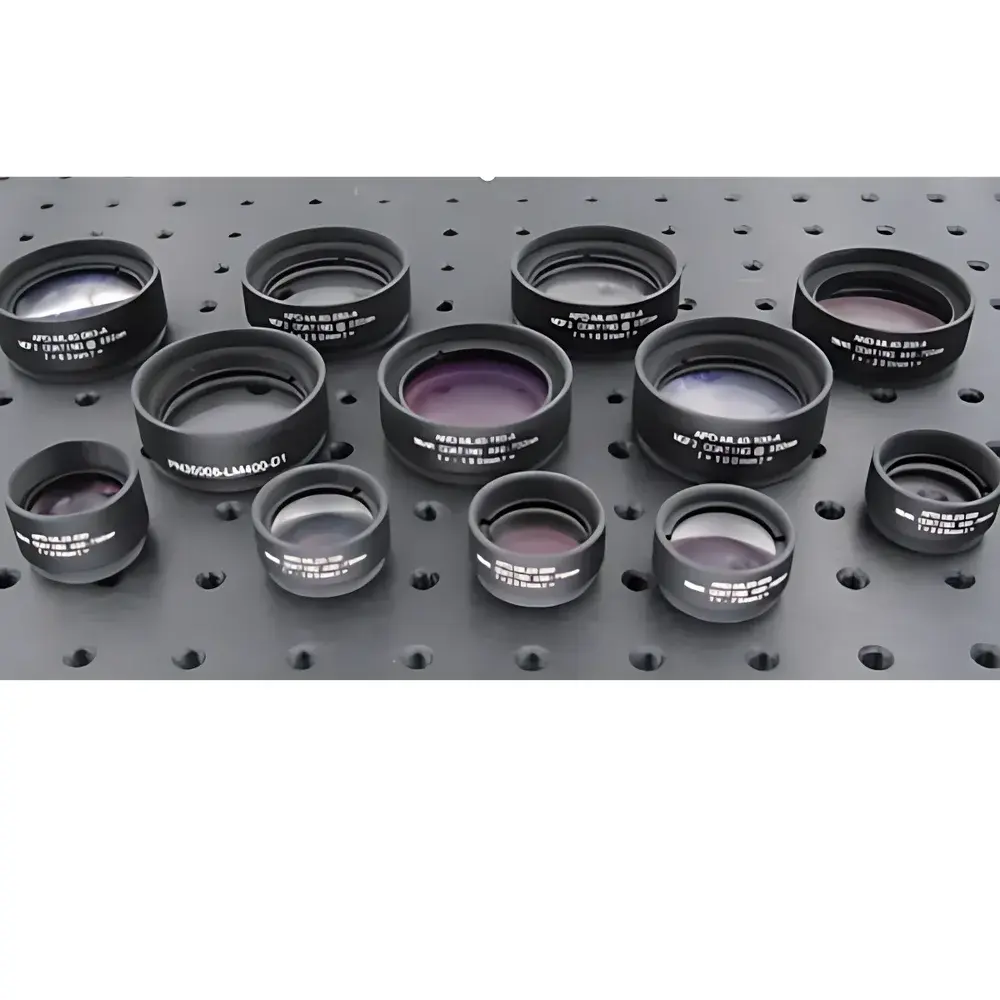
MiXran Meg1021 Pre-Mounted Achromatic Doublet Lens (Standard Focal Length, VIS-Coated)
| Brand | MiXran |
|---|---|
| Origin | Beijing, China |
| Model | Meg1021 |
| Focal Length Options | 30–1000 mm |
| Clear Aperture | 24–48 mm |
| Mount Thread | M28.5×0.6 / M42×0.75 / M48×0.75 / M52×0.75 |
| Coating | Broadband AR, Ravg < 0.5% @ 400–700 nm |
| Lens Type | Achromatic Positive Doublet |
| Diameter Options | 25.4 mm, 40 mm, 50 mm (50.8 mm), Custom Mounting Included |
Overview
The MiXran Meg1021 is a pre-assembled, precision-engineered achromatic doublet lens series designed for demanding optical laboratory applications requiring high chromatic correction and minimal wavefront distortion across the visible spectrum (400–700 nm). Each lens employs a cemented two-element design—typically BK7 and SF2 (or equivalent low-dispersion crown/flint glass pairs)—to correct both axial chromatic aberration and spherical aberration at paraxial focus. The lenses are optimized for collimation, beam expansion, imaging, and relay systems in modular optical benches, particularly those conforming to the OB (Optical Bridge) mechanical standard. All units are factory-aligned, centering error < 3 arcmin, and delivered fully mounted in black anodized aluminum cells with standardized external threading for direct integration into kinematic mounts, lens tubes, or filter wheels without additional alignment hardware.
Key Features
- Pre-mounted and collimation-verified: No user alignment required; each lens undergoes focal plane verification using interferometric reference standards prior to shipment.
- Broadband anti-reflection coating: Ravg 99% transmission per surface and minimizes ghosting and stray light in multi-lens assemblies.
- Modular mechanical interface: Compatible with OB-standard optical rail systems via M28.5×0.6 (25.4 mm), M42×0.75 / M48×0.75 (40 mm), and M52×0.75 (50/50.8 mm) external threads—enabling rapid interchangeability with shutter holders, iris diaphragms, and detector mounts.
- Protected handling architecture: Supplied with removable front/rear aluminum protective caps (optional but recommended); cap threads match lens cell specifications to prevent cross-threading during storage or transport.
- Consistent mechanical referencing: Back focal distance (BFL) tolerance maintained within ±0.15 mm across all focal lengths; mechanical reference surface perpendicularity ≤ 5 arcsec relative to optical axis.
- Traceable manufacturing: Each lens carries a unique serial number engraved on the mount flange, linked to its metrology report (available upon request), including measured effective focal length (EFL), BFL, and transmitted wavefront error (TWE) at 632.8 nm.
Sample Compatibility & Compliance
The Meg1021 series supports integration into ISO/IEC 17025-accredited optical test setups and complies with mechanical interoperability requirements defined in ISO 10110-1 (optical element drawing standards) and DIN 31000 (modular optical system interfaces). While not certified to specific regulatory frameworks (e.g., FDA 21 CFR Part 11), the lenses are routinely deployed in GLP-compliant spectroscopy, laser cavity alignment, and OEM instrumentation where traceable optical performance and repeatable mounting repeatability (< ±2 µm axial runout) are critical. All coatings meet MIL-C-48497A Class 1 durability specifications for abrasion resistance and environmental stability (40 °C / 90% RH, 24 h). RoHS 3 and REACH compliance is confirmed for all constituent materials, including adhesives and anodization layers.
Software & Data Management
No embedded firmware or proprietary software is associated with the Meg1021 lens—it is a passive optical component. However, full optical prescription data (including surface radii, thicknesses, glass types, and coating dispersion curves) is provided in Zemax .ZMX and CODE V .SEQ formats upon order confirmation. Metrology reports include CSV-exportable focal length validation datasets referenced to NIST-traceable HeNe laser interferometers. For integration into automated optical alignment workflows, mechanical CAD models (STEP AP242, SAT) are available under NDA, enabling precise co-simulation with motion stages, cameras, and beam profilers in tools such as MATLAB Optics Toolbox, Python-based raytracing libraries (e.g., RayOpto), or Ansys Zemax OpticStudio.
Applications
- Laser beam conditioning: Collimation of diode lasers (e.g., 405 nm, 532 nm, 635 nm) and fiber-coupled sources prior to spatial filtering or modulation.
- Microscopy illumination paths: Köhler illumination train components in transmitted-light brightfield and phase contrast systems.
- Spectrometer fore-optics: Input focusing elements for Czerny-Turner and Offner configurations, where chromatic fidelity directly impacts spectral resolution.
- Machine vision calibration targets: High-NA relay optics for telecentric lens testing and distortion mapping across industrial camera sensors.
- Educational optics labs: Standardized components for undergraduate experiments in Gaussian optics, Fourier plane analysis, and aberration characterization.
- OEM instrument design: Drop-in replacements for legacy achromats in flow cytometers, confocal scanners, and optical coherence tomography (OCT) sample arms.
FAQ
Are custom focal lengths or diameters available beyond the published catalog?
Yes—MiXran offers engineering support for non-standard EFLs (±5 mm increments), alternate diameters (e.g., 30 mm, 60 mm), and extended spectral coatings (e.g., UV-VIS 250–700 nm or NIR 700–1100 nm) under minimum order quantities (MOQ ≥ 10 units). Lead time extends by 4–6 weeks.
What is the maximum permissible incident power density for continuous-wave laser use?
For uncooled operation at 532 nm, the damage threshold is ≥500 W/cm² (CW, 10.6 mm beam diameter, 1/e²). For pulsed lasers (10 ns, 10 Hz), LIDT is ≥5 J/cm². Consult the detailed LIDT report for wavelength- and pulse-duration-specific values.
Do the mounting cells include strain-relief features for thermal cycling?
Yes—the aluminum cells incorporate radial expansion grooves and stress-relieved retaining rings to maintain centration stability across −20 °C to +60 °C ambient ranges, verified per IEC 60068-2-14 (cyclic temperature shock).
Is there documentation supporting ISO 10110-5 surface quality specifications?
All Meg1021 lenses meet ISO 10110-5:2018 Grade 60-40 scratch-dig specification. Surface roughness (Ra) is < 5 nm, measured via white-light interferometry; certificates of conformance are included with each shipment.
Can these lenses be used in vacuum environments?
The standard version is rated for ≤10⁻³ mbar; for ultra-high vacuum (UHV, ≤10⁻⁹ mbar), specify UHV-compatible epoxy and outgassing-tested aluminum (per ASTM E595) at time of order.





