
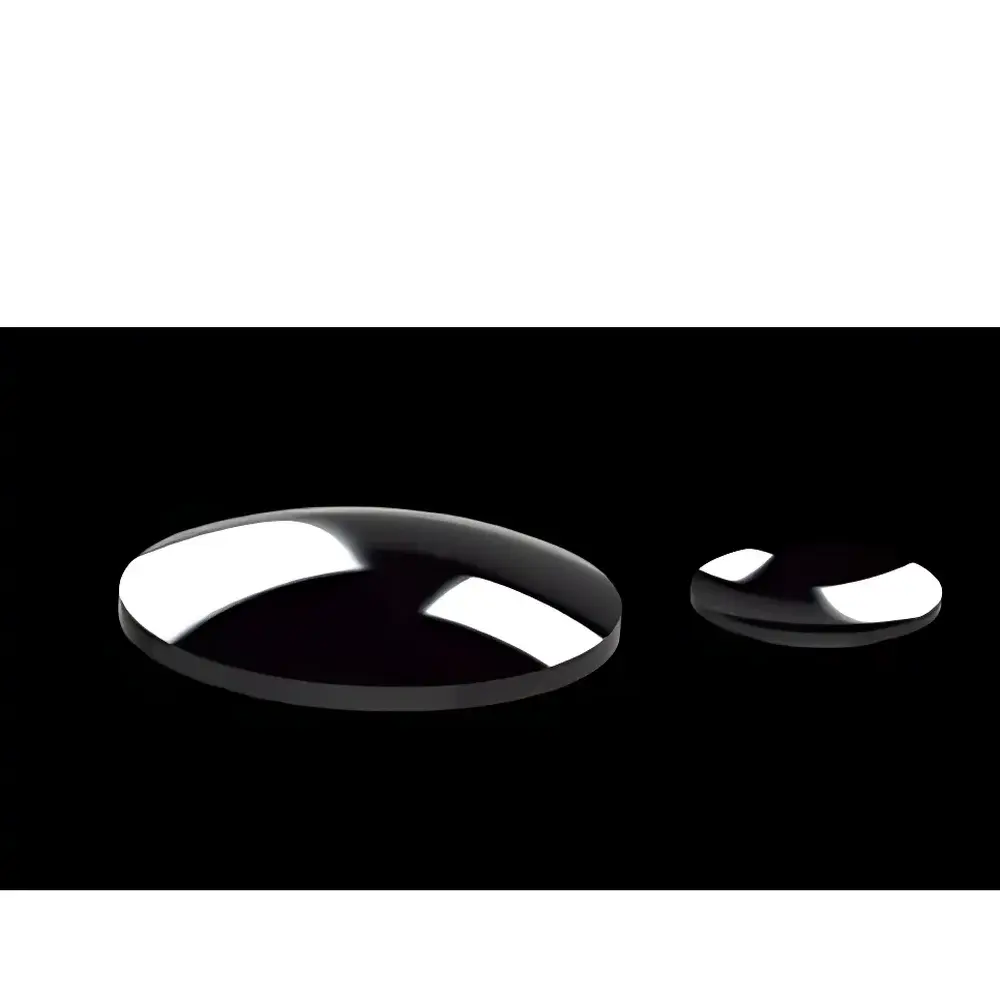
MiXran Meg1036 Germanium Positive Meniscus Lens
| Brand | MiXran |
|---|---|
| Model | Meg1036 |
| Material | Germanium (Ge) |
| Lens Type | Positive Meniscus |
| Coating Options | Uncoated or Broadband AR Coating (IR2, Ravg < 1.5% @ 8–12 µm) |
| Diameter | 25–50 mm |
| Focal Length (EFL) | 25–100 mm |
| Center Thickness | 2.5–4 mm |
| Edge Thickness | 1.3–4 mm |
| Radius of Curvature R1/R2 | Varies per configuration (e.g., +28.3 / −42.5 mm for 25 mm Ø × 25 mm EFL) |
| Compliance | ISO 10110-1 optical manufacturing standard |
| Mounting Compatibility | Standard SM-threaded lens mounts (e.g., SM25, SM50 series) |
| Origin | Beijing, China |
Overview
The MiXran Meg1036 is a precision-engineered germanium (Ge) positive meniscus lens designed for demanding mid-wave to long-wave infrared (MWIR–LWIR) optical systems operating in the 8–12 µm atmospheric transmission window. Germanium’s high refractive index (~4.0 at 10 µm) and low dispersion make it ideal for compact, aberration-controlled IR focusing optics—particularly where thermal stability, minimal absorption, and high transmission are critical. Unlike plano-convex or biconvex geometries, the positive meniscus form features both surfaces convex with differing radii, enabling inherent correction of spherical aberration when oriented with the more strongly curved surface facing the collimated input beam. This geometry is widely adopted in thermal imaging objectives, CO₂ laser beam shaping, FTIR spectrometer relay optics, and uncooled microbolometer-based sensor modules.
Key Features
- High-purity Czochralski-grown germanium substrate with ≤ 0.5 arcmin wavefront distortion (λ/4 @ 10.6 µm, measured interferometrically)
- Optimized surface figure accuracy: λ/8 PV @ 10.6 µm per surface, compliant with ISO 10110-5 specification
- Two coating options: uncoated (native Ge surface, ~36% Fresnel reflectance per interface) or broadband anti-reflection (IR2) coating with average reflectance <1.5% across 8–12 µm
- Thermal expansion coefficient of 6.1 × 10⁻⁶ K⁻¹ ensures stable focal length under ambient temperature fluctuations (15–35°C)
- Surface quality rated at 60-40 scratch-dig per MIL-PRF-13830B, verified via dark-field inspection
- Edge-isolated mounting design compatible with industry-standard SM25 and SM50 kinematic lens cells (e.g., Thorlabs LM25, LM50 series)
Sample Compatibility & Compliance
The Meg1036 lens is specified for integration into optomechanical assemblies requiring passive IR transmission without active cooling. Its germanium substrate is intrinsically opaque to visible light and UV, eliminating stray-light interference in multispectral systems. All lenses undergo batch-certified spectral transmittance verification using FTIR spectroscopy (PerkinElmer Spectrum Two), with full spectral reports traceable to NIM (National Institute of Metrology, China). Manufacturing adheres to ISO 9001:2015 quality management protocols; surface cleanliness meets ISO 14644-1 Class 8 cleanroom handling standards prior to packaging. No RoHS exemptions apply—Ge material complies fully with Directive 2011/65/EU Annex II substance restrictions.
Software & Data Management
While the Meg1036 is a passive optical component, its metrological data—including measured radius values, center thickness, transmitted wavefront error (TWE), and coating spectral curves—is archived in a secure, audit-ready format compliant with ISO/IEC 17025 documentation requirements. Each shipped unit carries a unique serial identifier linked to its calibration certificate (PDF + CSV), supporting GLP-compliant lab recordkeeping. For system-level modeling, Zemax OpticStudio™ and CODE V® prescription files (.zmx, .seq) are available upon request, including thermal expansion coefficients and Sellmeier dispersion parameters for germanium (valid from 2–14 µm).
Applications
- Thermal imaging lens assemblies for uncooled VOx and a-Si microbolometer detectors (e.g., FLIR Boson®, Seek Thermal CompactPRO)
- Beam collimation and focusing in industrial CO₂ laser processing heads (10.6 µm wavelength)
- Relay optics in Fourier-transform infrared (FTIR) spectrometers requiring diffraction-limited performance at cryogenic detector temperatures
- Gas sensing modules utilizing non-dispersive infrared (NDIR) detection of hydrocarbons, SF₆, or refrigerants in the 8–12 µm fingerprint region
- Calibration targets and reference optics in national metrology institutes conducting LWIR radiometric intercomparisons
FAQ
Is this lens suitable for use with cooled MCT detectors?
Yes—germanium’s transmission remains >50% down to 77 K; however, thermal stress analysis is recommended for vacuum-cryogenic mounts due to differential contraction between Ge and aluminum housings.
What is the damage threshold for pulsed CO₂ laser exposure?
Uncoated Ge exhibits a typical LIDT of 0.5 J/cm² for 10.6 µm, 10 ns pulses; IR2-coated variants reduce absorption but require pulse-energy derating by 20%—consult application engineering for specific pulse parameter validation.
Can I specify custom radii or thickness tolerances?
Yes—custom configurations (±0.1 mm radius tolerance, ±0.05 mm thickness control) are available under OEM agreement with minimum order quantity of 10 units.
Does the IR2 coating survive repeated cleaning with acetone or methanol?
The multilayer dielectric stack is resistant to standard solvent cleaning per ISO 10110-7; however, ultrasonic agitation or abrasive wipes are prohibited to preserve coating integrity.
Is there a warranty covering delamination or coating failure?
MiXran provides a 24-month limited warranty against manufacturing defects in materials and workmanship, excluding misuse, improper mounting-induced stress, or exposure beyond specified environmental limits (humidity >80% RH, ambient >50°C).



