
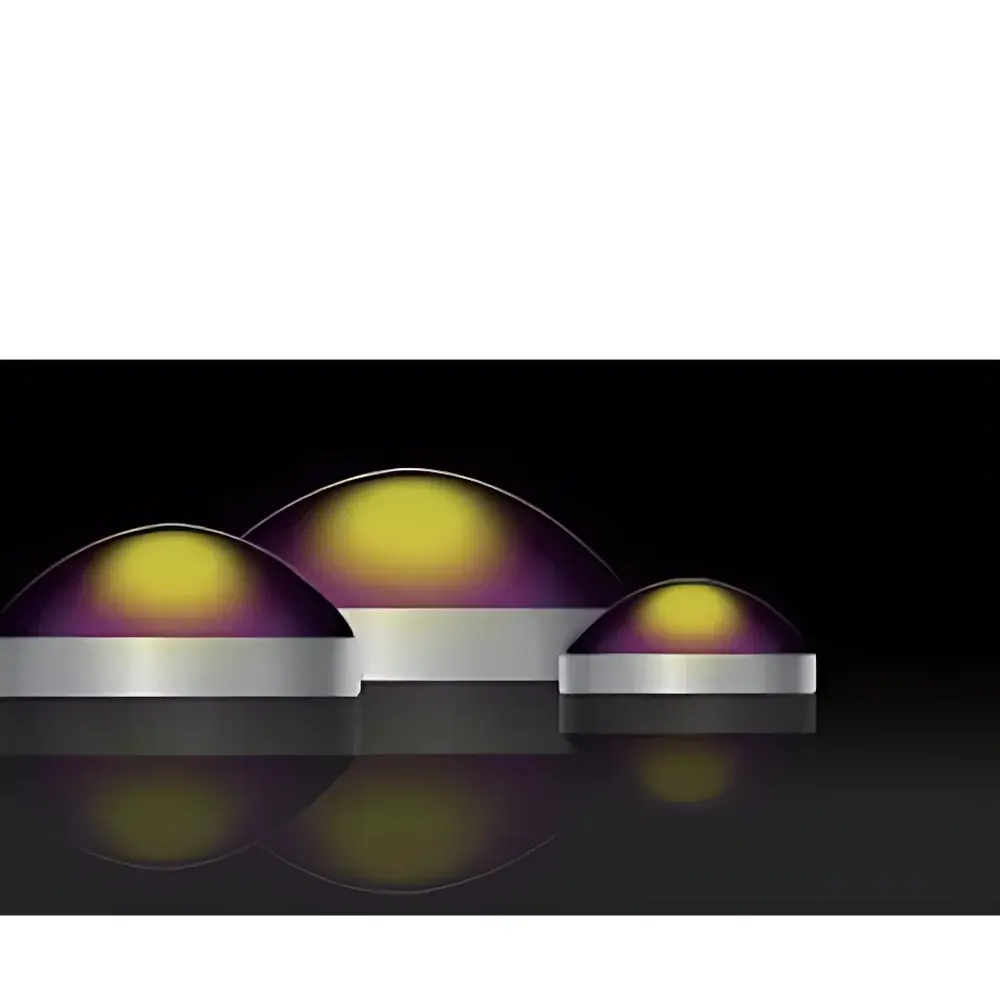
MiXran Meg1038 High-Precision Aspheric Lens
| Brand | MiXran |
|---|---|
| Model | Meg1038 |
| Type | Precision Aspheric Optical Lens |
| Material | H-ZF7L / H-ZF2 (Schott-equivalent high-refractive-index, low-dispersion optical glass) |
| Surface Figure Accuracy | λ/4 @ 633 nm (RMS), typical for precision-polished aspheres |
| Coating Options | Uncoated, VIS AR (400–700 nm), NIR AR (650–1050 nm), SWIR AR (1000–1650 nm) |
| Diameter Range | 10–50 mm |
| EFL Range | 10–37.5 mm |
| NA Range | 0.5–0.67 |
| Compliance | ISO 10110-5 (surface form tolerances), ISO 10110-7 (surface quality), MIL-PRF-13830B (scratch-dig) |
Overview
The MiXran Meg1038 is a series of high-precision, rotationally symmetric aspheric lenses engineered for demanding optical systems requiring diffraction-limited performance, minimal spherical aberration, and compact beam shaping. Manufactured using deterministic magnetorheological finishing (MRF) and sub-aperture polishing techniques, each lens exhibits surface figure accuracy better than λ/4 RMS at 633 nm — meeting ISO 10110-5 specification for precision aspheres. Unlike traditional spherical optics, the Meg1038’s monolithic aspheric profile eliminates the need for multi-element correction, reducing system complexity, weight, and internal reflections. These lenses are optimized for collimation, focusing, and imaging in visible (VIS), near-infrared (NIR), and short-wave infrared (SWIR) spectral bands, supporting applications from laser diode coupling to spectroscopic instrumentation and machine vision optics.
Key Features
- Precision aspheric surface generated via computer-controlled polishing, ensuring consistent wavefront fidelity across production lots
- High-index, low-dispersion optical glass substrates (H-ZF7L and H-ZF2) selected for superior Abbe number control and thermal stability (dn/dT ≈ −1.5 × 10⁻⁶ /°C)
- Surface quality compliant with ISO 10110-7 (60-40 scratch-dig standard) and MIL-PRF-13830B for critical laser applications
- Multiple broadband anti-reflection coating options deposited via ion-assisted e-beam evaporation: VIS (400–700 nm, R<0.25% avg.), NIR (650–1050 nm, R<0.3% avg.), and SWIR (1000–1650 nm, R<0.4% avg.)
- Center thickness tolerance ±0.05 mm; focal length tolerance ±0.5% (measured at 633 nm HeNe wavelength under collimated interferometric verification)
- Mounting-ready geometry with plano-convex or convex-convex configurations, compatible with standard SM-threaded lens holders (e.g., Thorlabs SM1, SM2)
Sample Compatibility & Compliance
The Meg1038 series supports integration into both free-space and fiber-coupled optical architectures. Its dimensional consistency and surface metrology traceability enable direct substitution in OEM modules certified to IEC 61215 (photovoltaic concentrators), ISO 13694 (laser beam characterization), and EN 61000-4-3 (EMC-immunity for optoelectronic subsystems). All coated variants undergo environmental durability testing per MIL-C-48497A (adhesion, humidity, abrasion) and pass 24-hour salt-spray exposure without delamination. Uncoated versions meet USP particulate limits when cleaned per ISO 14644-1 Class 5 cleanroom protocols — suitable for vacuum-compatible optical benches (outgassing rate <1×10⁻⁶ g/cm²·hr, per ASTM E595).
Software & Data Management
Each Meg1038 lens ships with a digital Certificate of Conformance (CoC) containing interferometric surface map data (Zernike coefficients up to 37-term expansion), measured MTF curves (at 50% contrast, 50 lp/mm), and coating spectral reflectance scans (200–2000 nm, 1 nm resolution). CoC files are provided in standardized XML format compliant with ASTM E2779-21 (optical component data exchange) and support import into Zemax OpticStudio (ZOS), CODE V, and FRED optical design platforms. Batch-level QA records—including polishing run ID, metrology timestamps, and operator certification—are archived for GLP/GMP traceability and FDA 21 CFR Part 11 audit readiness.
Applications
- Laser diode collimation and fiber coupling in telecom transceivers (1310/1550 nm) and LiDAR illumination modules
- High-resolution microscopy objectives where field curvature correction is essential (e.g., confocal scanning, OCT sample arms)
- Spectrometer fore-optics requiring wide spectral transmission and minimal ghosting (e.g., FTIR, Raman spectrometers)
- Machine vision lenses for semiconductor wafer inspection, leveraging high NA and low distortion (<0.15% TV distortion at f/2.8)
- Thermal imaging front-end optics operating in SWIR band (1000–1650 nm), benefiting from low absorption in H-ZF2 substrate
- Space-qualified optical assemblies where mass reduction and single-element aberration correction are mission-critical
FAQ
What metrology standards verify surface accuracy for the Meg1038?
Interferometric verification is performed using a Zygo Verifire™ XP dynamic interferometer calibrated to NIST-traceable standards; surface figure is reported per ISO 10110-5 with λ/4 RMS tolerance referenced to 633 nm.
Can Meg1038 lenses be customized with non-standard coatings or radii?
Yes — MiXran offers OEM coating design (including dual-band, polarizing, or high-LIDT variants) and custom aspheric profiles under NDA; lead time extends to 8–12 weeks for non-stock configurations.
Is thermal drift compensated in the lens design?
While the Meg1038 itself is a passive element, its H-ZF7L/H-ZF2 material selection provides low thermo-optic coefficient (dn/dT) and near-zero focal shift over −10 °C to +60 °C — verified per ISO 10110-12 thermal stability testing.
Do you provide mounting fixtures or kinematic adapters?
Standard SM-threaded mounts (SM1, SM2) and adjustable kinematic lens cells are available as optional accessories; mechanical drawings and STEP files are supplied upon request.
Are test reports available for individual serial-numbered units?
Yes — every shipped lens includes a unique CoC with full interferogram, spectral scan, and dimensional inspection report; digital archives are retained for 10 years per ISO 9001:2015 clause 8.5.2.




