
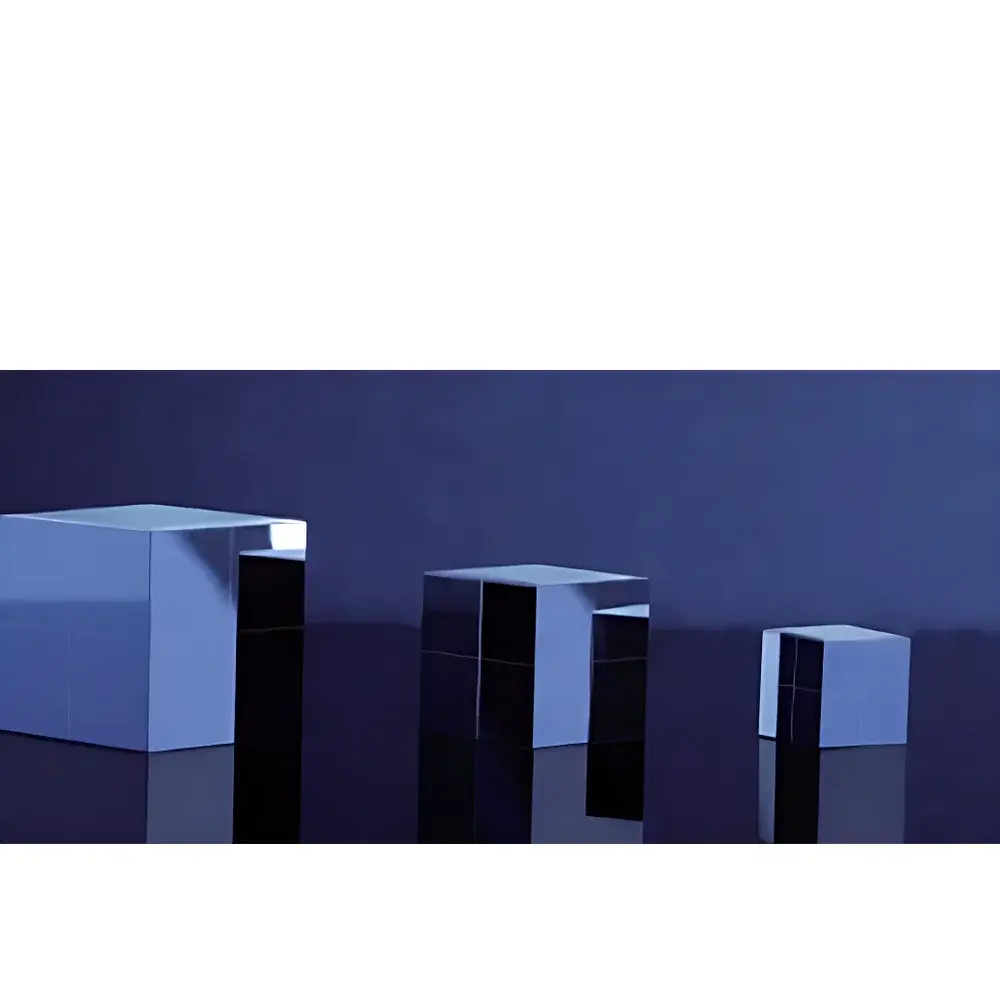
MiXran Meg1047 Precision Cube Corner Retroreflector Prism
| Brand | MiXran |
|---|---|
| Model | Meg1047 |
| Type | Cube Corner Retroreflector Prism |
| Dimensions (mm) | 10×10×10 / 15×15×15 / 20×20×20 |
| Angular Accuracy | <5 arcseconds |
| Scribe Line Width | 0.04 mm |
| Scribe Centering Tolerance | <0.1 mm |
| Average Reflectivity (5 Faces) | >85% @ 633 nm |
| Material | N-BK7 or Fused Silica (standard) |
| Coating | Dielectric Enhanced Aluminum (standard) |
| Compliance | ISO 10110-7, MIL-PRF-13830B Surface Quality |
Overview
The MiXran Meg1047 Precision Cube Corner Retroreflector Prism is an optically engineered passive component designed for high-fidelity beam return in metrology, laser alignment, interferometry, and photogrammetric applications. Based on the principle of total internal reflection combined with precisely aligned orthogonal mirror surfaces, the Meg1047 ensures near-zero angular deviation between incident and retroreflected beams—regardless of input angle within its acceptance cone. Each unit consists of three mutually perpendicular reflecting faces meeting at a single apex, forming a geometrically stable corner-cube structure. Manufactured from high-homogeneity optical substrates (N-BK7 or fused silica), the prism undergoes precision lapping, polishing, and deterministic coating to achieve angular accuracy better than 5 arcseconds and wavefront distortion <λ/10 @ 633 nm (per ISO 10110-5). Its five reflective surfaces—including the three active corner faces plus two auxiliary calibration faces—are coated with dielectric-enhanced aluminum optimized for broadband performance from 400–1100 nm, delivering average reflectivity exceeding 85% across the visible and near-infrared spectrum.
Key Features
- Precision-ground orthogonal geometry ensuring angular deviation <5 arcseconds—critical for sub-micron alignment stability in laser tracker and coordinate measuring machine (CMM) applications
- Dual-standard surface quality: scratch-dig per MIL-PRF-13830B (40-20 typical) and surface flatness λ/10 @ 633 nm (verified via phase-shifting interferometry)
- Consistent scribe line width of 0.04 mm and centering tolerance <0.1 mm—enabling repeatable mechanical mounting and optical axis registration in multi-prism arrays
- Five-face functional design: three active retroreflecting faces plus two reference faces for fiducial alignment and system-level calibration traceability
- Thermally stable monolithic construction with coefficient of thermal expansion (CTE) matched to common optical mounts (e.g., Invar, stainless steel), minimizing misalignment drift over operational temperature ranges (−20 °C to +60 °C)
- Available in three standard apertures: 10 mm, 15 mm, and 20 mm cubic edge lengths—each validated for use in ISO/IEC 17025-accredited calibration laboratories
Sample Compatibility & Compliance
The Meg1047 is compatible with standard kinematic and flexure-based optical mounts (e.g., Thorlabs KM100, Newport UMB100), as well as custom vacuum-compatible holders for ultra-high-stability interferometric setups. All units are supplied with individual test reports including interferometric surface maps, spectral reflectance curves (200–1200 nm), and angular deviation measurements traceable to NIM (National Institute of Metrology, China) standards. The prisms comply with ISO 10110-7 (surface imperfections), ISO 10110-5 (surface form), and ISO 9001:2015 manufacturing controls. For regulated environments—including FDA-regulated medical device alignment systems and aerospace-grade LIDAR calibration—the Meg1047 supports full documentation packages compliant with ISO/IEC 17025 and GLP audit requirements.
Software & Data Management
While the Meg1047 is a passive optical component requiring no firmware or embedded software, it integrates seamlessly into automated metrology workflows via standardized calibration protocols. Users may import its certified angular error map and reflectance profile into commercial alignment simulation platforms such as Zemax OpticStudio, CODE V, or MATLAB-based beam propagation models. Each prism ships with a unique serial-numbered digital certificate containing raw interferogram data (in .mat and .tif formats), enabling traceable re-analysis and long-term performance trending. For enterprise clients operating under 21 CFR Part 11 compliance, MiXran provides optional electronic audit trails and secure PDF certificates with digital signatures validated against SHA-256 cryptographic hashes.
Applications
- Laser tracker target arrays for industrial 3D coordinate metrology (e.g., API Radian, Leica AT960)
- Reference elements in heterodyne and homodyne interferometers for displacement and vibration measurement
- Calibration standards for optical encoder systems and absolute distance meters (ADM)
- Field-deployable retroreflector targets in photogrammetric surveying and UAV-based geospatial mapping
- Alignment references in synchrotron beamline instrumentation and free-electron laser (FEL) diagnostic stations
- Primary targets in national metrology institute (NMI) intercomparisons for angular metrology and beam divergence validation
FAQ
What substrate materials are available for the Meg1047 series?
Standard configurations use N-BK7 glass; fused silica is available upon request for UV transmission or reduced thermal drift.
Is the 85% reflectivity value measured at normal incidence or averaged over angle of incidence?
The value represents the average reflectivity across 0°–10° angle of incidence at 633 nm, measured per ISO 9211-4 using a calibrated spectrophotometer.
Can the Meg1047 be used in vacuum environments?
Yes—when specified with low-outgassing dielectric coatings and cleaned to ISO 14644-1 Class 5, it meets ESA ECSS-Q-ST-70-02C requirements for space-qualified optics.
Do you provide mounting fixtures or kinematic bases for the Meg1047?
MiXran offers optional stainless-steel kinematic mounts (model KM-Meg1047) with ±0.5 µm repeatability and integrated fiducial marks for co-alignment with laser interferometer heads.
How is angular accuracy verified for each unit?
Each prism undergoes full-aperture autocollimation testing using a Zygo Verifire™ XP interferometer, with results documented in its Certificate of Conformance per ISO/IEC 17025 Annex A.





