
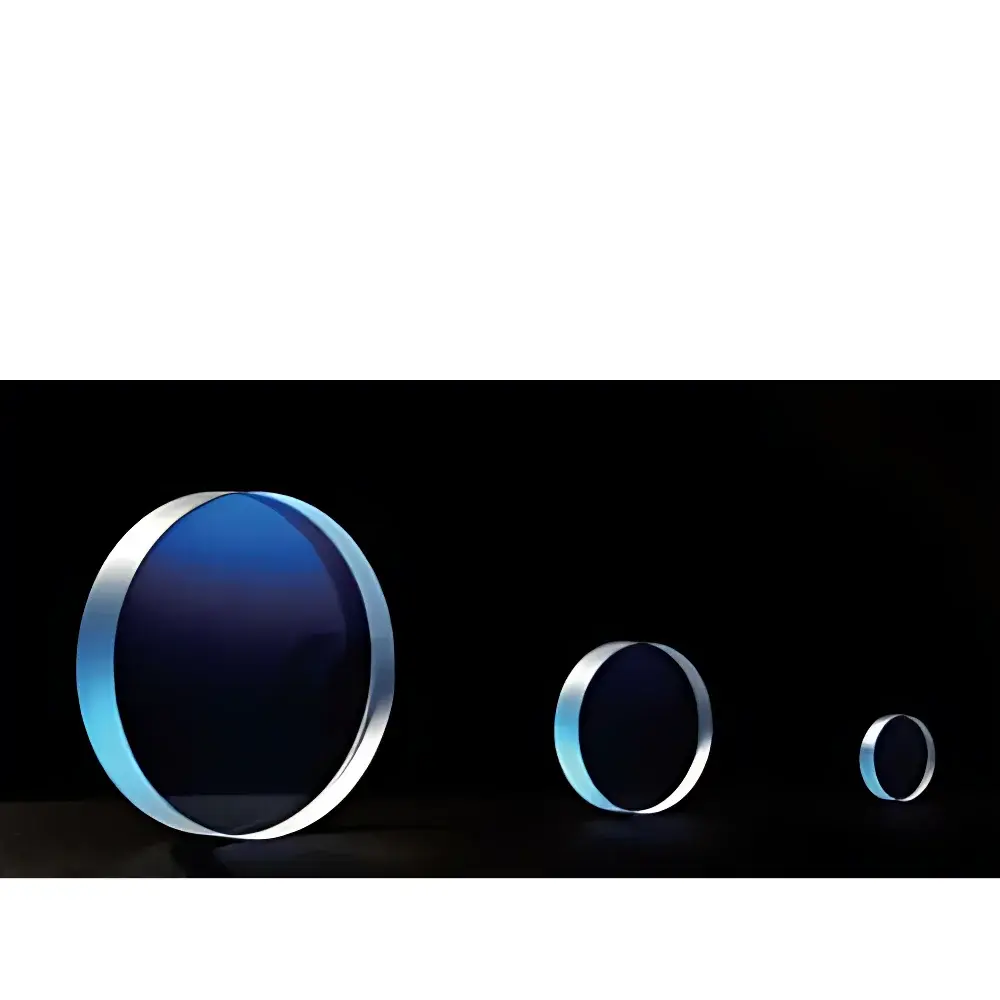
MiXran Meg1064 High-Precision Fused Silica Wedged Window
| Brand | MiXran |
|---|---|
| Model | Meg1064 |
| Material | UV-grade fused silica |
| Wedge angle | 0.5° (standard) |
| Surface quality | 20–10 scratch-dig |
| Surface flatness | λ/10 @ 633 nm |
| Parallelism | < 3 arcsec |
| AR coating options | UV (250–400 nm), VIS (350–700 nm), NIR (600–1100 nm), SWIR (900–1700 nm) |
| Diameter options | Φ12.5 mm, Φ12.7 mm, Φ25.0 mm, Φ25.4 mm, Φ38.1 mm, Φ50.0 mm, Φ50.8 mm |
| Thickness options | 3 mm, 6 mm, 10 mm |
| Compliance | ISO 10110-7, MIL-O-13830A |
Overview
The MiXran Meg1064 is a high-precision wedged window engineered for demanding optical systems where stray light suppression and beam deviation control are critical. Fabricated from UV-grade fused silica—selected for its exceptional transmission from 185 nm to 2.1 µm, low thermal expansion (α ≈ 0.55 × 10⁻⁶ /°C), and high laser-induced damage threshold—the Meg1064 eliminates ghost reflections inherent in parallel-plane windows by introducing a controlled wedge angle of 0.5° (standard). This geometry ensures that residual back-reflections are angularly separated from the primary optical path, making it indispensable in interferometers, ultrafast laser cavities, vacuum viewports, spectroscopic cells, and high-sensitivity imaging systems operating under low-light or multi-wavelength conditions.
Key Features
- UV-grade fused silica substrate with certified homogeneity (Δn < 1 × 10⁻⁶) and bubble/inclusion grade ≤ ISO 10110-3 Class 5
- Precision wedge angle of 0.5° ± 0.05°, verified via autocollimation and interferometric angle metrology
- Surface flatness λ/10 @ 633 nm (peak-to-valley), measured per ISO 10110-5 using phase-shifting interferometry
- Surface quality rated 20–10 scratch-dig per MIL-O-13830A, inspected under 100× dark-field illumination
- Multiple anti-reflection (AR) coating variants optimized for spectral bands: UV (250–400 nm), VIS (350–700 nm), NIR (600–1100 nm), and SWIR (900–1700 nm), each achieving average R < 0.25% per surface
- Consistent thickness tolerance of ±0.05 mm across all diameter options (Φ12.5 mm to Φ50.8 mm) and thickness variants (3 mm, 6 mm, 10 mm)
- Edge finish: fine ground and polished, with optional protective bevel (0.15 mm × 45°) to mitigate chipping during mounting
Sample Compatibility & Compliance
The Meg1064 is compatible with standard kinematic and flexure-based optical mounts (e.g., Thorlabs KM100, Newport UMB12.5) and vacuum-compatible flanges (CF-16, CF-35). Its fused silica composition ensures stability under UHV conditions (<10⁻⁹ mbar) and resistance to gamma irradiation (up to 10⁶ rad). All coated variants comply with ISO 9001:2015 manufacturing controls and undergo batch-level spectral verification using a calibrated PerkinElmer Lambda 1050+ spectrophotometer. Coating adhesion meets MIL-C-48497A requirements (tape test per ASTM D3359), and environmental durability conforms to MIL-STD-810G Method 509.5 (humidity exposure) and Method 502.5 (thermal cycling: –40°C to +70°C, 50 cycles).
Software & Data Management
While the Meg1064 is a passive optical component, full traceability is provided via a digital certificate of conformance (CoC) delivered with each unit. The CoC includes interferometric surface map data (Zernike coefficients up to n=6), spectral reflectance curves (300–1800 nm, 1 nm resolution), wedge angle measurement report, and lot-specific fused silica certification (OH content < 1 ppm, metallic impurities < 10 ppb by ICP-MS). These files are supplied in vendor-neutral formats (CSV, TIFF, PDF/A-2b) and are compatible with laboratory LIMS platforms supporting ASTM E2996 metadata tagging. Batch records are retained for 15 years in accordance with GLP archival requirements.
Applications
- Laser cavity optics in Ti:sapphire, dye, and excimer systems requiring minimal intracavity feedback
- Vacuum chamber viewports for synchrotron beamlines and EUV lithography development tools
- Reference windows in FTIR spectrometers and dual-comb absorption spectrometers
- Beam delivery optics in femtosecond CPA and OPCPA systems where group delay dispersion must remain uncompromised
- Calibration standards for wavefront sensor alignment and null testing of aspheric mirrors
- Environmental monitoring sensors deployed in stratospheric balloon payloads (low outgassing, radiation-hardened)
FAQ
What is the purpose of the wedge angle in the Meg1064 window?
The 0.5° wedge eliminates coherent back-reflections by directing residual surface reflections away from the primary optical axis—critical for interferometric stability and laser cavity Q-factor preservation.
Can custom wedge angles or diameters be ordered?
Yes. MiXran offers wedge angles from 0.1° to 3.0° (±0.02° tolerance) and non-standard diameters up to Φ100 mm upon request; lead time extends by 4–6 weeks.
Is the UV-grade fused silica certified for 193 nm or 157 nm excimer applications?
All Meg1064 substrates are tested for 193 nm transmission (>85% at 10 mm thickness); 157 nm qualification requires optional fluorine-loading and is available under separate part numbering (Meg1064-F2).
How is coating durability validated for high-power laser use?
AR coatings undergo ISO 21254-1 LIDT testing at 1064 nm (10 ns pulse, 20 Hz, Ø0.5 mm spot); typical damage thresholds exceed 15 J/cm² for nanosecond pulses and >1 GW/cm² for picosecond regimes.
Do you provide mounting fixtures or kinematic adapters?
Standard SM-threaded retaining rings (e.g., SM1RR, SM2RR) are recommended; custom machined aluminum or Invar mounts with thermal compensation grooves are available as value-added options.




