
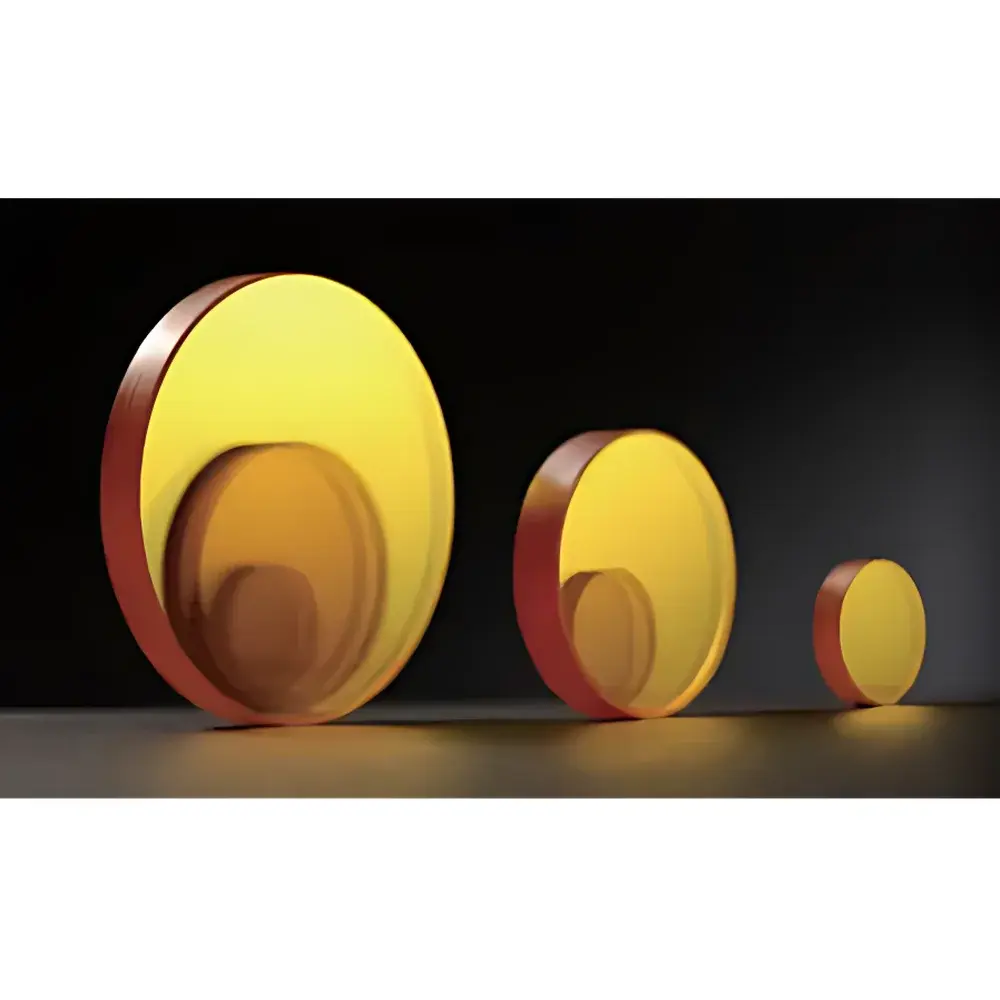
MiXran Meg1073 ZnSe Planar Optical Window
| Brand | MiXran |
|---|---|
| Model | Meg1073 |
| Material | Zinc Selenide (ZnSe) |
| Transmission Range | 0.5–20 µm |
| Surface Flatness | λ/4 @ 633 nm |
| Parallelism | < 1 arcmin |
| AR Coating Options | Uncoated |
| Standard AR Coating | Ravg < 1.5% @ 8–12 µm |
| Available Diameters | Φ12.5 mm, Φ12.7 mm, Φ25.0 mm, Φ25.4 mm, Φ40.0 mm, Φ50.0 mm |
| Thickness Options | 3 mm, 5 mm |
| Substrate Grade | Laser-Quality Polished ZnSe |
| Compliance | ISO 10110-1, MIL-O-13830A Surface Quality |
Overview
The MiXran Meg1073 ZnSe Planar Optical Window is a precision-engineered transmissive optical component designed for demanding mid-infrared (MIR) and far-infrared (FIR) applications. Fabricated from high-purity, laser-grade zinc selenide (ZnSe), this window exhibits exceptional transmission across the broad spectral range of 0.5–20 µm—making it particularly suitable for CO₂ laser systems (10.6 µm), FTIR spectrometers, thermal imaging setups, and gas sensing platforms operating in the 8–12 µm atmospheric window. Unlike fused silica or BK7 windows, ZnSe offers negligible absorption in the MIR region while maintaining mechanical robustness and thermal stability under moderate power densities. The Meg1073 series features optically polished surfaces meeting ISO 10110-1 surface form specifications (λ/4 wavefront distortion @ 633 nm) and parallelism tolerance < 1 arcminute—ensuring minimal beam deviation and wavefront error in collimated or focused optical paths.
Key Features
- High-transmission ZnSe substrate with certified bulk homogeneity and low scatter (< 5 ppm RMS surface roughness)
- Standard anti-reflection (AR) coating optimized for the 8–12 µm band (Ravg < 1.5%), reducing Fresnel losses and ghost reflections in multi-pass IR configurations
- Multiple diameter and thickness options (Φ12.5–50.0 mm; 3 mm and 5 mm thicknesses) to accommodate diverse mechanical housing interfaces and pressure differential requirements
- Surface quality compliant with MIL-O-13830A (scratch-dig 20–10), verified via interferometric inspection and dark-field microscopy
- Thermal expansion coefficient of 7.1 × 10⁻⁶ K−1, enabling stable performance in temperature-cycled environments typical of industrial process monitoring
- Chemically inert to most non-oxidizing acids and solvents—compatible with standard cleanroom handling protocols (Class 1000 or better)
Sample Compatibility & Compliance
The Meg1073 window is compatible with vacuum, inert gas, and ambient-pressure optical enclosures. Its ZnSe substrate is non-hygroscopic and does not require hermetic sealing—unlike KBr or CsI alternatives—reducing long-term maintenance overhead. All units are supplied with full material certification, including refractive index dispersion data (Sellmeier coefficients), absorption coefficient curves (α(λ)), and batch-specific interferometric test reports. Manufacturing adheres to ISO 9001:2015 quality management standards. While not inherently FDA- or IEC 61000-certified (as passive optical components), the Meg1073 meets optical interface requirements referenced in ASTM E1421 (standard practice for FTIR instrument calibration) and supports GLP-compliant documentation workflows when integrated into validated analytical systems.
Software & Data Management
As a passive optical component, the Meg1073 requires no embedded firmware, drivers, or software integration. However, its optical parameters—including measured transmission spectra, surface flatness maps, and coating reflectance curves—are delivered digitally in standardized formats (CSV, .SDF, and PDF metrology reports) upon request. These files are structured to interoperate with common optical design platforms such as Zemax OpticStudio and CODE V, supporting accurate system-level modeling of insertion loss, polarization-dependent loss (PDL), and thermal lensing effects. Traceable calibration data includes NIST-traceable wavelength references and uncertainty budgets per ISO/IEC 17025 guidelines.
Applications
- CO₂ laser beam delivery windows in material processing and medical ablation systems
- Input/output ports for Fourier-transform infrared (FTIR) spectrometers and tunable quantum cascade laser (QCL) platforms
- Environmental monitoring housings for open-path gas analyzers targeting CH₄, CO, NO₂, and SF₆ in the 8–12 µm fingerprint region
- Thermal imaging detector windows in uncooled microbolometer arrays (e.g., VOx-based sensors)
- Reference-grade calibration windows for radiometric source characterization in NIST-accredited labs
- Optical isolation barriers in high-voltage or explosive atmosphere-rated instrumentation (ATEX/IECEx-compatible mounting flanges available on request)
FAQ
Is the Meg1073 window suitable for high-power CO₂ laser applications?
Yes—ZnSe has a damage threshold of > 500 MW/cm² (10 ns pulse, 10.6 µm), making it appropriate for industrial-grade CW and pulsed CO₂ lasers when properly cooled and aligned.
Can custom AR coatings be applied outside the standard 8–12 µm band?
Yes—MiXran offers bespoke thin-film designs for wavelengths from 2–14 µm, including dual-band (e.g., 3–5 µm + 8–12 µm) and broadband (> 1 octave) variants; lead time increases by 3–4 weeks.
What is the maximum operating temperature for sustained use?
Continuous operation up to 200 °C is permissible; above this, gradual increase in absorption coefficient occurs due to phonon-assisted transitions—thermal shock testing confirms survivability up to 300 °C for short-duration exposure.
Are mounting fixtures or kinematic mounts available?
Standard SM1 (1.035″-40) and CF-35 flange-compatible retaining rings are stocked; custom O-ring grooves and vacuum-brazed metal housings can be quoted separately.
Do you provide spectral transmission data for individual units?
Yes—each shipped window includes a unique serial-numbered spectral scan (200–20,000 cm⁻¹) acquired on a Bruker VERTEX 80v FTIR with KBr beamsplitter and liquid-nitrogen-cooled MCT detector.




