
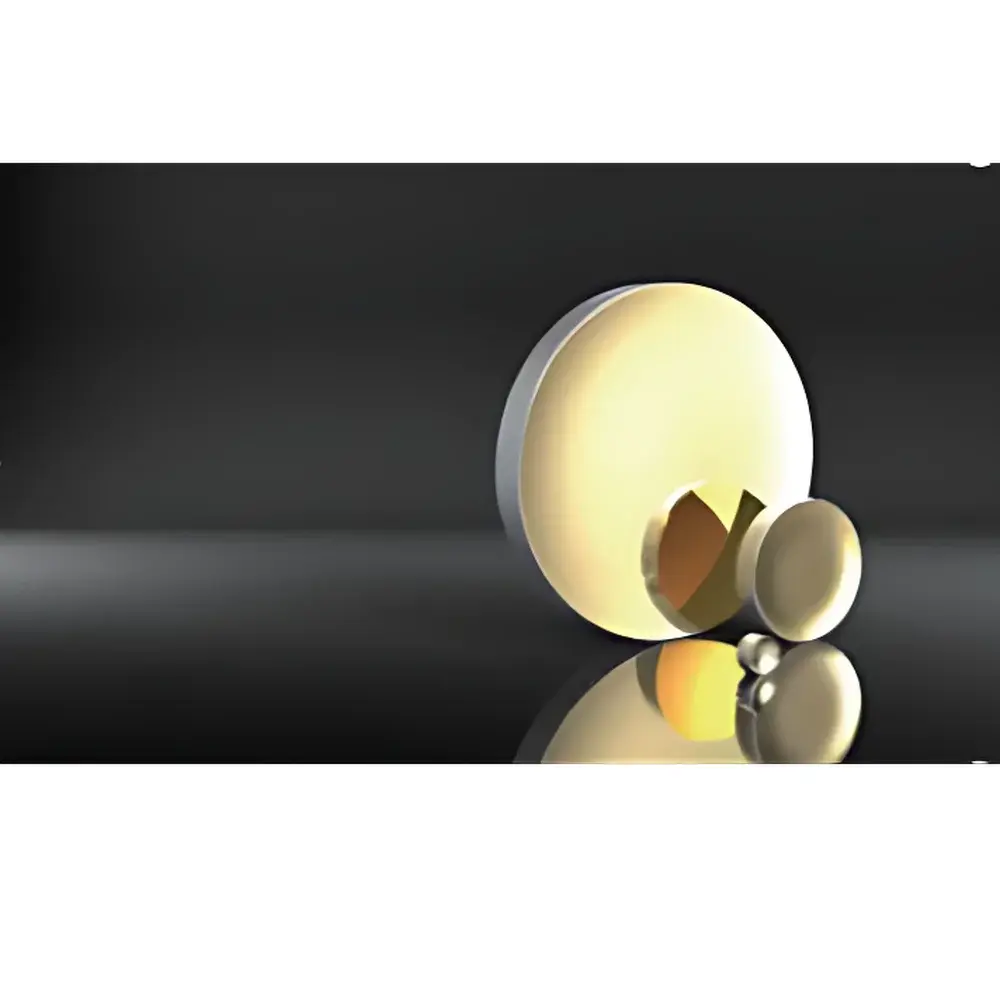
MiXran Meg1079 Plano-Concave Spherical Mirror
| Brand | MiXran |
|---|---|
| Model | Meg1079 |
| Optical Component Type | Plano-Concave Spherical Mirror |
| Substrate Material | Fused Silica (Standard) |
| Available Coatings | Uncoated / Protected Aluminum (Al + SiO₂) / UV-Enhanced Aluminum (UVAL) |
| Diameter / Clear Aperture | Φ12.5 mm to Φ75.0 mm (also available in square: 12.5×12.5 mm to 50.0×50.0 mm, and rectangular: 50.0×25.0 mm) |
| Focal Length (EFL) | 5 mm to 1000 mm |
| Radius of Curvature (R₁) | 10 mm to 2000 mm |
| Center Thickness (Tc) | 3.2 mm to 13.76 mm |
| Edge Thickness (Te₁/Te₂) | 3.2 mm to 13.76 mm |
| Surface Quality | λ/4 @ 633 nm (standard) |
| Surface Flatness (Plano Side) | λ/4 PV (typical) |
| Surface Roughness | <5 Å RMS (typical) |
Overview
The MiXran Meg1079 Plano-Concave Spherical Mirror is a precision optical component engineered for beam expansion, collimation reversal, and optical path folding in laser systems, interferometers, spectroscopic setups, and alignment-sensitive instrumentation. As a plano-concave mirror, it features one flat (plano) surface and one spherically concave surface, with the radius of curvature (R₁) precisely matched to twice the effective focal length (EFL = R₁/2). This geometry introduces negative optical power, enabling controlled beam divergence when used with collimated input — a critical function in applications such as cavity dumping, retro-reflection stabilization, and aberration compensation in multi-element optical trains. Manufactured from high-purity fused silica (Suprasil®-grade equivalent), the Meg1079 exhibits exceptional transmission from deep ultraviolet (185 nm) through near-infrared (2.2 µm), low thermal expansion (α ≈ 0.55 × 10⁻⁶ /°C), and high laser-induced damage threshold (LIDT > 5 J/cm² at 1064 nm, 10 ns, 20 Hz). All substrates undergo deterministic polishing to meet λ/4 surface accuracy (PV) and <5 Å RMS roughness, ensuring minimal wavefront distortion and high Strehl ratio performance.
Key Features
- Precision-engineered plano-concave geometry with certified radius of curvature tolerance ±0.2% and EFL traceability to NIST-traceable interferometric calibration
- Three standard coating options: uncoated (for broadband transmission or custom coating deposition), protected aluminum (Al + 100 nm SiO₂ overcoat; Ravg > 90% from 400–2000 nm), and UV-enhanced aluminum (UVAL; Ravg > 85% from 250–400 nm, optimized for excimer and deuterium lamp applications)
- Multiple aperture formats: round (Φ12.5–Φ75.0 mm), square (12.5×12.5–50.0×50.0 mm), and rectangular (50.0×25.0 mm) to accommodate space-constrained or anamorphic optical layouts
- Fused silica substrate with certified homogeneity (Δn < 1 × 10⁻⁶), low birefringence (<5 nm/cm), and compliance with MIL-O-13830A scratch-dig specification (20–10)
- Edge clearance optimized per ISO 10110-7: chamfered edges (0.2–0.3 mm × 45°) with black anodized aluminum mounts available upon request for stray-light suppression
Sample Compatibility & Compliance
The Meg1079 is compatible with standard kinematic mirror mounts (e.g., Thorlabs KM100, Newport UMB1) and vacuum-compatible holders (CF-35/CF-63 flange adapters optional). It meets ISO 10110 optical drawing standards for surface form, irregularity, and coating specifications. All coated variants are tested per ISO 9211-3 for spectral reflectance uniformity and environmental durability (damp heat, abrasion, adhesion per ASTM D3359). The UVAL coating conforms to ISO 13665 for UV reflectance stability under 254 nm irradiation (≤0.5% reflectance loss after 100 h). For regulated environments, documentation packages include full material certificates (EN 10204 3.1), coating spectral data sheets (350–2000 nm, 1 nm resolution), and surface metrology reports (Zygo GPI interferometer, 633 nm HeNe source).
Software & Data Management
While the Meg1079 is a passive optical element, its performance integration into system-level modeling is supported via comprehensive optical design data files. Each batch includes Zemax-compatible .ZBF (Zemax Binary File) and CODE V .DAT files containing measured surface sag tables, coating dispersion models (Cauchy coefficients), and LIDT curves. Digital twin metadata — including serial-number-tracked interferometric maps, coating thickness profiles (ellipsometry verified), and batch-specific thermal expansion coefficients — is accessible via MiXran’s secure customer portal under ISO/IEC 27001-certified infrastructure. Audit trails comply with FDA 21 CFR Part 11 requirements for electronic records in GMP-aligned optical assembly workflows.
Applications
- Laser resonator design: negative-power correction elements in unstable cavities and mode-matching optics for Ti:sapphire and fiber lasers
- UV-VIS spectrometer beam conditioning: collimator mirrors in Czerny-Turner and Offner configurations where chromatic aberration must be minimized
- Interferometric metrology: reference arms in Michelson and Twyman-Green interferometers requiring high fringe contrast and low ghost reflection
- Semiconductor inspection tools: illumination path folding mirrors in mask alignment systems operating at 193 nm (ArF) and 248 nm (KrF)
- Space-qualified instruments: radiation-hardened fused silica substrate with outgassing data (ASTM E595 TTC < 0.5%) supports use in low-Earth orbit payloads
FAQ
What is the difference between protected aluminum and UV-enhanced aluminum coatings?
Protected aluminum uses a dielectric overcoat (typically SiO₂) to prevent oxidation and increase durability in ambient air, delivering >90% average reflectance from 400–2000 nm. UV-enhanced aluminum replaces SiO₂ with a multi-layer MgF₂/TiO₂ stack optimized for 250–400 nm, achieving >85% reflectance at 254 nm and improved resistance to ozone-induced degradation.
Can the Meg1079 be used in ultra-high vacuum (UHV) environments?
Yes — uncoated fused silica versions are UHV-compatible (base pressure <10⁻⁹ mbar). Coated variants require pre-baking (120°C, 24 h) and are rated for ≤10⁻⁷ mbar without outgassing-induced contamination. Full outgassing test reports (CNES/ECSS-Q-ST-70-02C) are provided on request.
Is custom radius or diameter available?
Yes. MiXran offers non-standard radii (±0.1% tolerance), elliptical apertures, and wedge-free substrates (Δ < 1 arcsec) under OEM agreement. Lead time extends by 4–6 weeks; minimum order quantity applies.
How is surface quality verified?
Each unit undergoes full-aperture phase-shifting interferometry (PSI) using a Zygo Verifire™ with λ/20 reference sphere. Surface irregularity is reported as PV and RMS values referenced to best-fit sphere; all units meet λ/4 PV (633 nm) and ≤0.05 µm RMS as standard.
Do you provide mounting hardware or kinematic solutions?
Standard products ship unmounted. However, MiXran partners with leading motion control suppliers (Newport, Thorlabs) to offer pre-aligned, stress-free kinematic mounts (e.g., 3-point flexure, piezo-tip/tilt) with thermal drift compensation — quoted separately per mechanical interface requirement.




