
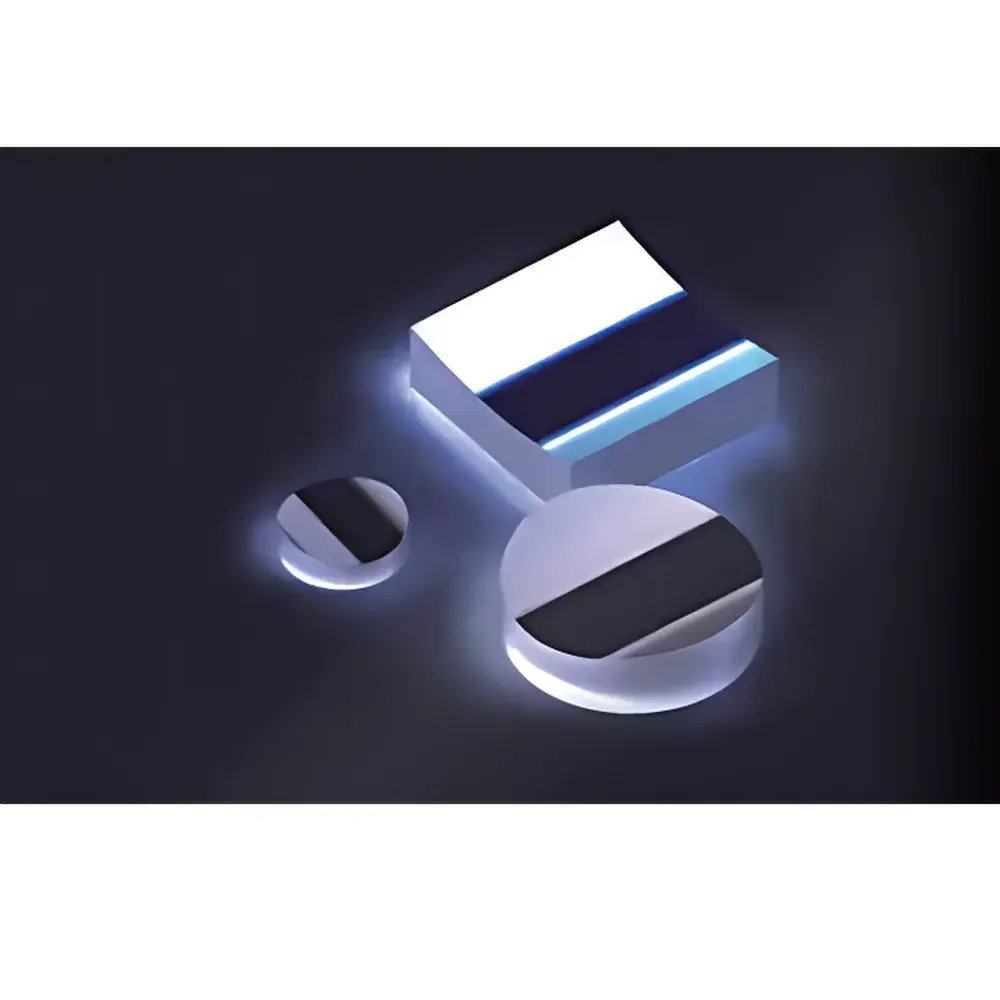
MiXran Meg1080 Plano-Concave Cylindrical Mirror
| Brand | MiXran |
|---|---|
| Model | Meg1080 |
| Optical Component Type | Plano-Concave Cylindrical Mirror |
| Substrate Material | Fused Silica or BK7 (standard) |
| Available Apertures | Ø12.5 mm, 12.5 × 12.5 mm, Ø25.0 mm, 25.0 × 25.0 mm |
| Focal Lengths (EFL) | 12.5–250 mm |
| Radius of Curvature (R₁) | 25–500 mm |
| Center Thickness (Tc) | 33.13–67.59 mm |
| Edge Thickness (Te) | 33.13–66.16 mm |
| Coating Options | Uncoated |
Overview
The MiXran Meg1080 Plano-Concave Cylindrical Mirror is a precision optical component engineered for beam shaping, line generation, and anamorphic correction in laser systems, interferometers, spectroscopic setups, and optical alignment applications. Unlike spherical mirrors, cylindrical mirrors introduce curvature along only one axis—enabling controlled focusing or collimation in a single dimension while preserving the orthogonal wavefront. The Meg1080 series employs high-homogeneity optical substrates (BK7 or fused silica, selectable per specification), ground and polished to λ/4 surface accuracy (RMS) and scratch-dig 40–20 per MIL-PRF-13830B. Its plano-concave geometry yields a negative focal length, making it ideal for diverging light in one plane—critical in applications such as laser line projection, astigmatism compensation, and slit illumination in monochromators.
Key Features
- Axis-specific optical power: Concave curvature along one axis only; plano surface orthogonal—enabling independent control of horizontal and vertical beam divergence.
- High-precision surface form: Surface irregularity ≤ λ/4 @ 632.8 nm (verified via interferometric testing); radius tolerance ±0.2% standard.
- Multiple substrate options: BK7 for visible/NIR applications (350–2000 nm); fused silica for UV stability and low thermal expansion (185–2100 nm).
- Customizable coatings: Protected aluminum (reflectivity >88% from 400–800 nm); UV-enhanced aluminum (>85% at 250 nm); protected silver (>95% from 500–2000 nm); protected gold (>97% from 700–12,000 nm).
- Robust mechanical design: Center and edge thicknesses optimized for mounting stability and minimal deformation under kinematic or flexure-based mounts.
- Traceable metrology: Each unit supplied with individual test report including measured radius of curvature (R₁), surface flatness (plano side), and coating spectral reflectance data.
Sample Compatibility & Compliance
The Meg1080 mirror is compatible with standard optomechanical mounts (e.g., SM1-threaded lens tubes, kinematic mirror mounts with 1/4″-20 or M6 taps). All substrates meet ISO 10110-1 dimensional tolerances (±0.1 mm diameter/side, ±0.2 mm thickness) and ISO 10110-7 surface quality specifications. Coating processes comply with ISO 9001-certified cleanroom protocols (Class 1000 or better). Reflectance data are validated per ASTM E430–18 (spectrophotometric measurement of specular reflectance). Units intended for regulated environments (e.g., medical laser systems or aerospace instrumentation) support full traceability documentation, including material certifications (MTRs), coating deposition logs, and interferometric verification reports—fully aligned with GLP/GMP documentation requirements.
Software & Data Management
While the Meg1080 is a passive optical element, its integration into optical design workflows is supported through native compatibility with industry-standard modeling platforms: Zemax OpticStudio (.ZAR/.ZOS), CODE V (.SEQ), and FRED (.FRED). Each product variant includes a calibrated optical model file (including real measured surface deviation maps where available) downloadable via secure customer portal. For OEM integrators, MiXran provides custom optical prescription files (OPD, Zernike coefficients) and coating dispersion datasets (n & k vs. wavelength) in ASCII format—enabling accurate non-sequential ray tracing and polarization-sensitive analysis. All documentation adheres to ISO 15530-3 standards for uncertainty propagation in optical metrology.
Applications
- Laser line generation: Coupled with cylindrical lenses or diode arrays to produce uniform line illumination for machine vision, structured light scanning, and confocal microscopy.
- Astigmatic correction: Compensating inherent astigmatism in off-axis parabolic systems or high-NA objective assemblies.
- Monochromator and spectrometer slits: Collimating light onto entrance slits while maintaining spatial coherence across the dispersion plane.
- Interferometric reference arms: Introducing controlled, axis-selective phase delay in Twyman–Green or Mach–Zehnder configurations.
- UV lithography beam conditioning: UVAL-coated variants used in excimer laser delivery systems (e.g., KrF, ArF) requiring high reflectance below 250 nm.
- Thermal imaging optics: Gold-coated versions integrated into MWIR/LWIR Fourier-transform infrared (FTIR) spectrometers operating from 3–12 µm.
FAQ
What is the difference between a plano-concave cylindrical mirror and a spherical concave mirror?
A plano-concave cylindrical mirror focuses light to a line (not a point) by curving only along one axis—making it suitable for anamorphic beam manipulation. A spherical concave mirror focuses to a point but introduces spherical aberration and lacks directional selectivity.
Can I specify custom radius of curvature or substrate material?
Yes. MiXran accepts custom R₁ values (±0.1% tolerance), alternate substrates (CaF₂, sapphire, ZnSe), and non-standard dimensions under OEM agreements—with lead times adjusted accordingly.
Are coating durability and environmental resistance documented?
All metallic coatings undergo adhesion testing per MIL-C-48497A and humidity cycling per ISO 9211-3. Reflectance stability is verified after 500 hours of 85°C/85% RH exposure for Al, Ag, and Au variants.
Do you provide mounting hardware or kinematic adapters?
Standard SM1-threaded retaining rings and cage-compatible mirror mounts are available separately; custom kinematic bases (e.g., tip/tilt platforms with piezo actuation) can be quoted upon request.
Is ISO 17025 calibration available for individual units?
Yes—certified radius measurement and surface figure verification by an ILAC-accredited laboratory is offered as an optional add-on service, including uncertainty budgeting per GUM (JCGM 100:2018).




