
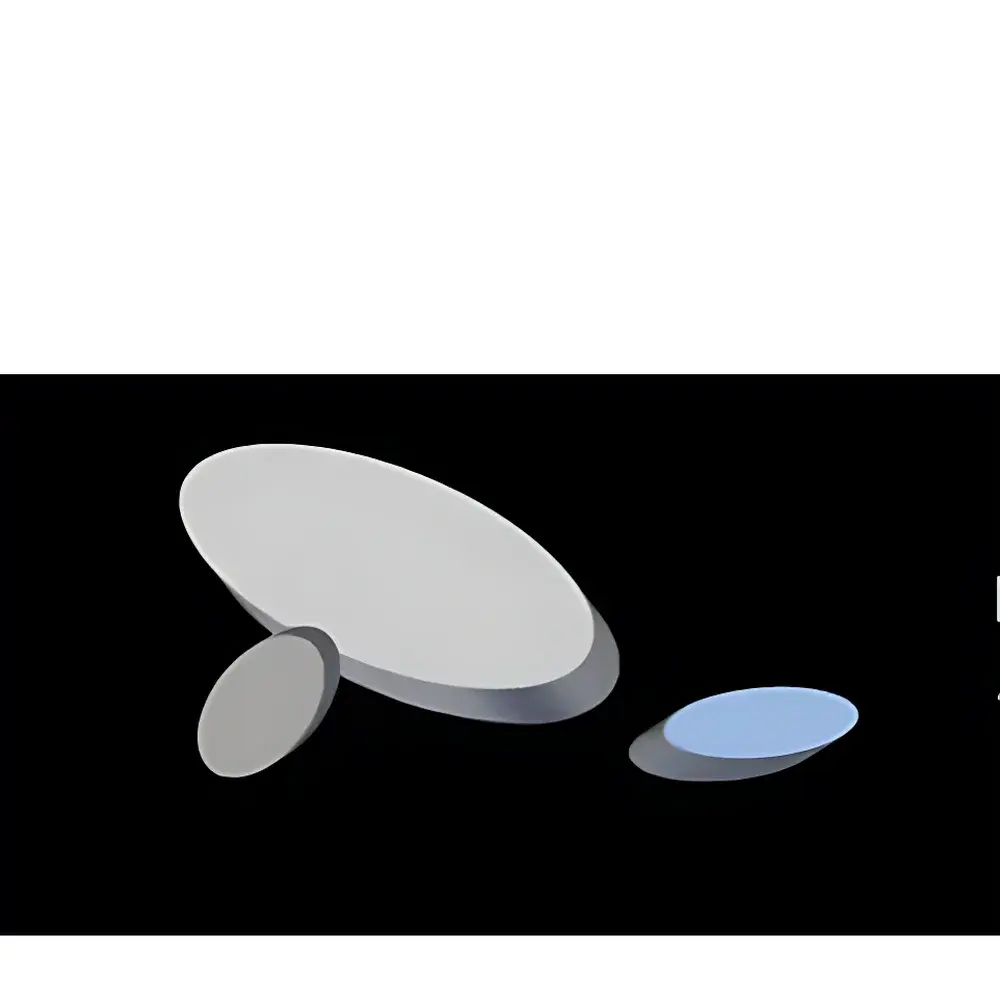
MiXran Meg1081 Elliptical Mirror
| Brand | MiXran |
|---|---|
| Model | Meg1081 |
| Optical Component Type | Elliptical Reflecting Mirror |
| Substrate Material | Fused Silica or BK7 (Standard) |
| Coating Options | Protected Aluminum (Al+), Protected Silver (Ag+), Protected Gold (Au+) |
| Surface Accuracy | λ/4 @ 633 nm (typ.) |
| Clear Aperture | ≥90% of minor axis |
| Damage Threshold | >500 MW/cm² (10 ns, 1064 nm, pulsed) |
| Mounting Compatibility | Standard kinematic mirror mounts (e.g., Thorlabs KM100, Newport UMB1) |
Overview
The MiXran Meg1081 Elliptical Mirror is a precision optical component engineered for high-fidelity beam shaping, focusing, and relay imaging in demanding laser and spectroscopic systems. Unlike spherical or parabolic mirrors, elliptical mirrors exploit the geometric property that light originating from one focal point is reflected with high spatial coherence to the second focal point—enabling diffraction-limited spot formation, efficient coupling into single-mode fibers, and aberration-controlled optical path folding. Designed for integration into ultrafast laser cavities, Raman spectrometers, ellipsometry setups, and vacuum-compatible beamlines, the Meg1081 adheres to ISO 10110-7 surface quality standards and supports wavelength operation from 250 nm (UV) to 12 µm (far-IR), depending on selected coating. Each unit undergoes interferometric verification (Zygo Verifire™) and is supplied with individual test reports documenting surface flatness, reflectance curves (300–12,000 nm), and coating adhesion per MIL-C-48497A.
Key Features
- Precision-ground and polished elliptical substrate with RMS surface roughness < 5 Å (measured by AFM)
- Three certified dielectric-enhanced metallic coatings: Protected Aluminum (Al+, 300–2000 nm), Protected Silver (Ag+, 450–20,000 nm), and Protected Gold (Au+, 700–12,000 nm), all meeting ISO 9211-3 environmental durability Class 2 specifications
- Standard substrate options include UV-grade fused silica (for deep-UV stability) and optical-grade BK7 (for cost-optimized visible/NIR applications)
- Customizable mounting interface: 1/4″-20 tapped holes (centered) or kinematic dowel pin alignment features per customer mechanical drawings
- Traceable metrology: Each mirror carries a unique serial number linked to its interferogram, spectral reflectance data, and coating thickness profile (ellipsometry verified)
Sample Compatibility & Compliance
The Meg1081 is compatible with standard optical breadboards (e.g., Thorlabs, Newport), vacuum chambers (UHV-rated variants available upon request), and cryogenic stages (tested at 77 K). All coatings are qualified per ASTM B571 for adhesion and MIL-STD-810G for thermal shock (−40 °C to +85 °C, 10 cycles). The component complies with RoHS 2015/863/EU and REACH SVHC Annex XIV restrictions. For regulated environments—including FDA-regulated analytical instrumentation and GLP-compliant spectroscopy labs—the mirror’s manufacturing documentation supports full traceability under ISO 9001:2015 and ISO/IEC 17025:2017 accredited calibration workflows.
Software & Data Management
While the Meg1081 is a passive optical element, MiXran provides downloadable optical design support files including Zemax® (.zmx) and Code V® (.seq) prescription models for all standard sizes (GM15-012 through GM15-080). These models incorporate measured surface error maps and coating dispersion data. Customers receive secure cloud access (via MiXran OptiVault™ portal) to spectral reflectance datasets (CSV/TXT), interferograms (ISO 14725-compliant .tif), and coating stress reports—all timestamped, digitally signed, and compliant with 21 CFR Part 11 audit trail requirements for life science instrumentation validation.
Applications
- Laser cavity design: Mode-matching and intracavity beam relay in Ti:sapphire, Yb:fiber, and OPO systems
- Raman and fluorescence microscopy: Efficient collection optics for confocal and multiphoton platforms
- Ellipsometric measurement heads: High-NA focusing and polarization-preserving reflection paths
- Vacuum UV beamlines: Fused silica substrates with Al+ coatings enable operation down to 121.6 nm (Lyman-α)
- Industrial machine vision: Compact illumination relays in semiconductor wafer inspection tools
FAQ
What is the typical wavefront error after reflection?
Measured transmitted wavefront error (TWE) of the substrate is ≤λ/8 PV @ 633 nm; total system wavefront error (including coating-induced distortion) is ≤λ/4 PV for all standard configurations.
Can I specify custom focal lengths or eccentricity?
Yes—MiXran offers fully custom elliptical geometry design (a, b, f₁, f₂) with tolerances down to ±10 µm on focal spacing and ±0.05° on orientation angle.
Is vacuum baking supported?
Standard Al+ and Ag+ coatings withstand 120 °C bakeout; Au+ and UHV-optimized variants (with Cr adhesion layer removed) support 200 °C bakeout and outgassing rates <1×10⁻⁹ Pa·m³/s·cm² per ASTM E595.
Do you provide mounting hardware or kinematic cells?
Standard units ship bare; optional accessories include stainless-steel kinematic mirror mounts (KM100-compatible), low-expansion Invar adapters, and magnetic base carriers for rapid prototyping.
How is coating uniformity validated across the elliptical aperture?
Spectrophotometric mapping is performed at 9-point grid (per ISO 9211-4), with reflectance variation ≤±1.2% across clear aperture for all coating types.




