
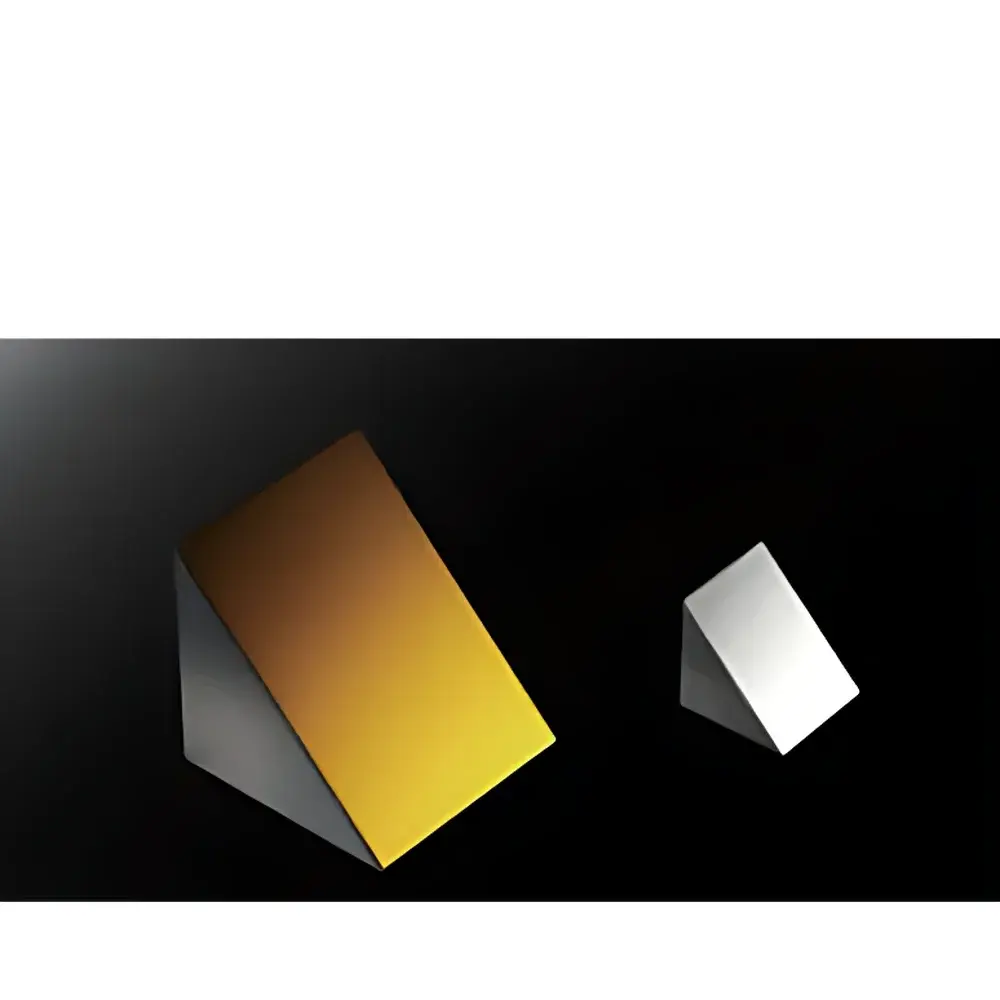
MiXran Meg1082 Right-Angle Reflecting Mirror
| Brand | MiXran |
|---|---|
| Model | Meg1082 |
| Type | Right-Angle Optical Mirror |
| Substrate Material | Precision-Annealed Fused Silica or BK7 (standard) |
| Coating Options | Protected Aluminum (UV-VIS-NIR), Enhanced UV-Aluminum, Protected Silver, Protected Gold, Dielectric High-Reflectivity (D02: 400–800 nm |
| D03 | 750–1250 nm) |
| Dimensional Tolerance | ±0.1 mm |
| Surface Flatness | λ/10 @ 633 nm (typical) |
| Surface Quality | 20–10 scratch-dig |
| Clear Aperture | ≥90% of nominal dimension |
| Bevel | 0.2–0.5 mm × 45° (standard) |
| Mounting | Unmounted, with optional kinematic or cage-compatible mounting adapters |
Overview
The MiXran Meg1082 Right-Angle Reflecting Mirror is a precision optical component engineered for stable beam folding and spatial reorientation in demanding laboratory, industrial, and OEM optical systems. Designed to meet ISO 10110 and MIL-PRF-13830B standards for surface quality and coating performance, the Meg1082 utilizes a monolithic 90° prism geometry—typically fabricated from high-homogeneity BK7 or fused silica—to ensure intrinsic alignment stability without reliance on adhesive bonding or mechanical adjustment. Its internal reflection path leverages total internal reflection (TIR) at the hypotenuse face when used uncoated, while the standard configuration features dielectric or metal-dielectric hybrid coatings optimized for minimal wavefront distortion (<λ/20 PV over clear aperture) and high polarization fidelity. Unlike flat mirror assemblies requiring precise angular alignment, the Meg1082 delivers inherent orthogonality between input and output beams—critical for interferometric setups, laser cavity folding, multi-axis alignment jigs, and compact spectrometer architectures.
Key Features
- Monolithic right-angle prism design eliminates alignment drift and thermal hysteresis associated with mounted flat mirrors
- Multiple coating options calibrated for spectral application requirements: protected aluminum (broadband 250–2000 nm), enhanced UV-aluminum (optimized 99.5% @ 400–800 nm; D03: R >99.5% @ 750–1250 nm)
- Tight dimensional tolerances (±0.1 mm) and surface flatness (λ/10 @ 633 nm) support diffraction-limited performance in collimated beam paths
- Surface quality rated 20–10 scratch-dig per MIL-PRF-13830B, ensuring compatibility with Class 100 cleanroom handling and high-power laser applications (tested up to 500 W/cm² CW at 1064 nm with D02/D03 coatings)
- Standard bevel (0.2–0.5 mm × 45°) mitigates edge chipping during cleaning and mounting; optional black anodized aluminum housing available for stray light suppression
- Available in seven standard cube sizes (5×5×5 mm to 50×50×50 mm), all with identical angular accuracy (deviation ≤ ±3 arcseconds from nominal 90°)
Sample Compatibility & Compliance
The Meg1082 is compatible with continuous-wave and pulsed laser sources across UV, VIS, and NIR bands—including excimer (193 nm, 248 nm), DPSS (355 nm, 532 nm, 1064 nm), and fiber lasers (780–1550 nm)—when paired with appropriate coatings. All metallic coatings include a SiO₂ overcoat for environmental durability (humidity resistance per ISO 9211-3, salt fog per ASTM B117). Dielectric coatings are deposited via ion-assisted e-beam evaporation, achieving adhesion class 5A per ISO 2409 and spectral stability verified over 1,000 thermal cycles (−40°C to +80°C). The component conforms to RoHS 2015/863/EU and REACH SVHC regulations. Documentation includes full coating spectral reflectance curves, surface metrology reports (Zygo interferometer data), and traceable calibration certificates (NIST-traceable reference standards).
Software & Data Management
While the Meg1082 is a passive optical element, MiXran provides downloadable technical documentation packages including: (1) coating spectral reflectance datasets (.csv and .txt formats) referenced to NIST SRM 2035; (2) Zemax OpticStudio-compatible .ZBF files for ray tracing integration; (3) STEP and IGES 3D models with GD&T annotations aligned to ASME Y14.5–2018; and (4) GLP-compliant test reports with audit trails for QA/QC environments. All digital assets are accessible via secure customer portal with role-based access control and version history—supporting FDA 21 CFR Part 11 compliance for regulated laboratories.
Applications
- Laser beam steering and cavity folding in Ti:sapphire, Nd:YAG, and ultrafast oscillator-amplifier systems
- Reference arms in Michelson, Mach-Zehnder, and Sagnac interferometers requiring long-term angular stability
- Optical breadboard integration for teaching labs and undergraduate optics curricula (e.g., Malus’ law verification, polarization analysis)
- OEM integration into portable Raman spectrometers, OCT probes, and LIDAR receiver modules where space-constrained orthogonal routing is required
- Alignment fiducials in photolithography steppers and EUV metrology tools
- Vacuum-compatible configurations (fused silica substrate, no organic adhesives) for synchrotron beamline instrumentation
FAQ
What is the maximum incident angle tolerance for maintaining orthogonal output?
The Meg1082 maintains beam deviation < ±5 arcseconds over ±1.5° input angle variation around normal incidence—verified by autocollimation testing per ISO 10110-7.
Can the Meg1082 be used in high-vacuum environments?
Yes—fused silica variants with dielectric coatings are qualified for UHV (10⁻⁹ mbar) operation; outgassing rates measured per ASTM E595 show TML <0.05% and CVCM <0.01%.
Is custom coating design supported?
Yes—MiXran offers bespoke dielectric stack design (e.g., polarization-preserving, ultra-low GDD, or dual-band HR) with prototype lead time of 4–6 weeks and full spectral validation.
How is angular accuracy verified during manufacturing?
Each unit undergoes interferometric angle measurement using a Leica LMS-2000 autocollimator traceable to PTB standards; raw data and uncertainty budgets are included in the certificate of conformance.
Are mounting solutions available?
Standard kinematic mounts (KCB1, KCB2) and SM1-threaded cage plates are stocked; custom machined aluminum housings with thermal expansion-matched interfaces can be supplied under NRE agreement.



