
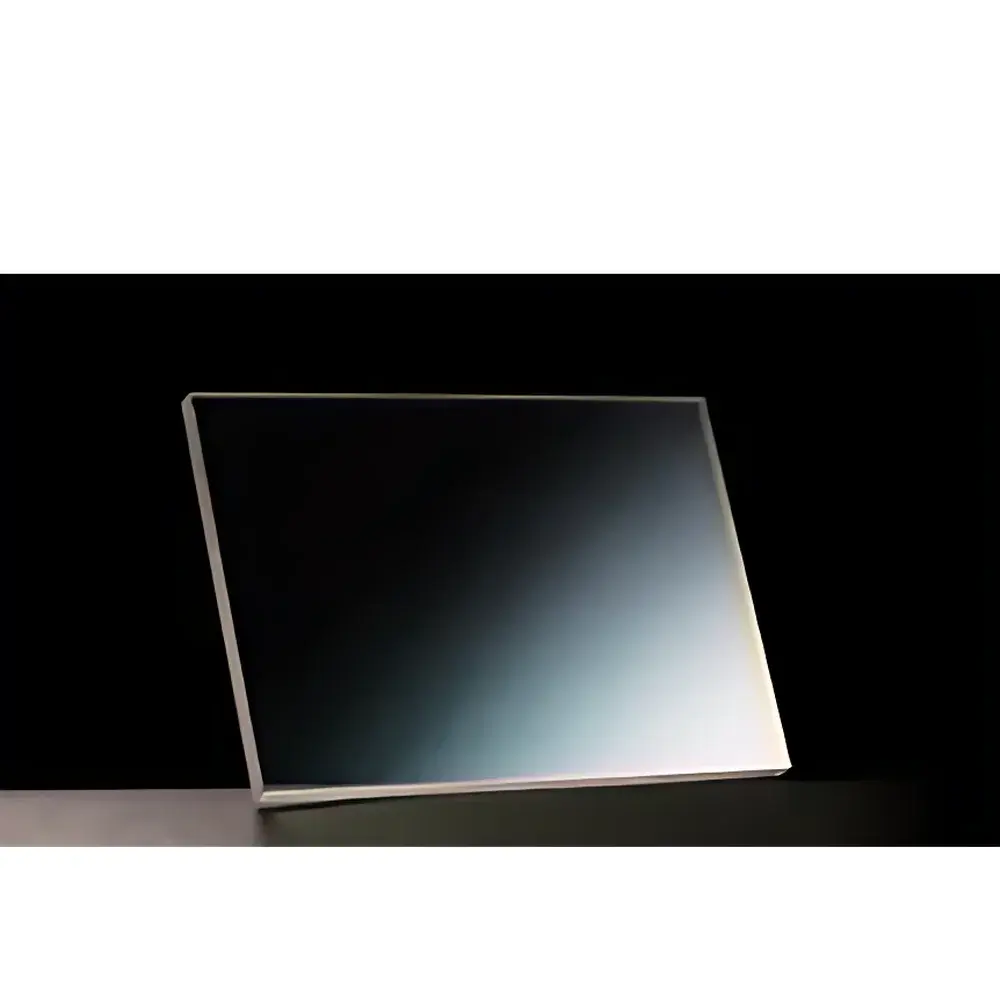
MiXran Meg1092 Aluminum-Coated Dot-Matrix Beamsplitter Plate
| Brand | MiXran |
|---|---|
| Model | Meg1092 |
| Type | Optical Beamsplitter Component |
| Coating | Vacuum-Deposited Aluminum Dot-Matrix Pattern |
| Substrate Material | Optical Glass (BK7 or equivalent) |
| Thickness | 1.5 mm ± 0.05 mm |
| Surface Flatness | λ/4 @ 633 nm |
| Surface Quality | 20–10 scratch-dig |
| Clear Aperture | ≥90% of nominal dimension |
| Operating Wavelength Range | 400–1100 nm (optimized for visible to NIR) |
| Reflectance/Transmittance Ratios | 30R/70T, 50R/50T, 70R/30T (±3% typical tolerance) |
| Dimension Options | Φ12.5 mm, 12.5×12.5 mm, 12.5×17.5 mm, Φ25 mm, 25×25 mm, 25×36 mm, Φ50 mm, 50×50 mm, 50×72 mm |
| Environmental Compliance | RoHS-compliant coating process |
| Packaging | Individually boxed with anti-static foam and desiccant |
Overview
The MiXran Meg1092 Aluminum-Coated Dot-Matrix Beamsplitter Plate is a precision optical component engineered for stable, polarization-insensitive beam division in free-space optical systems. Unlike continuous thin-film beamsplitters, the Meg1092 employs a high-contrast, vacuum-deposited aluminum dot-matrix pattern on optically polished glass substrate—achieving controlled reflectance/transmittance ratios through geometric modulation rather than interference effects. This design eliminates wavelength-dependent phase shifts and angular sensitivity common in dielectric coatings, making it especially suitable for broadband applications across the visible and near-infrared spectrum (400–1100 nm). The 1.5 mm substrate thickness ensures mechanical rigidity for mounting in kinematic or lens-tube-based optical breadboards, while maintaining minimal wavefront distortion (<λ/4 @ 633 nm). Its non-polarizing behavior and low group delay dispersion support time-critical interferometric setups, multi-channel imaging systems, and laser power monitoring configurations where consistent intensity partitioning is required independent of input polarization state.
Key Features
- Vacuum-deposited aluminum dot-matrix structure enabling precise, spectrally flat R/T ratios (30R/70T, 50R/50T, 70R/30T) without interference fringes
- Optimized for broadband operation from 400 nm to 1100 nm with <±3% deviation in specified splitting ratio across full range
- High surface quality (20–10 scratch-dig) and λ/4 surface flatness ensuring minimal wavefront error in collimated beam paths
- Nine standard aperture formats—from Φ12.5 mm to 50×72 mm—supporting integration into compact OEM modules and large-format optical benches
- RoHS-compliant aluminum deposition process with no heavy-metal adhesives or organic binders, meeting ISO 10110-7 cleanliness standards for cleanroom-compatible handling
- Thermally stable performance: coefficient of thermal expansion matched to BK7 substrate minimizes stress-induced birefringence under ambient fluctuations (20–30 °C)
Sample Compatibility & Compliance
The Meg1092 is compatible with standard optomechanical mounts including SM1 (1.035″-40), RMS (0.8-36), and custom flange interfaces. Its aluminum dot-matrix architecture avoids the angle-of-incidence sensitivity inherent in pellicle or plate-type dielectric beamsplitters—delivering consistent R/T performance from 0° to ±15° incidence. All units undergo 100% inspection per ISO 10110-3 (surface imperfections) and ISO 10110-5 (transmitted wavefront error), with test reports available upon request. The component complies with ISO 9001:2015 manufacturing protocols and meets the material restrictions outlined in EU Directive 2011/65/EU (RoHS 2). It is routinely deployed in Class 1000 cleanrooms and qualifies for inclusion in FDA-regulated optical subassemblies under 21 CFR Part 820 when integrated into final medical device designs.
Software & Data Management
While the Meg1092 is a passive optical element requiring no firmware or driver software, its performance parameters are fully documented in machine-readable format (CSV and JSON) for integration into optical design workflows. Each product variant includes a traceable calibration certificate listing measured R/T values at 488 nm, 633 nm, and 780 nm, along with surface flatness and transmitted wavefront data. These files conform to the Photonics Metadata Standard (PMS-1.2) and can be imported directly into Zemax OpticStudio, CODE V, and FRED simulation environments. For traceability in GLP/GMP environments, batch-level metrology logs—including interferometric surface maps and spectrophotometric scans—are archived for 10 years and accessible via secure customer portal using unique product ID (e.g., GPBS12-25×36-50-PD).
Applications
- Laser power sampling and feedback control in industrial CO₂, diode, and DPSS laser systems
- Broadband beam routing in hyperspectral imaging spectrometers and Fourier-transform instruments
- Reference channel generation in dual-path interferometers (Michelson, Mach–Zehnder) where polarization independence is critical
- Multi-sensor illumination distribution in fluorescence microscopy and confocal scanning platforms
- OEM integration into portable spectroscopic analyzers and environmental monitoring sensors operating under variable thermal conditions
- Alignment verification tools in optical assembly lines, leveraging consistent 50R/50T response for real-time intensity balancing
FAQ
Is the Meg1092 suitable for use with ultraviolet (UV) or mid-infrared (MIR) wavelengths?
No—the aluminum dot-matrix coating is optimized for 400–1100 nm; below 400 nm, native aluminum oxidation reduces reflectance, and above 1100 nm, absorption increases significantly. For UV applications, fused silica substrates with MgF₂-protected aluminum are recommended; for MIR, gold-coated variants are available under custom order.
Can the Meg1092 withstand high-power laser irradiation?
It is rated for continuous-wave (CW) laser power densities up to 500 W/cm² at 1064 nm with proper heat sinking. Pulsed lasers (ns–ps regime) require derating based on pulse energy density; consult application engineering for LIDT validation reports.
Are custom R/T ratios or substrate materials available?
Yes—custom dot pitch, fill factor, and substrate materials (e.g., fused silica, CaF₂, or sapphire) can be manufactured under NRE agreement. Minimum order quantity applies.
What mounting recommendations ensure optimal wavefront preservation?
Use low-stress kinematic mounts with compliant gaskets (e.g., Viton O-rings); avoid clamping directly on the coated surface. For high-precision applications, specify optional kinematic mounting holes (M2.5 or #0-80) during ordering.
Does MiXran provide ISO/IEC 17025-accredited calibration for individual units?
Accredited calibration is available as an add-on service through our partner metrology lab (CNAS-certified, scope ID: CNAS LXXXXX); lead time extends by 5 business days.



