
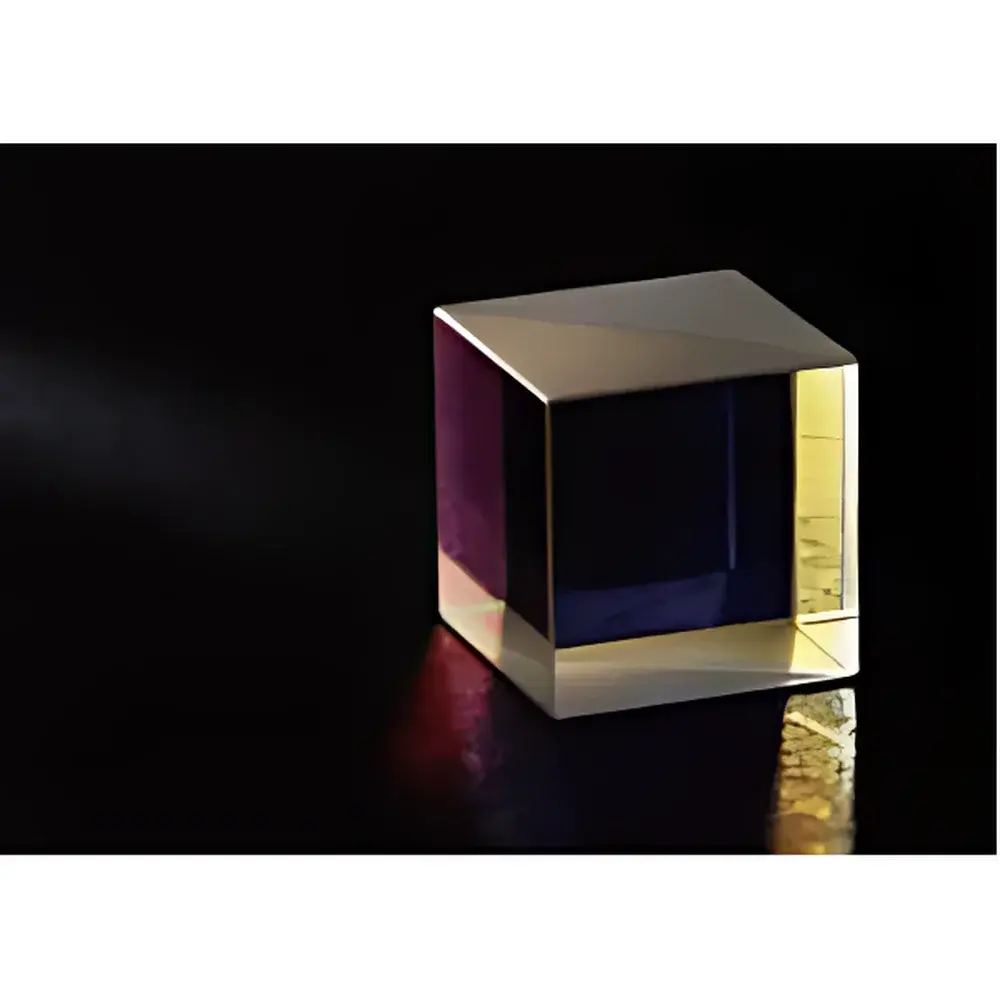
MiXran Meg1101 Non-Polarizing Cube Beam Splitter
| Brand | MiXran |
|---|---|
| Model | Meg1101 |
| Component Type | Optical Element |
| Cube Dimensions | 5–50.8 mm (standard sizes) |
| Splitting Ratio Options | 10R/90T, 30R/70T, 50R/50T, 70R/30T, 90R/10T |
| Spectral Ranges | VIS (400–700 nm), NIR (700–1100 nm), SWIR (1100–1600 nm) |
| Substrate Material | BK7 or Fused Silica (application-dependent) |
| Coating | Dielectric multilayer, broadband anti-reflection (AR) on exit faces |
| Surface Quality | 20–10 scratch-dig |
| Wavefront Distortion | λ/8 @ 633 nm |
| Extinction Ratio | >1000:1 (non-polarization-sensitive design) |
Overview
The MiXran Meg1101 is a precision-engineered non-polarizing cube beam splitter designed for stable optical power division in demanding laboratory, industrial, and research-grade photonic systems. Unlike polarizing beam splitters, the Meg1101 maintains consistent reflection/transmission (R/T) ratios across both orthogonal polarization states (s- and p-polarized light), eliminating polarization-dependent intensity fluctuations. Its monolithic cube architecture—comprising two right-angle prisms optically contacted with a dielectric thin-film coating at the hypotenuse interface—ensures high mechanical stability, minimal beam deviation (<3 arcsec), and long-term alignment integrity. The device operates via amplitude splitting rather than polarization separation, making it ideal for interferometry, laser cavity coupling, optical sensing, and multi-channel detection where polarization fidelity must be preserved upstream of the split.
Key Features
- Non-polarizing performance: Uniform R/T ratio for s- and p-polarized components across specified spectral bands (VIS, NIR, SWIR)
- Multiple standard cube sizes: 5 mm, 10 mm, 12.5 mm, 15 mm, 20 mm, 25.4 mm, 50.0 mm, and 50.8 mm edge lengths
- Configurable splitting ratios: 10R/90T, 30R/70T, 50R/50T, 70R/30T, and 90R/10T — optimized per wavelength range
- Dual-side broadband AR coating: <0.25% residual reflectance per surface in designated band (e.g., R<0.25% @ 400–700 nm for VIS variants)
- High wavefront fidelity: λ/8 transmitted wavefront error (measured at 633 nm), ensuring minimal phase distortion in coherent applications
- Robust environmental stability: Thermally matched BK7 or fused silica substrates; coating adhesion qualified to MIL-C-48497A
- No ghost images or internal reflections: Optimized cement layer index matching and wedge-free assembly
Sample Compatibility & Compliance
The Meg1101 is compatible with continuous-wave (CW) and pulsed laser sources up to 5 J/cm² (10 ns, 1064 nm) for coated NIR/SWIR versions, and 2 J/cm² for VIS-grade configurations. It meets ISO 10110-7 surface quality standards (20–10 scratch-dig) and complies with RoHS 2011/65/EU for hazardous substance restrictions. While not a regulated medical or safety-critical device, its optical specifications align with common requirements for ISO/IEC 17025-accredited calibration labs performing photometric or radiometric system validation. No FDA or CE marking is applicable, as it is classified as a passive optical component under EU Directive 2014/30/EU (EMC) and 2014/35/EU (LVD) exemptions.
Software & Data Management
As a passive optical element, the Meg1101 requires no firmware, drivers, or software integration. However, its performance parameters—including spectral transmittance/reflectance curves, angular sensitivity data (±2° incidence tolerance), and damage threshold reports—are provided in NIST-traceable calibration documentation upon request. These datasets are supplied in standardized ASCII (.csv) and PDF formats, compatible with optical design platforms such as Zemax OpticStudio, CODE V, and FRED. For traceability in GLP/GMP environments, batch-specific test reports include serial-numbered metrology records from interferometric surface verification and spectrophotometric characterization (PerkinElmer Lambda 1050+).
Applications
- Laser beam sampling for real-time power monitoring without polarization bias
- Reference arm conditioning in Michelson and Mach–Zehnder interferometers
- Multi-spectral imaging systems requiring simultaneous VIS/NIR channel routing
- Fiber-optic sensor interrogation units where polarization-maintaining paths are impractical
- Optical coherence tomography (OCT) sample arms requiring balanced signal distribution
- Automated alignment stations in semiconductor lithography tooling
- Education kits for fundamental optics laboratories emphasizing amplitude vs. polarization splitting principles
FAQ
What does “non-polarizing” mean in this context?
It indicates that the beam splitter’s R/T ratio remains invariant for both s- and p-polarized incident light within ±1% across its rated spectral band — unlike polarizing cubes whose behavior varies strongly with polarization state.
Can the Meg1101 be used with ultrafast lasers?
Yes, when specified with fused silica substrates and chirped dielectric coatings; group delay dispersion (GDD) data is available upon request for pulses <100 fs.
Is custom coating or size available?
Yes — MiXran offers OEM customization including non-standard dimensions, alternate substrate materials (CaF₂, UV-grade fused silica), and tailored R/T curves (e.g., 45R/55T) with lead times of 6–8 weeks.
How is angular alignment sensitivity characterized?
The Meg1101 exhibits <±0.5% R/T variation over ±2° of angular deviation from normal incidence in the VIS band; full angular response curves are included in technical datasheets.
Does it require cleaning before installation?
Each unit undergoes Class 100 cleanroom handling and is shipped sealed in nitrogen-purged containers; minimal cleaning with spectroscopic-grade acetone and lint-free wipes is recommended only if contamination is visually confirmed.





