
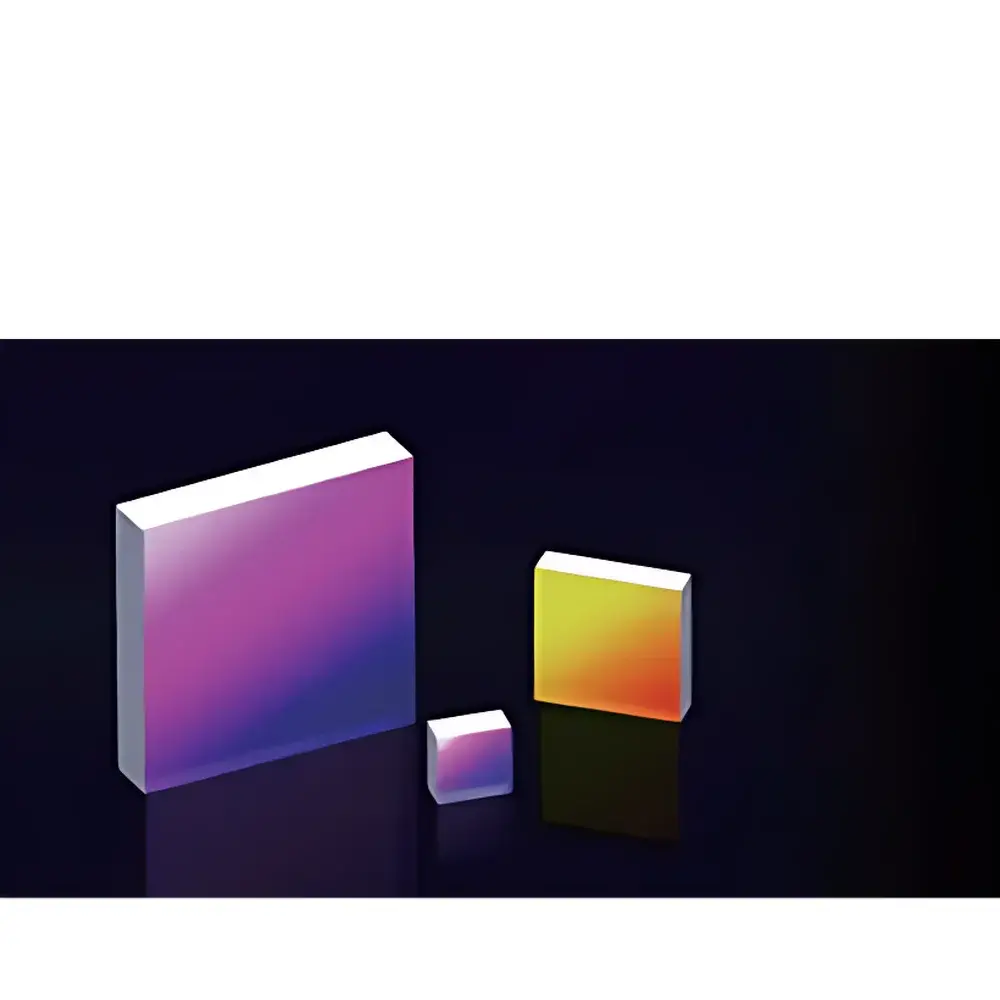
MiXran Meg1103 Planar Holographic Diffraction Grating
| Brand | MiXran |
|---|---|
| Model | Meg1103 |
| Type | Planar Holographic Diffraction Grating |
| Wavelength Range | UV (180–400 nm) and VIS (400–780 nm) |
| Groove Density Options | 600, 1200, 1800, 2400, 3600 l/mm |
| Blaze Wavelength (UV) | 250 nm |
| Blaze Wavelength (VIS) | 500 nm |
| Typical Peak Efficiency (UV @ 250 nm) | 0.25–0.67 (depending on groove density) |
| Typical Peak Efficiency (VIS @ 500 nm) | 0.33–0.79 |
| Angular Dispersion (UV) | 1.67–0.25 nm/mrad (at 250 nm) |
| Angular Dispersion (VIS) | 0.79–0.33 nm/mrad (at 500 nm) |
| Substrate Dimensions | 12.7×12.7×6 mm, 25×25×6 mm, 50×50×9.5 mm |
| Substrate Material | Fused Silica (UV-grade) |
| Coating | Protected Aluminum (Al + MgF₂ overcoat) |
| Surface Flatness | λ/10 @ 633 nm |
| RMS Surface Roughness | < 5 Å |
| Damage Threshold | > 500 mJ/cm² (pulsed, 20 ns, 25 Hz, 266 nm) |
Overview
The MiXran Meg1103 is a high-performance planar holographic diffraction grating engineered for precision spectral dispersion in ultraviolet (UV) and visible (VIS) optical systems. Unlike ruled gratings, the Meg1103 is fabricated using interference lithography to produce sinusoidal groove profiles with minimal ghosting, stray light, and periodic errors—critical attributes for demanding applications such as monochromators, spectrographs, tunable lasers, and UV-VIS spectrophotometers. Its holographically recorded structure ensures exceptional wavefront fidelity and high diffraction efficiency across designated wavelength bands, particularly at its optimized blaze wavelengths (250 nm for UV variants and 500 nm for VIS variants). The grating operates on the principle of constructive interference of light scattered from periodic microstructures, enabling accurate angular separation of spectral components in accordance with the grating equation: mλ = d(sin α + sin β), where m is the diffraction order, λ the wavelength, d the groove spacing, and α, β the incident and diffracted angles.
Key Features
- Holographic fabrication eliminates ruling artifacts (e.g., ghosts, echellettes), delivering superior spectral purity and signal-to-noise ratio
- UV-grade fused silica substrate with λ/10 surface flatness and sub-5 Å RMS roughness for minimal wavefront distortion
- Protected aluminum coating (Al + MgF₂) optimized for broadband reflectivity from 180 nm to 780 nm
- Five standard groove densities (600–3600 l/mm) to support diverse resolution and dispersion requirements
- Three standardized physical formats: 12.7×12.7×6 mm, 25×25×6 mm, and 50×50×9.5 mm—compatible with industry-standard kinematic mounts and spectrograph slit assemblies
- Consistent efficiency calibration data provided per lot, traceable to NIST-traceable reference standards
- Laser damage threshold exceeding 500 mJ/cm² (266 nm, 20 ns pulses) enables integration into pulsed UV laser systems
Sample Compatibility & Compliance
The Meg1103 is designed for use in vacuum- and air-compatible optical trains. Its fused silica substrate exhibits negligible outgassing under UHV conditions (<1×10⁻⁹ Torr), making it suitable for synchrotron beamlines and space-qualified instrumentation. All units comply with ISO 10110-7 (surface imperfections) and ISO 14999-3 (interferometric testing of optical elements). While not certified to a specific regulatory framework (e.g., FDA or CE), the grating meets general requirements for laboratory-grade optical components under ISO/IEC 17025-accredited manufacturing practices. Documentation includes individual test reports listing measured efficiency curves (±2% uncertainty), surface flatness maps, and coating reflectance spectra.
Software & Data Management
No embedded firmware or proprietary software is associated with the Meg1103, as it functions as a passive optical component. However, performance modeling and system integration are supported via standard optical design platforms including Zemax OpticStudio, CODE V, and FRED. Each delivered unit is supplied with a digital calibration dossier containing CSV-formatted diffraction efficiency vs. wavelength (200–800 nm, 1 nm step), angular dispersion curves, and polarization-dependent loss (PDL) data. These datasets are compatible with Python (NumPy/SciPy), MATLAB, and LabVIEW for custom spectral simulation and instrument alignment workflows. For GLP/GMP environments, batch-level traceability—including substrate lot number, holographic exposure parameters, and interferometric verification logs—is retained for 10 years.
Applications
- High-resolution UV monochromators for photoelectron spectroscopy (PES) and vacuum UV absorption studies
- Compact VIS spectrometers in portable environmental monitoring systems (e.g., NO₂, O₃ detection)
- External cavity diode lasers (ECDLs) requiring low-stray-light feedback gratings
- Beam combiners/splitters in multi-wavelength fluorescence lifetime imaging (FLIM) setups
- Educational optics labs demonstrating Bragg diffraction, Rayleigh criteria, and spectral resolution limits
- Custom Fourier-transform spectrometer (FTS) input optics where phase stability and minimal polarization sensitivity are critical
FAQ
Is the Meg1103 suitable for use below 180 nm (e.g., VUV at 121 nm)?
No. The MgF₂ overcoat and fused silica substrate exhibit strong absorption below 180 nm; dedicated CaF₂ or LiF substrates would be required for vacuum UV operation.
Can the grating be cleaned with standard optical solvents?
Yes—use spectroscopic-grade acetone or isopropanol applied with lint-free lens tissue; avoid ultrasonic cleaning or abrasives due to the delicate holographic relief structure.
What is the typical polarization sensitivity of the Meg1103?
For p- and s-polarized incidence at the blaze angle, efficiency variation is ≤3% across all groove densities and sizes—verified per ISO 15362 Annex B.
Are custom groove densities or substrate dimensions available?
Yes. MiXran offers OEM customization including non-standard sizes (e.g., 75×25 mm rectangular blanks), alternative coatings (e.g., enhanced Al, Au, or dielectric HR), and bespoke blaze optimization (±10 nm tolerance). Lead time: 8–12 weeks.
Does the quoted price include mounting hardware or kinematic adapters?
No. Pricing reflects the bare grating only. Compatible kinematic mounts (e.g., Thorlabs KM100, Newport UMB1) and UV-reflective adhesives (e.g., Norland NOA61) are available separately.





