
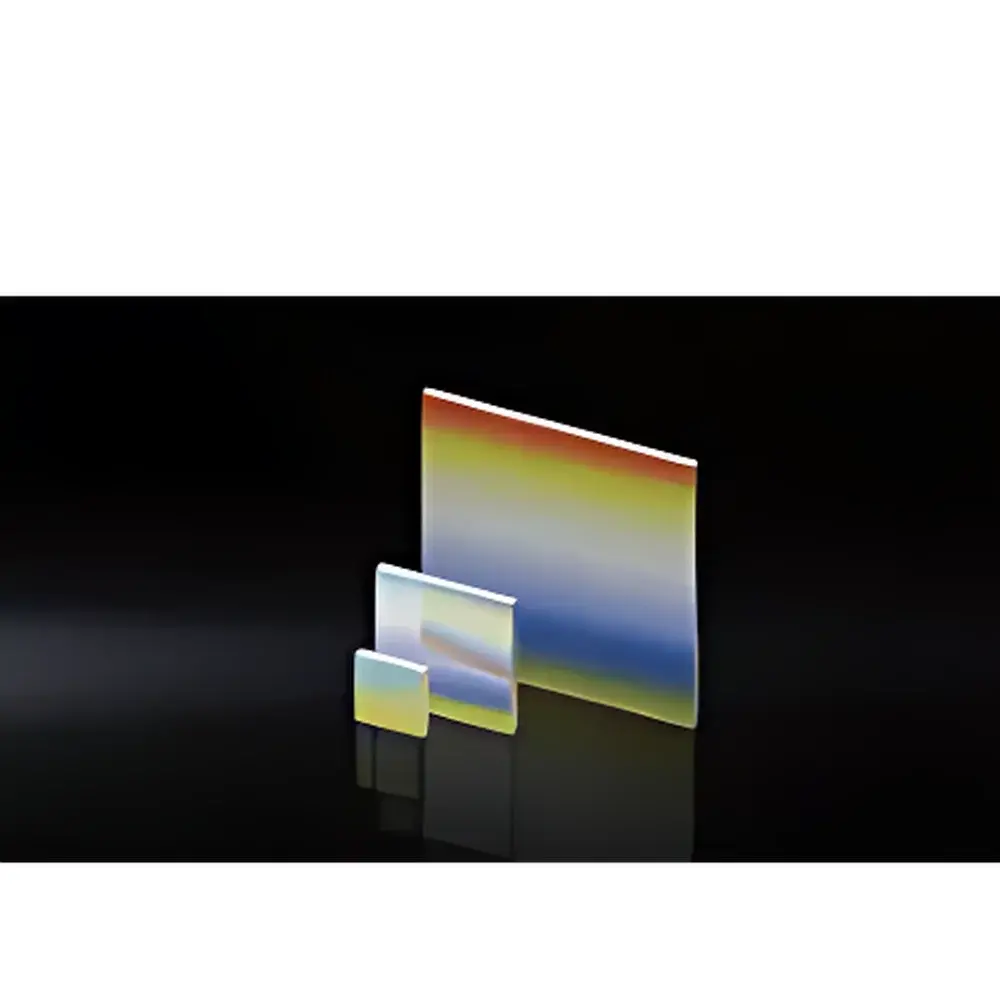
MiXran Meg1104 Transmission Grating
| Brand | MiXran |
|---|---|
| Model | Meg1104 |
| Optical Component Type | Transmission Diffraction Grating |
| Substrate Material | UV Fused Silica (for UV variants) / B270 Optical Crown Glass (for VIS & NIR variants) |
| Groove Density Options | 300, 600, 830, 1200 lines/mm |
| Available Apertures | 12.7 × 12.7 × 2 mm (UV), 12.7 × 12.7 × 3 mm (VIS/NIR), 25 × 25 × 2–3 mm, 50 × 50 × 2–3 mm |
| Blaze Angles | 8.63° (300 l/mm, UV), 22.02° (600 l/mm, UV), 19.39° (830 l/mm, UV), 36.87° (1200 l/mm, UV) |
| Wavelength Ranges | UV (180–400 nm), Visible (400–780 nm), NIR (780–1100 nm) |
| Compliance | ISO 10110-7 (optical component surface quality), RoHS-compliant substrate processing |
Overview
The MiXran Meg1104 is a precision-engineered transmission diffraction grating designed for high-efficiency spectral dispersion in ultraviolet (UV), visible (VIS), and near-infrared (NIR) optical systems. Based on the principles of scalar diffraction theory and optimized blaze geometry, the Meg1104 leverages ruled or holographically replicated groove profiles to maximize first-order diffraction efficiency within designated wavelength bands. Unlike reflective gratings, its transmission architecture enables compact, alignment-tolerant spectrometer designs—particularly advantageous in OEM instrumentation, portable hyperspectral sensors, and fiber-coupled spectroscopic modules. Each Meg1104 grating is fabricated with stringent wavefront error control (< λ/4 @ 633 nm) and certified surface quality (scratch-dig per ISO 10110-7), ensuring minimal stray light and high signal-to-noise ratio in demanding monochromator and polychromator applications.
Key Features
- Multi-band spectral coverage: UV-optimized variants use synthetic fused silica substrates with high transmission down to 180 nm; VIS and NIR versions employ B270 optical crown glass for broadband homogeneity and low thermal expansion.
- Four standard groove densities: 300, 600, 830, and 1200 lines/mm—each paired with a calculated blaze angle to maximize theoretical first-order efficiency at target wavelengths (e.g., 36.87° for 1200 l/mm UV gratings).
- Three standardized thickness configurations: 2 mm for UV-grade fused silica (minimizing absorption and birefringence), 3 mm for VIS/NIR B270 substrates (enhancing mechanical stability during mounting and thermal cycling).
- Multiple aperture options: 12.7 × 12.7 mm (standard benchtop integration), 25 × 25 mm (modular spectrometer cores), and 50 × 50 mm (high-throughput imaging spectrographs).
- Laser-grade surface flatness: λ/4 PV wavefront tolerance across clear aperture, verified via interferometric testing prior to coating and packaging.
- Traceable metrology: Each unit carries a unique product ID (e.g., GGR03-2525-60VIS) linked to its measured efficiency curve, groove density verification report, and substrate certification data.
Sample Compatibility & Compliance
The Meg1104 grating is compatible with collimated beam diameters up to 80% of its clear aperture and supports input NA ≤ 0.25 without significant efficiency roll-off. It is routinely integrated into ISO/IEC 17025-accredited optical test benches and complies with key international standards for optical components: ISO 10110-7 (surface imperfections), ISO 9022-3 (environmental resistance to humidity and temperature cycling), and RoHS Directive 2011/65/EU (hazardous substance restrictions). For regulated analytical instrumentation (e.g., UV-Vis-NIR spectrophotometers used in pharmaceutical QC), the grating’s documented batch traceability and substrate certification support GLP/GMP documentation requirements—including audit-ready records of material origin (Beijing-manufactured, fully documented supply chain), cleaning protocol validation, and post-fabrication inspection logs.
Software & Data Management
While the Meg1104 is a passive optical component, its performance integration is supported through MiXran’s Grating Performance Toolkit—a downloadable resource containing CSV-formatted efficiency curves (measured at ±0.5 nm resolution), Zemax-compatible .DAT files for physical optics modeling, and MATLAB scripts for predicting angular dispersion (dθ/dλ) and resolving power (R = mN) under user-defined illumination conditions. All datasets are timestamped, digitally signed, and archived with SHA-256 checksums to ensure integrity for FDA 21 CFR Part 11–aligned validation workflows. Efficiency curves are generated using NIST-traceable calibrated CCD spectroradiometers operating under controlled Class 1000 cleanroom conditions.
Applications
- Compact UV spectrometers for ozone monitoring and semiconductor process control (185–280 nm range).
- Visible-band hyperspectral imagers in agricultural remote sensing and food safety inspection systems.
- NIR transmission gratings deployed in handheld medical oximeters and non-invasive glucose analyzers (780–1050 nm).
- Teaching laboratories for undergraduate optics courses—demonstrating Rayleigh criterion, angular dispersion, and grating equation validation (mλ = d sin θ).
- OEM integration into Fourier-transform and linear-variable filter (LVF)-hybrid spectrometers requiring stable, low-polarization-sensitivity dispersion elements.
- Custom monochromator upgrades where space constraints prohibit reflective grating mounts.
FAQ
What is the maximum incident beam diameter supported by the 50 × 50 mm Meg1104 grating?
The recommended maximum collimated beam diameter is 40 mm to maintain uniform efficiency and avoid vignetting at the aperture edges.
Are custom groove densities or blaze angles available?
Yes—MiXran offers engineering consultation for non-standard groove densities (e.g., 450, 950 l/mm) and substrate materials (CaF₂, MgF₂) under NRE-supported development contracts.
Do Meg1104 gratings require anti-reflection coatings?
UV variants include single-layer MgF₂ AR coating (R < 1.5% @ 254 nm); VIS/NIR versions feature dual-layer BBAR coatings optimized for 400–1000 nm (R < 0.8% average). Coating specifications are included in the delivery certificate.
How is thermal stability characterized for long-term deployment?
B270-based gratings exhibit dn/dT ≈ +2.5 × 10⁻⁶ /°C and CTE ≈ 7.1 × 10⁻⁶ /°C; fused silica variants show dn/dT ≈ −0.9 × 10⁻⁶ /°C and CTE ≈ 0.55 × 10⁻⁶ /°C—data validated per ISO 10110-10.
Can Meg1104 be used in vacuum environments?
UV-grade fused silica variants are vacuum-compatible (outgassing rate < 1.0 × 10⁻¹⁰ Pa·m³/s·cm² per ASTM E595), while B270 versions require pre-baking and are rated for moderate vacuum (≤10⁻³ mbar) only.



