
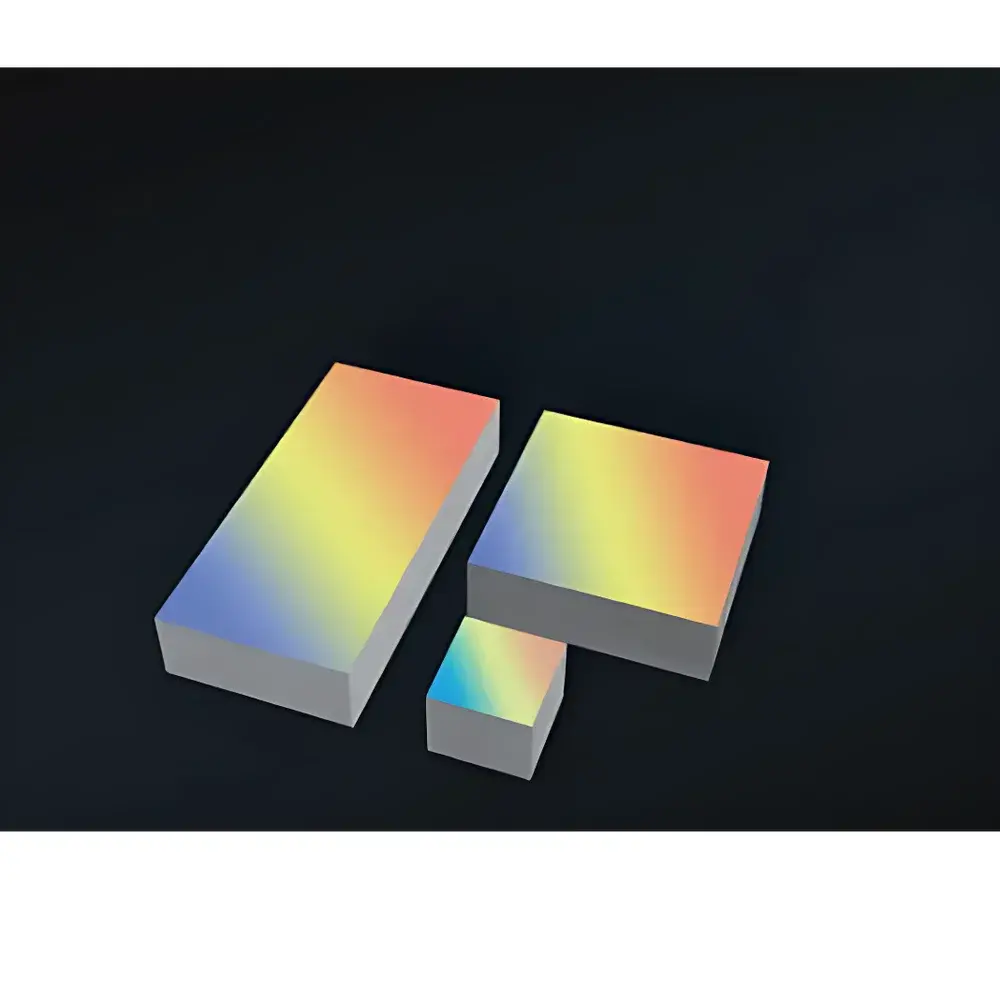
MiXran Meg1105 Echelle Grating
| Brand | MiXran |
|---|---|
| Model | Meg1105 |
| Grating Type | Echelle Grating |
| Substrate Dimensions | 12.7×12.7×6 mm, 25×25×9.5 mm, 25×50×9.5 mm |
| Groove Density | 31.6, 79, 79, 316 l/mm |
| Blaze Wavelength | UV–5.7 µm |
| Blaze Angle | 3°, 5°, 63°, 75° |
| Angular Dispersion | 14.37–1.44 nm/mrad |
| Product Codes | GGR04-1313-XXX to GGR04-2550-XXX |
| Origin | Beijing, China |
| Component Category | Optical Element |
Overview
The MiXran Meg1105 Echelle Grating is a high-efficiency, ruled or holographically fabricated diffraction grating engineered for high-resolution spectral dispersion in echelle spectrograph systems. Unlike conventional plane gratings, echelle gratings operate at high diffraction orders (typically m ≥ 30) with low groove density and steep blaze angles—enabling broad spectral coverage with exceptional resolving power (R = λ/Δλ > 50,000 in optimized configurations). The Meg1105 series utilizes precision diamond ruling or advanced replication techniques on low-thermal-expansion fused silica or BK7 substrates, ensuring long-term stability under vacuum, cryogenic, or ambient laboratory conditions. Its design supports cross-dispersion architectures where a second, orthogonal disperser separates overlapping orders—making it integral to astronomical spectrographs (e.g., ESPRESSO, HARPS-type instruments), laser-induced breakdown spectroscopy (LIBS), and high-fidelity Fourier-transform absorption diagnostics.
Key Features
- Multiple substrate formats: 12.7 × 12.7 × 6 mm, 25 × 25 × 9.5 mm, and 25 × 50 × 9.5 mm—compatible with standard kinematic mounts and vacuum-compatible optical benches.
- Four standardized groove densities: 31.6 l/mm, 79 l/mm (dual variants: 63° and 75° blaze), and 316 l/mm—each optimized for specific wavelength bands from deep UV (190 nm) to mid-infrared (5.7 µm).
- Precision blaze angles (3°, 5°, 63°, 75°) engineered to maximize efficiency in Littrow or off-Littrow configurations; peak diffraction efficiency exceeds 75% at design wavelength under TE-polarized illumination.
- Low wavefront distortion (< λ/8 RMS over clear aperture) and surface roughness < 5 Å RMS—critical for maintaining Strehl ratio in diffraction-limited spectroscopic systems.
- Optional broadband anti-reflection (BBAR) coatings on substrate rear faces to suppress ghost orders and stray light—available per ISO 10110-7 specifications.
- Traceable metrology: Each unit is supplied with individual test report including groove uniformity mapping (±0.2% groove spacing variation), absolute efficiency calibration (NIST-traceable reference), and surface flatness interferogram.
Sample Compatibility & Compliance
The Meg1105 grating is compatible with collimated beam diameters up to 20 mm and incident angles ranging from 30° to 85°, depending on blaze geometry. It meets ISO 10110-5 (surface quality: 60-40 scratch-dig), ISO 10110-7 (coating specifications), and MIL-PRF-13830B for environmental robustness. All units are qualified for operation under Class 100 cleanroom handling protocols and pass thermal cycling tests (−40 °C to +80 °C, 5 cycles) without delamination or coating degradation. While not inherently compliant with FDA 21 CFR Part 11, the grating may be integrated into systems certified for GLP/GMP environments when paired with validated alignment procedures and documented installation protocols.
Software & Data Management
No embedded firmware or proprietary software is associated with the Meg1105—consistent with passive optical component standards. However, its performance parameters are fully importable into industry-standard optical design platforms including Zemax OpticStudio (via .DAT or .GRATING files), CODE V, and FRED. Diffraction efficiency curves, phase maps, and order overlap tables are provided in ASCII format for integration into Python-based spectral simulation pipelines (e.g., using SciPy’s interpolation modules or custom ray-tracing kernels). Calibration reports include QR-coded metadata linking to secure cloud storage of raw interferometric and spectrophotometric datasets—supporting audit-ready traceability in regulated R&D settings.
Applications
- Astronomical high-resolution spectroscopy: echelle cross-dispersed spectrographs for radial velocity measurements and exoplanet atmospheric characterization.
- Laser plasma diagnostics: time-resolved emission spectroscopy in inertial confinement fusion experiments and pulsed laser ablation setups.
- Environmental monitoring: compact, field-deployable UV-Vis-NIR analyzers for NOx, SO2, and CH4 detection using multi-order spectral fitting algorithms.
- Industrial process control: inline LIBS systems for real-time elemental analysis in metallurgy and semiconductor wafer inspection.
- Academic research: teaching-grade echelle demonstration systems for undergraduate optics laboratories emphasizing angular dispersion theory and order separation mathematics.
FAQ
What is the difference between an echelle grating and a standard plane grating?
Echelle gratings use low groove density and high blaze angles to operate at very high diffraction orders, enabling superior spectral resolution and broad simultaneous coverage—whereas standard gratings rely on higher groove density and lower orders, trading resolution for simplicity and throughput.
Can the Meg1105 be used in vacuum or UHV environments?
Yes—fused silica variants are rated for ≤10−9 mbar vacuum compatibility; outgassing rates comply with ECSS-Q-ST-70-02C when mounted using indium or copper gaskets.
Is custom groove density or blaze angle available?
Yes—MiXran offers OEM echelle fabrication with customer-specified groove profiles (blaze shape, duty cycle) and substrate materials (CaF2, SiC, or IR-transmissive chalcogenide glasses) under NDA and minimum order quantities.
How is diffraction efficiency measured and reported?
Efficiency is measured at NIST-accredited facilities using calibrated photodiode arrays and monochromated sources; reports include ±0.8% uncertainty (k=2) across the specified blaze wavelength band.
Do you provide mounting hardware or kinematic cells?
Standard kinematic mounts (e.g., Thorlabs KM100-compatible adapters) and custom-designed zero-stress holders are available as optional accessories—quoted separately per mechanical interface requirements.




