
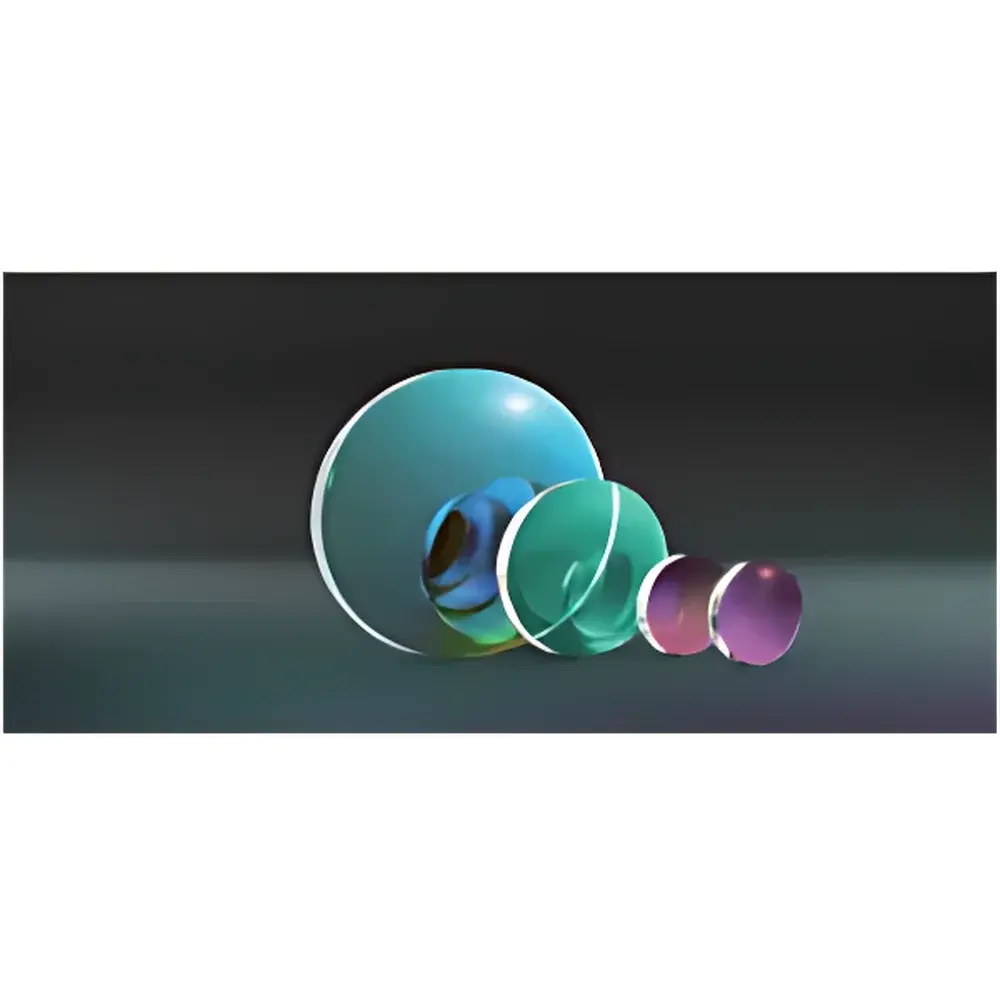
MiXran Meg1109 High-Performance Shortwave Pass Optical Filter
| Brand | MiXran |
|---|---|
| Origin | Beijing, China |
| Model | Meg1109 |
| Component Type | Optical Filter |
| Available Diameters | 12.5 mm, 25 mm, 50 mm |
| Center Wavelength Range | 400–1100 nm |
| Transmission Band | Typically 300–(CW−15) nm |
| Cut-on Edge | Sharp transition at center wavelength (±5 nm tolerance) |
| Blocking Range | (CW+15)–1530 nm (OD ≥ 4 typical) |
| Substrate | Fused silica or BK7 (specification-dependent) |
| Surface Quality | 60-40 scratch-dig |
| Parallelism | < 3 arcmin |
| Clear Aperture | ≥ 90% of diameter |
Overview
The MiXran Meg1109 is a precision-engineered shortwave pass (SWP) optical filter designed for demanding spectral separation tasks in spectroscopy, fluorescence imaging, laser safety, and multiband optical systems. Operating on the principle of thin-film interference, the Meg1109 employs multi-layer dielectric coatings deposited via ion-assisted e-beam evaporation to achieve steep cut-on edges, high transmission (>90% avg.) within the passband, and deep out-of-band rejection (optical density ≥4 from cut-on +15 nm to 1530 nm). Unlike absorptive filters, its hard-coated design ensures thermal stability, minimal angle-dependent shift (<0.3 nm per degree incidence), and long-term environmental robustness—critical for alignment-sensitive setups such as confocal microscopes, OCT light engines, and UV-VIS-NIR spectrophotometer auxiliary optics.
Key Features
- Center wavelength selection across 400–1100 nm in 25 nm increments (e.g., 400, 425, 450…1100 nm), enabling precise matching to excitation sources or detector quantum efficiency peaks.
- Three standard clear apertures: 12.5 mm (Ø12.5), 25 mm (Ø25), and 50 mm (Ø50), all with ≥90% clear aperture ratio and mounted in black anodized aluminum rings (unmounted substrates available upon request).
- High laser damage threshold: >500 mJ/cm² @ 1064 nm, 10 ns pulse (tested per ISO 21254-1), suitable for pulsed LED and low-energy Q-switched laser applications.
- Low wavefront distortion: λ/4 PV @ 633 nm over full clear aperture, preserving beam quality in collimated or focused paths.
- Coating durability compliant with MIL-C-48497A Class A specifications; passes 24-hour humidity (95% RH, 40°C), adhesion (ASTM D3359 Tape Test), and abrasion resistance (CS-10 wheel, 1000 cycles).
Sample Compatibility & Compliance
The Meg1109 is compatible with standard SM1 (1.035″-40) lens tubes, C-mount and M25×0.75 filter holders, and custom kinematic mounts. All variants are RoHS 2015/863/EU compliant and manufactured under ISO 9001:2015-certified processes. While not classified as medical or aerospace-grade hardware, its performance parameters align with common requirements in ISO 10110-7 (optical component surface imperfections), ISO 9211-4 (interference filters — environmental testing), and ASTM E275 (standard practice for describing and measuring transmission characteristics of optical filters). Documentation includes individual spectral transmittance curves (measured on PerkinElmer Lambda 1050+ with 1 nm resolution) and coating lot traceability.
Software & Data Management
Each Meg1109 filter ships with a digital Certificate of Conformance (CoC) containing measured spectral data (CSV and PNG), substrate material ID, coating run number, and calibration date. Spectral files are compatible with industry-standard analysis tools including Thorlabs’ Optics Toolbox, Ocean Insight’s OceanView, and MATLAB-based optical system modeling (e.g., using Zemax OpticStudio’s user-defined surface import). No proprietary software or drivers are required. For integration into GLP/GMP environments, raw spectral datasets support audit-trail-ready metadata embedding (ISO/IEC 17025 Annex A.2) and can be archived alongside instrument logs in LIMS platforms.
Applications
- Laser Line Separation: Isolating fundamental harmonics (e.g., 532 nm green from 1064 nm IR in DPSS lasers) while rejecting pump leakage and ASE.
- Fluorescence Microscopy: Serving as excitation filters in widefield or epifluorescence systems where high UV-VIS throughput and sharp cutoff prevent bleed-through between fluorophore channels (e.g., DAPI/FITC dual-band excitation).
- Solar Simulation & Photovoltaic Testing: Defining AM1.5G spectral sub-bands for quantum efficiency measurements of perovskite and multi-junction solar cells.
- Environmental Monitoring Sensors: Enabling selective detection of gas absorption features (e.g., NO₂ at 400–450 nm, SO₂ at 280–320 nm) in open-path DOAS systems when paired with broadband deuterium-halogen sources.
- Educational Optics Labs: Demonstrating wavelength-dependent interference, cut-on edge characterization, and Beer-Lambert law deviations in undergraduate physics and photonics curricula.
FAQ
What is the typical angle of incidence (AOI) sensitivity for the Meg1109?
The center wavelength shifts by ≤0.3 nm per degree increase in AOI (0° to ±10°); performance remains stable up to ±15° for non-critical applications.
Can the Meg1109 be used in vacuum or high-temperature environments?
Yes—fused silica variants operate continuously from –40°C to +80°C and are UHV-compatible (outgassing rate <1×10⁻⁹ Pa·m³/s·cm² per ASTM E595); BK7 versions are rated to +60°C ambient.
Is custom center wavelength or bandwidth available?
Yes—MiXran offers OEM coating runs with CW tolerances down to ±2 nm and tailored blocking ranges (e.g., extended NIR suppression to 2000 nm); minimum order quantity applies.
How is spectral uniformity verified across the clear aperture?
Each filter undergoes point-scanning photometry at 5 radial positions (center + four quadrants) using a 1 mm probe; transmission variation is reported in the CoC and must remain within ±2.5% of nominal peak value.
Do you provide mounting solutions or threaded adapters?
Standard unmounted filters include SM1-threaded retaining rings; custom CNC-machined mounts (e.g., SM2-compatible, kinematic flip mounts) are available under separate part numbers and lead times.





