
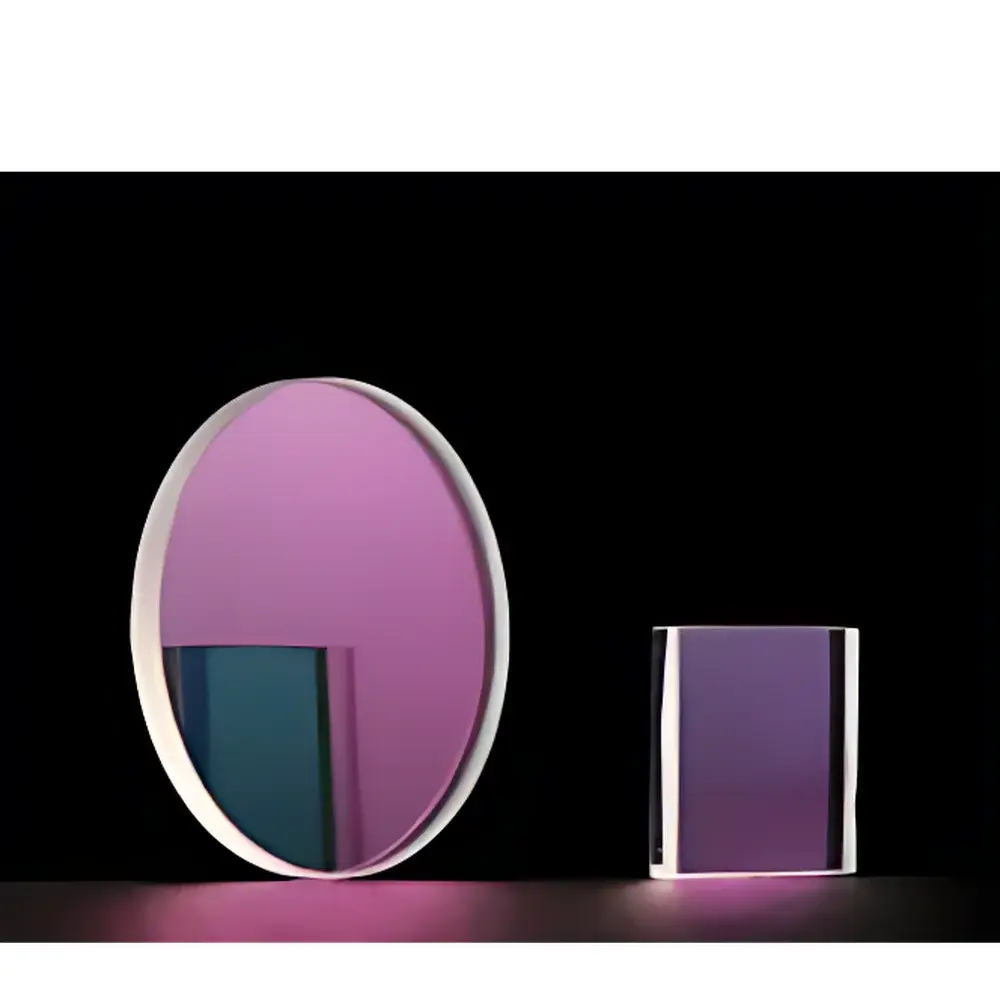
MiXran Meg1117 High-Performance Dielectric Hot Mirror
| Brand | MiXran |
|---|---|
| Model | Meg1117 |
| Subcategory | Optical Component – Hot Mirror |
| Coating Type | All-Dielectric Multilayer |
| Transmission Range | 400–700 nm (Visible) |
| Reflection Band | 750–1200 nm (NIR) |
| Substrate Material | Fused Silica or BK7 (Customizable) |
| Surface Flatness | λ/4 @ 633 nm |
| Parallelism | < 30 arcsec |
| Damage Threshold | > 5 J/cm² @ 1064 nm, 10 ns, 10 Hz |
| AR-Coated Backside Option | Available |
| Dimension Tolerances | ±0.1 mm (diameter/side), ±0.05 mm (thickness) |
| Environmental Compliance | RoHS-compliant coating process |
Overview
The MiXran Meg1117 is a high-performance all-dielectric hot mirror engineered for precision optical systems requiring efficient spectral separation between visible and near-infrared (NIR) radiation. Unlike absorptive heat-absorbing filters—whose thermal loading limits power handling capability—the Meg1117 employs a vacuum-deposited, multilayer dielectric coating optimized using thin-film interference principles. This design achieves high transmission (>95% average) across the visible spectrum (400–700 nm) while simultaneously reflecting >98% of incident energy in the NIR range (750–1200 nm), effectively isolating thermal load from downstream optics and detectors. Its negligible absorption (<0.2% integrated over both bands) eliminates thermally induced wavefront distortion, birefringence, or coating delamination under sustained irradiation—making it suitable for continuous-wave (CW) laser illumination, high-intensity LED arrays, and broadband halogen sources operating at multi-watt power densities.
Key Features
- All-dielectric, ion-assisted deposition (IAD) coating ensures long-term environmental stability and resistance to humidity, temperature cycling, and UV exposure.
- Low absorption architecture enables operation with high-power light sources without active cooling—though forced-air cooling is recommended for source-side placement in systems exceeding 10 W/cm² irradiance.
- Available in standard round (Φ12.5 mm to Φ110 mm) and rectangular (12.5×12.5 mm to 110×120 mm) formats, with substrate thickness options of 1.1 mm and 2.0 mm to accommodate mechanical mounting constraints and optical path length requirements.
- Optional anti-reflection (AR) coating on the substrate back surface minimizes ghost reflections and etalon effects in collimated or low-f/# imaging configurations.
- Surface quality rated at 20–10 scratch-dig per MIL-PRF-13830B; surface flatness maintained at λ/4 @ 633 nm for interferometric-grade applications.
- Coating performance validated via spectrophotometric measurement traceable to NIST standards, with full spectral data (350–1400 nm) provided per lot.
Sample Compatibility & Compliance
The Meg1117 hot mirror is compatible with standard optomechanical mounts (e.g., SM1-threaded lens tubes, kinematic mirror mounts, and custom CNC-machined holders). It integrates seamlessly into fluorescence microscopy filter cubes, machine vision lighting assemblies, spectroscopic sample compartments, and solar simulation setups. As a passive optical component, it requires no electrical interface or calibration. The dielectric stack is manufactured under ISO 9001-certified cleanroom conditions, and all coatings comply with EU RoHS Directive 2011/65/EU restrictions on hazardous substances. While not a medical device or safety-critical component, its performance consistency supports GLP-aligned experimental protocols where spectral fidelity and repeatability are essential.
Software & Data Management
No embedded firmware or proprietary software is associated with the Meg1117, as it functions as a static optical element. However, spectral transmission and reflection curves (CSV and ASCII format) are supplied with each shipment for integration into optical design software such as Zemax OpticStudio, CODE V, or FRED. Users may import these datasets directly to model stray light, thermal loading, and system throughput during ray tracing simulations. Batch-specific test reports include measurement uncertainty budgets aligned with ISO/IEC 17025 guidelines, supporting audit readiness for regulated R&D environments.
Applications
- Visible/NIR beam separation in fluorescence lifetime imaging (FLIM) and confocal microscopy systems.
- Thermal load mitigation in high-brightness projection optics and laser-pumped phosphor illumination engines.
- Blocking NIR leakage in CCD- and CMOS-based spectrometers using silicon detectors, improving signal-to-noise ratio in UV-Vis absorbance measurements.
- Protective filtering for thermal-sensitive optical sensors in industrial inspection, aerospace EO/IR systems, and automotive head-up display (HUD) calibration rigs.
- Reference-grade spectral conditioning in photobioreactor monitoring and plant phenotyping platforms where PAR (Photosynthetically Active Radiation) quantification must exclude NIR-induced heating artifacts.
FAQ
Can the Meg1117 be used at Brewster’s angle?
Yes—its all-dielectric design supports non-normal incidence use; however, polarization-dependent shifts in cutoff wavelength occur above 15°. Custom designs for 45° or 56° AOI are available upon request.
Is the substrate material specified per order?
Standard substrates are BK7 for cost-sensitive applications and fused silica for UV-transmission or high-laser-damage-threshold requirements. Material selection is confirmed prior to coating.
What is the typical lead time for custom dimensions or coating revisions?
Standard catalog items ship within 5 business days; custom sizes or AR-backside variants require 12–18 working days from order confirmation.
Does the Meg1117 meet MIL-C-48497A or similar military specifications?
While not formally certified to MIL specs, its coating adhesion (per ASTM D3359), humidity resistance (per MIL-STD-810H Method 507.6), and thermal shock performance (−40°C to +85°C, 10 cycles) exceed baseline requirements for Class II optical components.
Can I obtain spectral data for a specific serial-numbered unit?
Yes—each shipped unit includes a unique calibration certificate with measured transmission/reflection spectra, lot ID, coating date, and metrology traceability statement.





