
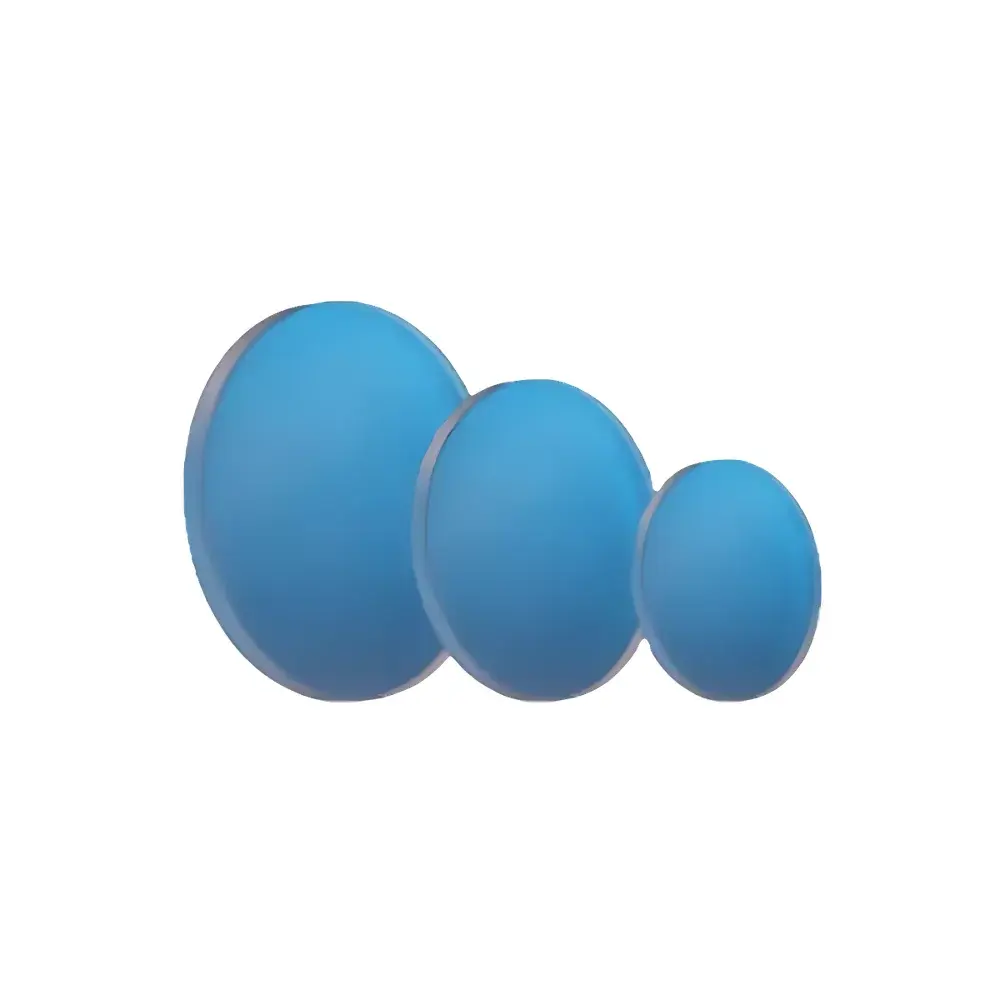
MiXran Meg1125 Borofloat® 33 High-Reflectivity Laser Mirror
| Brand | MiXran |
|---|---|
| Model | Meg1125 |
| Substrate | Schott Borofloat® 33 |
| Diameter | 12.7–50.8 mm |
| Thickness | 3.1–12.7 mm |
| Coating Type | HR (High-Reflectivity) Dielectric |
| Wavelength Ranges | 441.6 nm, 488–514.5 nm, 532 nm, 632.8 nm, 1030–1090 nm, 1520–1580 nm |
| Reflectivity (Rs & Rp) | >98.5% |
| Acceptance Angle | 0–45° AOI |
| Laser Damage Threshold | 2–10 J/cm² @ 10 ns pulse, 10 Hz, 1064 nm equivalent testing protocol |
| Surface Quality | λ/10 @ 633 nm (typical) |
| Parallelism | <3 arcsec |
| Clear Aperture | ≥90% of diameter |
Overview
The MiXran Meg1125 is a precision-engineered high-reflectivity laser mirror designed for demanding optical alignment, cavity construction, and beam steering applications in research-grade and industrial laser systems. Fabricated from Schott Borofloat® 33—a low-thermal-expansion, high-homogeneity borosilicate glass—the substrate delivers exceptional dimensional stability under thermal load and mechanical stress. The mirror employs ion-beam-sputtered (IBS) or electron-beam evaporated dielectric multilayer coatings optimized for high reflectance across critical laser wavelengths, including UV (441.6 nm), visible (488–514.5 nm, 532 nm, 632.8 nm), and near-infrared (1030–1090 nm, 1520–1580 nm) spectral bands. Each coating is engineered to maintain >98.5% reflectivity for both s- and p-polarized light at incidence angles up to 45°, ensuring consistent performance in non-normal-incidence configurations common in resonator design and interferometric setups.
Key Features
- Schott Borofloat® 33 substrate with CTE of 3.25 × 10⁻⁶ K⁻¹, minimizing thermal lensing and drift during high-duty-cycle operation
- λ/10 surface flatness (measured at 633 nm) and <3 arcsec parallelism—critical for wavefront preservation in ultrafast and single-frequency laser cavities
- Dual-polarization (Rs & Rp) high-reflectivity coatings validated via spectrophotometry per ISO 9211-4 and calibrated against NIST-traceable standards
- Laser-induced damage threshold (LIDT) certified per ISO 21254-1:2011; values range from 2 J/cm² to 10 J/cm² (10 ns pulse, 10 Hz, spot size ≥0.5 mm) depending on wavelength and coating variant
- Clear aperture ≥90% of nominal diameter, supporting full utilization of beam profiles without vignetting in collimated or focused paths
- Optional custom mounting compatibility (e.g., kinematic mounts, SM-threaded housings) available upon request for OEM integration
Sample Compatibility & Compliance
The Meg1125 mirrors are compatible with continuous-wave (CW), pulsed nanosecond, and picosecond laser sources operating within specified wavelength bands and power densities. All variants comply with RoHS 2015/863/EU and REACH SVHC regulations. Coating durability meets MIL-C-48497A requirements for environmental robustness—including humidity cycling (95% RH, 40°C, 240 h) and abrasion resistance per ASTM D3363. For regulated environments, documentation packages include full traceability to substrate lot numbers, coating deposition logs, and LIDT test reports—supporting GLP/GMP audit readiness and ISO/IEC 17025-accredited calibration workflows.
Software & Data Management
While the Meg1125 is a passive optical component, MiXran provides comprehensive digital asset support for system integrators and lab managers. Each shipment includes a downloadable PDF datasheet with spectral reflectance curves (400–2000 nm), LIDT validation summaries, and substrate certification documents. Optional integration with MiXran’s Optical Component Management Portal enables batch-level query of coating performance history, cross-referenced against real-world field deployment data from academic and industrial partners. All documentation adheres to FDA 21 CFR Part 11-compliant electronic record retention protocols when accessed through authenticated enterprise accounts.
Applications
- High-finesse Fabry–Pérot and ring laser cavities requiring polarization-insensitive reflectance stability
- Ultrafast Ti:sapphire and Yb:fiber amplifier output couplers and folding mirrors
- Confocal microscopy beam combiners and dichroic routing elements
- Quantum optics experiments involving entangled photon sources and cavity QED platforms
- Industrial laser material processing systems (e.g., marking, welding) where thermal management and long-term reflectance consistency are mission-critical
- Calibration reference mirrors for radiometric and photometric instrumentation per ISO/IEC 17025 requirements
FAQ
What is the maximum recommended average power density for continuous-wave use?
For CW operation, thermal loading must remain below 0.5 W/cm² on the coated surface to prevent coating degradation; this limit scales inversely with substrate thickness and is verified via finite-element thermal modeling per ANSI Z80.10.
Can these mirrors be used at angles beyond 45° incidence?
Performance degrades rapidly above 45° AOI due to increasing polarization splitting and phase shift asymmetry; custom coatings for 0–70° AOI are available under engineering consultation.
Is vacuum-compatible mounting available?
Yes—standard uncoated rear surfaces are polished to <10 Å RMS roughness and compatible with indium or copper gasket sealing; bake-out rated to 150°C for UHV (<10⁻⁹ mbar) environments.
Do you provide spectral reflectance measurement reports for individual units?
Yes—every mirror shipped with serial-numbered certification includes a measured reflectance curve (±0.2% absolute accuracy) acquired on a PerkinElmer Lambda 1050+ spectrophotometer with integrating sphere accessory.
Are there options for anti-reflection (AR) coating on the substrate backside?
AR coating on the rear face is available as a factory option (R < 0.25% @ target wavelength) to suppress etalon effects in high-gain cavities; lead time increases by 5 business days.




