
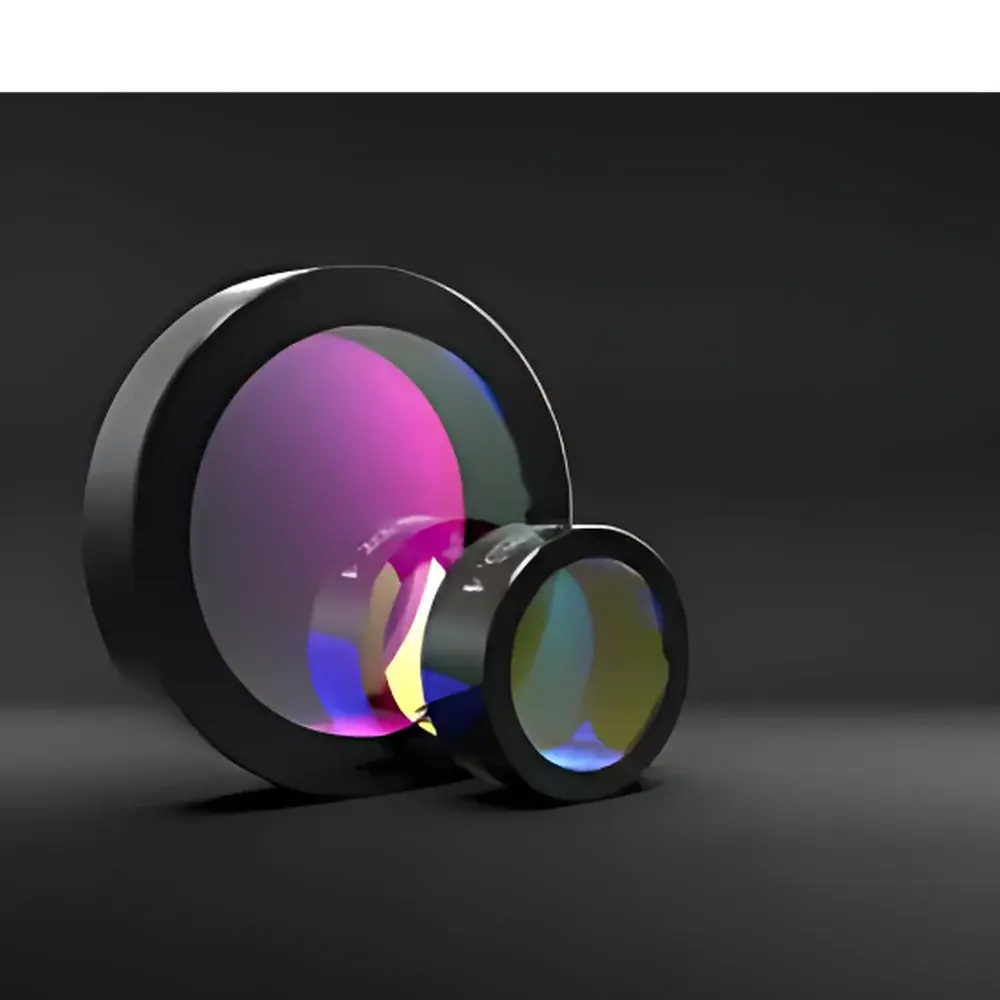
MiXran Meg1133 Narrowband Optical Interference Filter (FWHM > 10 nm)
| Brand | MiXran |
|---|---|
| Model | Meg1133 |
| Component Type | Optical Filter |
| Diameter Options | 12.7 mm & 25.4 mm |
| Center Wavelength Range | 214–2000 nm |
| FWHM Options | 13–75 nm |
| Center Wavelength Tolerance | ±2–±7 nm |
| FWHM Tolerance | ±2–±8 nm |
| Peak Transmission | 10–75% |
| Substrate Material | Optical-grade fused silica or BK7 (application-optimized) |
| Surface Quality | 60-40 scratch-dig |
| Parallelism | <3 arcsec |
| Clear Aperture | ≥90% of diameter |
| Operating Temperature Range | –20 °C to +70 °C |
| Damage Threshold | >500 mJ/cm² @ 10 ns, 10 Hz, 1064 nm |
Overview
MiXran Meg1133 Narrowband Optical Interference Filters are precision thin-film coated components engineered for spectral isolation in demanding optical systems. Based on multi-layer dielectric interference principles, these filters selectively transmit a defined wavelength band—defined by center wavelength (CWL) and full width at half maximum (FWHM)—while rejecting adjacent spectral regions with high optical density (OD > 4–6 typical in blocking bands). Unlike absorptive filters, the Meg1133 series relies on constructive and destructive interference within precisely controlled quarter-wave stacks, ensuring minimal thermal load, high laser damage resistance, and angular insensitivity up to ±5° incidence for collimated beams. Designed for integration into spectroscopy, fluorescence microscopy, LIDAR receivers, Raman excitation/detection pathways, and industrial machine vision systems, each filter is individually characterized via calibrated spectrophotometry (PerkinElmer Lambda 1050+ or equivalent) and supplied with a traceable test report.
Key Features
- Precision CWL options spanning ultraviolet (214 nm) to mid-infrared (2000 nm), including key laser lines (e.g., 532 nm, 632.8 nm, 780 nm, 1064 nm, 1550 nm, 1900 nm)
- FWHM bandwidths from 13 nm to 75 nm—engineered for applications requiring moderate spectral selectivity without excessive signal attenuation
- High peak transmission (>10% to >75%, depending on CWL and FWHM; optimized via layer count and material selection)
- Tight manufacturing tolerances: CWL ±2 nm (for NIR/SWIR) to ±7 nm (visible/UV); FWHM ±2 nm to ±8 nm—verified per ISO 9022-5 and MIL-PRF-13830B
- Optical substrates selected per application: UV-grade fused silica (CWL < 350 nm), BK7 (visible), or IR-grade CaF₂ or fused silica (NIR/SWIR) to ensure low autofluorescence and minimal absorption
- Hard-coated, ion-assisted deposition (IAD) multilayer stacks providing environmental stability compliant with ISO 9211-4 (humidity, abrasion, adhesion)
- Standard diameters: 12.7 mm (½″) and 25.4 mm (1″), with clear aperture ≥90% and parallelism <3 arcsec for minimal wavefront distortion
Sample Compatibility & Compliance
The Meg1133 series is compatible with standard optomechanical mounts (SM1, SM2 threading), cage systems, and custom filter wheels. All filters meet RoHS 2015/863/EU and REACH SVHC requirements. Coating durability is validated per ISO 9211-4:2013 (adhesion, humidity, salt spray) and MIL-C-48497A (laser-induced damage threshold testing). For regulated environments—including clinical diagnostics instrumentation and pharmaceutical analytical systems—the filters support system-level compliance with IEC 61000-4 (EMC), IEC 61326-1 (electrical safety), and FDA 21 CFR Part 11 when integrated into validated instrument workflows. Documentation includes individual spectral transmission curves, CWL/ FWHM measurement uncertainty budgets, and substrate certification (e.g., Schott data sheets).
Software & Data Management
Each Meg1133 filter ships with a unique product ID (e.g., GNIF-40-532-D12) and a digital spectral report in CSV and PDF formats, containing normalized transmission data (0.1 nm step resolution) across the full 200–2200 nm range. These reports are structured for direct import into optical design software (Zemax OpticStudio, CODE V, FRED) and spectral analysis platforms (MATLAB, Python SciPy, OriginLab). Batch traceability enables GLP/GMP-aligned inventory management: lot numbers, coating run IDs, and metrology timestamps are embedded in the report metadata. For OEM integration, MiXran provides an optional API-accessible spectral database (RESTful JSON endpoint) supporting automated BOM validation and calibration history tracking.
Applications
- Fluorescence Imaging: Excitation and emission filtering in widefield and confocal microscopes—paired with LED or laser sources (e.g., 488 nm excitation with 525/50 nm emission filter)
- Raman Spectroscopy: Notch and edge filters for laser rejection; narrowband filters for shifted Stokes/anti-Stokes line isolation
- Environmental Sensing: Gas detection (CH₄ at 1650 nm, CO₂ at 2000 nm) using NDIR photodetector modules
- Biomedical Diagnostics: Pulse oximetry (660/940 nm dual-band), blood analyte sensing (e.g., bilirubin at 450 nm), and flow cytometry optical path conditioning
- Industrial Metrology: Colorimetric sorting, laser line monitoring, and machine vision lighting control under ambient broadband illumination
- Free-Space Optical Communications: WDM channel selection in 1310/1550 nm bands with precise channel spacing and crosstalk suppression
FAQ
What is the typical damage threshold for Meg1133 filters under pulsed laser irradiation?
The average LIDT is >500 mJ/cm² at 1064 nm (10 ns pulse width, 10 Hz repetition rate, Ø0.5 mm beam). Exact values depend on CWL, FWHM, and substrate; full test reports are provided per unit.
Can Meg1133 filters be used at non-normal incidence?
Yes—peak transmission shifts toward shorter wavelengths with increasing angle. Shift is ~0.5 nm per degree for visible filters; angular tuning curves are included in the spectral report.
Do you offer custom CWL or FWHM specifications outside the standard catalog?
Yes. Custom designs (including ultra-narrow FWHM <10 nm, customized blocking ranges, or wedged substrates) are available with lead times of 8–12 weeks and minimum order quantities apply.
Are mounting adapters or retention rings included?
No—filters are supplied unmounted. Standard SM1-threaded retention rings (e.g., Thorlabs SM1RR) and kinematic mounts are recommended for optimal alignment and thermal stability.
How is spectral performance verified prior to shipment?
Every filter undergoes full-spectrum transmission measurement on a NIST-traceable UV-VIS-NIR spectrophotometer. CWL and FWHM are extracted using second-derivative peak detection algorithms per ASTM E275-20 Annex A1.




