
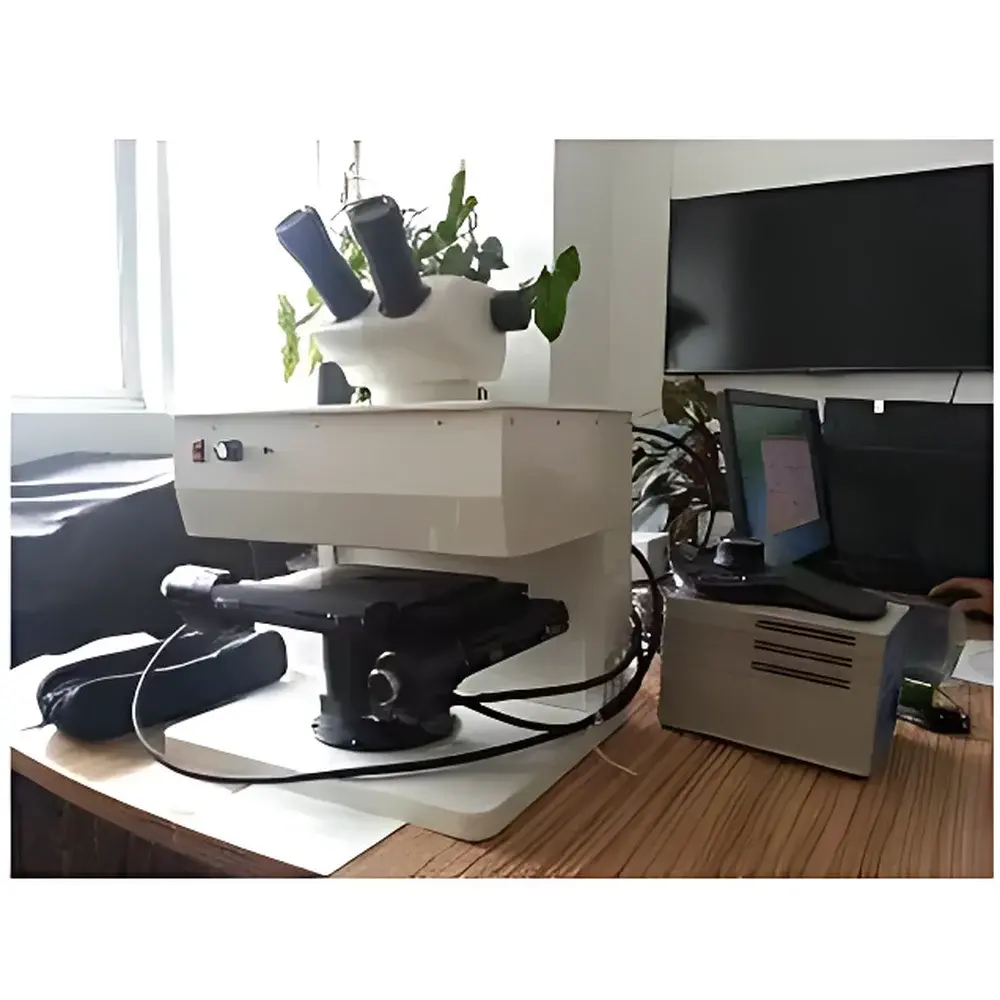
MiXran MICROMILL SAMPLING VI Automated Micro-Sampling System
| Brand | MiXran |
|---|---|
| Origin | USA |
| Manufacturer Type | Authorized Distributor |
| Origin Category | Imported |
| Model | MICROMILL SAMPLING VI |
| Pricing | Available Upon Request |
Overview
The MiXran MICROMILL SAMPLING VI is an automated micro-sampling system engineered for high-precision, non-destructive material extraction under optical guidance. It integrates a motorized XYZ translation stage with modular microscope coupling—supporting stereo, inverted, and upright configurations—to enable real-time visual navigation during sampling. The system operates on a vertical sampling principle: a vertically aligned, pneumatically stabilized sampling probe (e.g., tungsten carbide or diamond-tipped drill needle) is positioned coaxially—or within sub-millimeter tolerance—relative to vacuum collection nozzles or micro-catchment chambers. This architecture ensures simultaneous drilling and particulate capture with minimal cross-contamination or positional drift. Designed for geological, metallurgical, and materials science laboratories, the MICROMILL SAMPLING VI complies with core principles of ISO/IEC 17025-compliant sample preparation workflows, where traceability, repeatability, and spatial registration are critical for downstream analysis (e.g., SEM-EDS, LA-ICP-MS, micro-XRF).
Key Features
- Modular optical integration: Compatible with stereo, inverted, and upright microscopes—enabling selection based on sample geometry, working distance, and depth-of-field requirements.
- Motorized XYZ stage with sub-micron repeatability: Programmable trajectory execution (linear, curved, raster, or user-defined path) synchronized with live optical feedback via eyepiece or digital camera feed.
- Coaxial sampling-collecting architecture: Vertical probe alignment ensures consistent impact angle and minimizes lateral force; vacuum or inert-gas-assisted collection prevents particle dispersion.
- Real-time spatial mapping: Automatic wide-field mosaic imaging generates a registered coordinate map; users define sampling coordinates directly on the stitched image interface.
- Software-controlled probe actuation: Adjustable dwell time, penetration depth, and rotational speed (where applicable) ensure adaptability across brittle (e.g., quartz, feldspar), ductile (e.g., copper alloys), or composite matrices.
- GLP-ready audit trail: All motion commands, image timestamps, stage coordinates, and operator inputs are logged in UTC-referenced, tamper-evident format compliant with FDA 21 CFR Part 11 requirements.
Sample Compatibility & Compliance
The MICROMILL SAMPLING VI accommodates solid, heterogeneous samples up to 150 mm × 100 mm × 50 mm (L×W×H), including polished thin sections, ore chips, slag fragments, alloy ingots, and ceramic composites. Its non-contact optical targeting eliminates pre-adhesive mounting for many applications—reducing preparation artifacts and preserving native surface chemistry. The system meets ASTM D7575–21 (Standard Test Method for Determination of Trace Elements in Solid Samples by Laser Ablation Inductively Coupled Plasma Mass Spectrometry) prerequisites for spatially resolved sampling. All mechanical interfaces conform to ISO 80000-4 (quantities and units – mechanics) and IEC 61000-6-2 (electromagnetic immunity for industrial environments).
Software & Data Management
The proprietary RELIOTRON Control Suite (v4.3+) provides intuitive graphical workflow design: users import sample images, draw sampling paths, assign probe parameters per segment, and preview stage motion in simulation mode. Acquired metadata—including stage coordinates, image hash values, timestamped video clips (H.264, 30 fps), and environmental logs (temperature/humidity)—are exported in vendor-neutral HDF5 or CSV formats. Integrated DICOM support enables correlation with micro-CT or synchrotron tomography datasets. Data integrity is enforced via SHA-256 checksums and optional network-based backup to NAS or LIMS endpoints.
Applications
- Geological provenance studies: Targeted micro-drilling of zircon rims vs. cores for U–Pb dating without cross-domain mixing.
- Metallurgical inclusion analysis: Isolation of MnS or Al₂O₃ clusters from steel matrix for EBSD phase identification.
- Forensic geoscience: Stratified sampling of soil horizons or sediment layers for trace-element fingerprinting.
- Archaeometric research: Extraction of pigment particles from painted pottery shards while preserving stratigraphic context.
- Quality control in additive manufacturing: Site-specific powder sampling from build plates prior to XRD or OES analysis.
FAQ
What microscope types are supported out-of-the-box?
Stereo (Leica M205, Zeiss Stemi 508), upright (Olympus BX53, Nikon Eclipse Ci), and inverted (Zeiss Axio Observer) platforms with standard C-mount or F-mount adapters.
Can the system operate under inert atmosphere?
Yes—optional glove-box integration kit includes sealed stage enclosure, N₂ purge port, and pressure-balanced probe feedthrough.
Is remote operation supported?
Full TCP/IP-based remote control is available via TLS-encrypted VNC session; requires local IT approval and static IP assignment.
What is the minimum feature size resolvable during targeting?
Dependent on coupled microscope optics; typical resolution limit is 0.7 µm at 100× magnification with oil immersion objective.
Does the system support multi-point batch processing?
Yes—CSV-based coordinate import allows unattended sequential sampling of ≥500 locations with automatic focus recalibration between points.





