
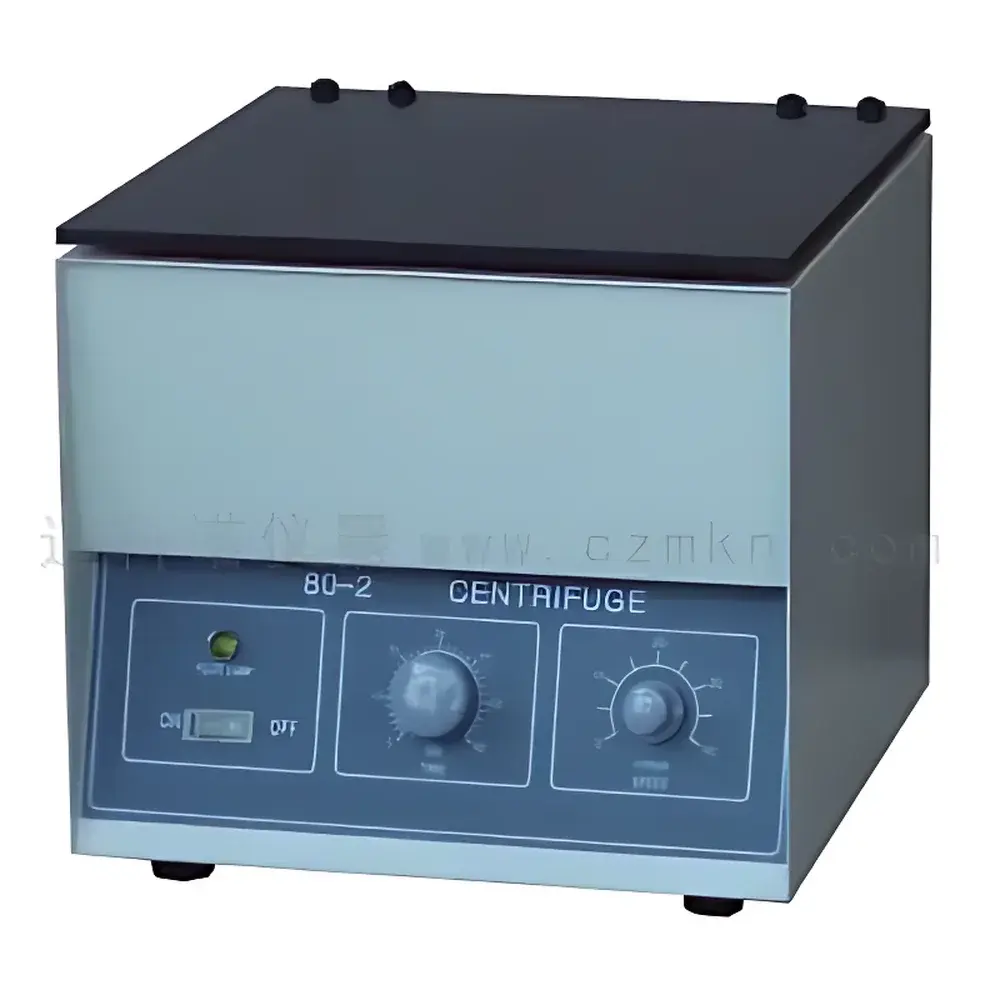
MKN 80-2 Benchtop Centrifuge
| Brand | MKN |
|---|---|
| Origin | Jiangsu, China |
| Model | 80-2 |
| Max Speed | 4000 rpm (infinitely variable) |
| Relative Centrifugal Force (RCF) | 2325 × g |
| Capacity | 12 × 20 mL |
| Timer Range | 0–60 min |
| Noise Level | ≤60 dB |
| Power Supply | AC 220 V, 50 Hz, 2 A |
| Construction | Die-cast aluminum rotor assembly |
| Compliance | Designed for GLP-compliant routine laboratory use |
Overview
The MKN 80-2 Benchtop Centrifuge is a compact, general-purpose centrifuge engineered for reliable sedimentation-based separation in clinical, biochemical, and chemical laboratories. It operates on the principle of radial acceleration—generating controlled centrifugal force to separate suspended particles or immiscible phases based on differences in density, size, and shape. With a maximum rotational speed of 4000 rpm and an RCF of 2325 × g, the unit delivers sufficient force for routine pelleting of erythrocytes, leukocytes, precipitated proteins, and particulate reagents without requiring refrigeration or vacuum systems. Its brushless DC motor enables smooth, low-vibration operation across the full speed range, while the integrated automatic balancing mechanism accommodates minor tube mass imbalances—reducing mechanical stress and extending service life. The device is designed for continuous-duty intermittent operation under ambient laboratory conditions (15–30 °C, <80% RH), with thermal management ensuring stable temperature rise (<15 K above ambient after 30 min runtime).
Key Features
- Die-cast aluminum rotor assembly with precision-machined tube pockets—resists deformation, minimizes microcrack propagation, and ensures long-term dimensional stability under repeated thermal cycling.
- Infinitely variable speed control (0–4000 rpm) via analog knob interface—enables fine-tuned optimization for diverse sample viscosities and sedimentation coefficients.
- Mechanical timer (0–60 minutes) with audible end-of-run signal—supports reproducible batch processing without software dependency or firmware updates.
- Low-noise enclosure (<60 dB at 1 m distance)—meets ISO 717-1 acoustic emission requirements for shared laboratory environments.
- Compact footprint (280 × 260 × 240 mm) and lightweight design (≤12 kg)—facilitates placement on standard lab benches or mobile carts without structural reinforcement.
- Over-speed protection, lid interlock, and automatic rotor deceleration—complies with IEC 61010-1 safety standards for Class II laboratory equipment.
Sample Compatibility & Compliance
The MKN 80-2 accepts standard conical-bottom polypropylene or glass centrifuge tubes (10–20 mL capacity) and accommodates common anticoagulant tubes (EDTA, heparin, citrate) used in serum/plasma separation workflows. It is routinely deployed in hospital core labs for hematocrit determination, coagulation assay preparation, and immunoassay sample clarification per CLSI GP44-A4 guidelines. While not certified for biosafety level 2 (BSL-2) containment, its sealed rotor housing prevents aerosol escape during normal operation when tubes are properly capped. The instrument meets CE marking requirements under the Low Voltage Directive (2014/35/EU) and Electromagnetic Compatibility Directive (2014/30/EU). It supports documentation traceability required under ISO/IEC 17025 for accredited testing laboratories, though it does not include electronic audit trails required for FDA 21 CFR Part 11 compliance.
Software & Data Management
The MKN 80-2 operates as a standalone electromechanical system with no embedded firmware, network interface, or data logging capability. All operational parameters—including speed setpoint, timer value, and run status—are manually configured and visually confirmed via analog dials and LED indicators. This architecture eliminates cybersecurity vulnerabilities, firmware obsolescence, and calibration drift associated with digital controllers. For laboratories requiring electronic recordkeeping, external time-stamped video recording or manual logbook entries (per GLP Annex 4) are recommended for process verification. No proprietary drivers, USB interfaces, or cloud connectivity are provided—ensuring compatibility with air-gapped environments and legacy IT infrastructure.
Applications
- Routine serum and plasma separation from whole blood specimens in clinical diagnostics and point-of-care settings.
- Sedimentation of precipitated immune complexes in qualitative agglutination assays (e.g., rheumatoid factor, anti-nuclear antibody screening).
- Clarification of reaction mixtures in organic synthesis and analytical chemistry workflows prior to HPLC or GC injection.
- Concentration of bacterial cell pellets for downstream DNA extraction or protein expression analysis.
- Removal of insoluble contaminants from buffer stock solutions and reagent preparations in QC/QA laboratories.
- Preparative separation of lipid fractions in basic nutritional biochemistry studies.
FAQ
What is the maximum relative centrifugal force (RCF) achievable with the MKN 80-2?
The unit delivers a maximum RCF of 2325 × g at 4000 rpm with the standard 20 mL tube configuration.
Does the centrifuge include a refrigeration system?
No. The MKN 80-2 is a non-refrigerated benchtop model intended for room-temperature applications only.
Can I use this centrifuge for radioactive or hazardous samples?
It is not designed for containment of volatile, corrosive, or radioactive materials; appropriate secondary containment and risk assessment per local EHS protocols are required.
Is rotor balancing required before each run?
The built-in mechanical auto-balancing system compensates for minor load asymmetries up to ±0.5 g per tube position; however, symmetrical loading remains essential for optimal performance and longevity.
What maintenance intervals are recommended?
Visual inspection of rotor integrity and lubrication of drive shaft bearings every 6 months—or after 500 operating hours—is advised per manufacturer’s service bulletin MKN-CF-802-REV3.



