
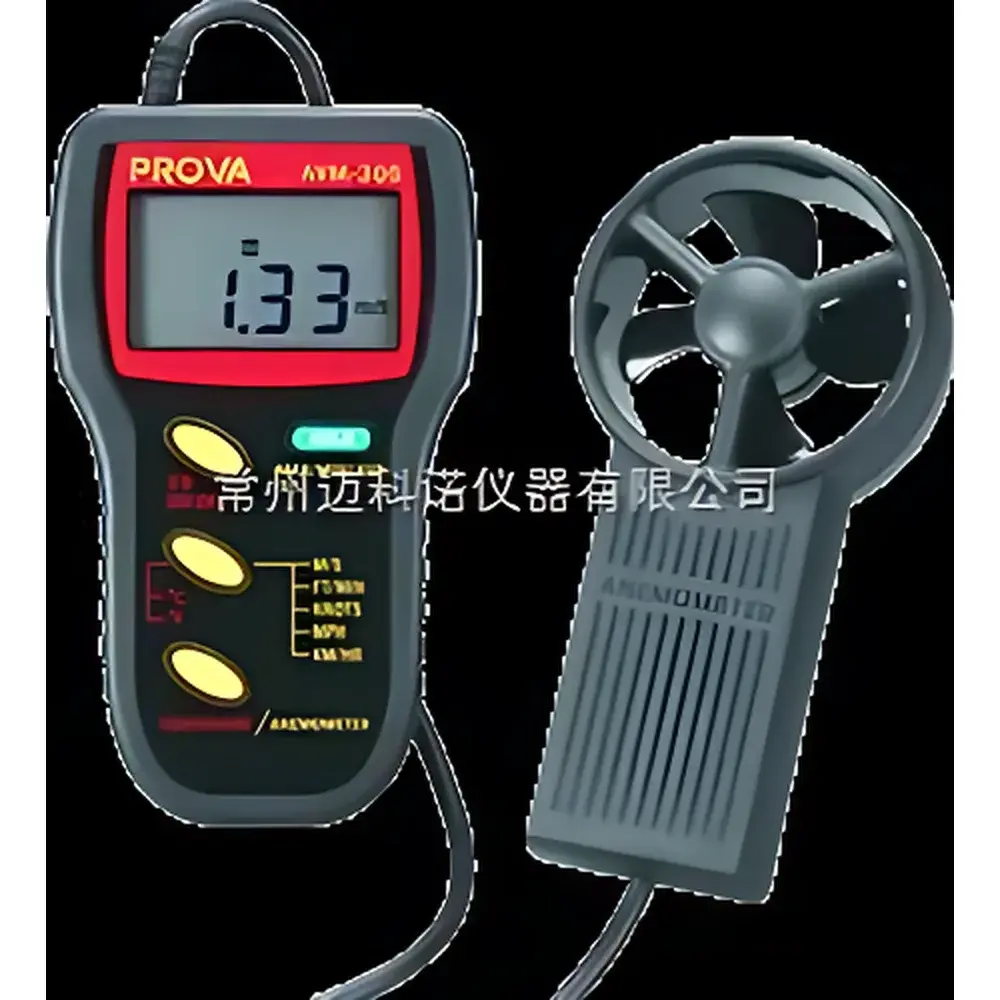
MKN AVM-301 Digital Vane Anemometer
| Brand | MKN |
|---|---|
| Model | AVM-301 |
| Type | Digital Vane Anemometer |
| Wind Speed Range | 0.0–45.0 m/s (0.0–100.0 mph, 0.0–88.0 knots, 0.0–160.0 km/h, 0–8800 ft/min) |
| Resolution | 0.01 m/s (varies by unit) |
| Accuracy | ±3% ±0.2 m/s (typical) |
| Temperature Range | –5.0–60.0 °C / 32.0–140.0 °F |
| Temp Resolution | 0.1 °C / 0.2 °F |
| Temp Accuracy | ±1.0 °C / ±1.8 °F |
| Display | 4-digit LCD with Max/Min/Avg/Hold functions |
| Power | Two 1.5 V AA batteries (≈200 h life) |
| Auto-off | 10 min |
| Interface | RS-232C (AVM-303 only |
| Dimensions (meter) | 78 × 130 × 40 mm |
| Fan Probe | 66 × 132 × 29.2 mm |
| Weight | 250 g (with batteries) |
| Operating Environment | 0–50 °C, <80% RH, 500 mbar–2 bar |
| Storage | –40–60 °C |
| Mounting | 1/4″–20 threaded port |
Overview
The MKN AVM-301 Digital Vane Anemometer is a handheld, battery-powered instrument engineered for reliable and repeatable measurement of air velocity and ambient temperature in HVAC commissioning, indoor air quality (IAQ) assessment, cleanroom validation, laboratory ventilation verification, and industrial process airflow monitoring. It employs a precision-calibrated vane-type sensor — consisting of a low-inertia rotating impeller coupled to a high-resolution optical encoder — to convert rotational speed into linear wind velocity across multiple engineering units. The device operates on the principle of aerodynamic torque balance, where incident airflow induces proportional angular velocity in the vane assembly, enabling direct analog-to-digital conversion with minimal hysteresis or thermal drift. Its compact probe design ensures minimal flow disturbance during point measurements, while the large 4-digit LCD provides real-time visibility of instantaneous, maximum, minimum, and time-weighted average values — critical for documenting transient airflow events per ISO 14644-3 or ASHRAE Standard 111.
Key Features
- Multi-unit wind speed display: m/s, ft/min, knots, km/h, and mph — selectable via front-panel button with automatic unit conversion logic
- Dual-parameter measurement: simultaneous wind velocity and ambient temperature (–5.0 to 60.0 °C), both with user-accessible calibration offset adjustment
- Statistical data capture: Max/Min/Avg/Hold functions support field-based trend analysis without external logging hardware
- Low-power architecture: Typical current draw of 6 mA enables ~200 hours of continuous operation using standard AA alkaline cells
- Intelligent power management: Auto-shutdown after 10 minutes of inactivity preserves battery life and prevents unintended data loss
- Integrated low-battery indicator: Visual warning appears prior to voltage threshold breach, ensuring measurement integrity
- Ergonomic, portable form factor: Lightweight (250 g with batteries) and balanced design facilitates single-hand operation in confined ducts or ceiling plenums
- Mechanical mounting interface: Standard 1/4″–20 UNC thread allows secure attachment to tripods, duct clamps, or custom fixtures for fixed-point monitoring
Sample Compatibility & Compliance
The AVM-301 is optimized for measuring turbulent and laminar airflow in non-corrosive, particle-free gaseous media at atmospheric pressure (500 mbar–2 bar operating range). It is not rated for explosive atmospheres (ATEX/IECEx), high-humidity condensing environments (>80% RH), or particulate-laden exhaust streams exceeding ISO 14644 Class 8 cleanliness. While not certified to specific regulatory standards, its measurement methodology aligns with foundational practices described in ISO 8540-2 (air velocity instrumentation), ASHRAE Guideline 12-2020 (HVAC system testing), and EN 13779:2007 (ventilation performance criteria). Temperature readings comply with ITS-90 traceability principles within its stated accuracy envelope. Device firmware and hardware architecture support GLP-compliant documentation workflows when used with the included PC software and RS-232C-to-USB interface.
Software & Data Management
The AVM-301 ships with Windows-compatible data acquisition software (provided on CD and digitally downloadable), enabling real-time serial communication via the included RS-232C-to-USB adapter cable. The software supports time-stamped data streaming, manual trigger capture, statistical summary export (CSV/Excel), and configurable alarm thresholds for out-of-spec velocity excursions. All data files include embedded metadata: instrument ID, date/time stamp, operator ID field, and unit configuration. Audit trail functionality records parameter changes and calibration events, supporting basic 21 CFR Part 11 readiness when deployed in regulated environments with appropriate organizational SOPs. No cloud synchronization or remote firmware updates are supported — all configuration and calibration remain local and user-controlled.
Applications
- HVAC system balancing and duct traverse surveys per ANSI/ASHRAE Standard 111
- Room air change rate validation in pharmaceutical cleanrooms (ISO 14644-1/2)
- Exhaust hood face velocity verification in chemical laboratories (ANSI Z9.5)
- Industrial dryer and oven airflow uniformity mapping
- Environmental chamber airflow profiling during thermal stress testing
- Building commissioning reports requiring traceable, NIST-traceable-capable velocity datasets
- Educational laboratory exercises in fluid mechanics and environmental engineering
FAQ
Does the AVM-301 support data logging without a PC connection?
No — internal memory storage is not implemented. Continuous logging requires active USB/RS-232C connection to a host computer running the supplied software.
Is the vane probe replaceable or serviceable in the field?
Yes — the fan probe is mechanically isolated from the main meter housing via a detachable cable and standardized connector, allowing replacement without recalibration if damaged.
Can the AVM-301 measure air velocity in high-temperature ducts above 60 °C?
No — the specified operating limit for the probe is 60 °C. Prolonged exposure beyond this threshold may degrade bearing lubrication and encoder accuracy.
What is the recommended recalibration interval?
MKN recommends annual recalibration against a NIST-traceable reference anemometer, especially when used in QA/QC or regulatory reporting contexts.
Is the RS-232C interface optically isolated?
No — the interface uses standard TTL-level signaling without galvanic isolation. Use only with grounded, noise-controlled PC environments to prevent communication errors.
Related Products







