
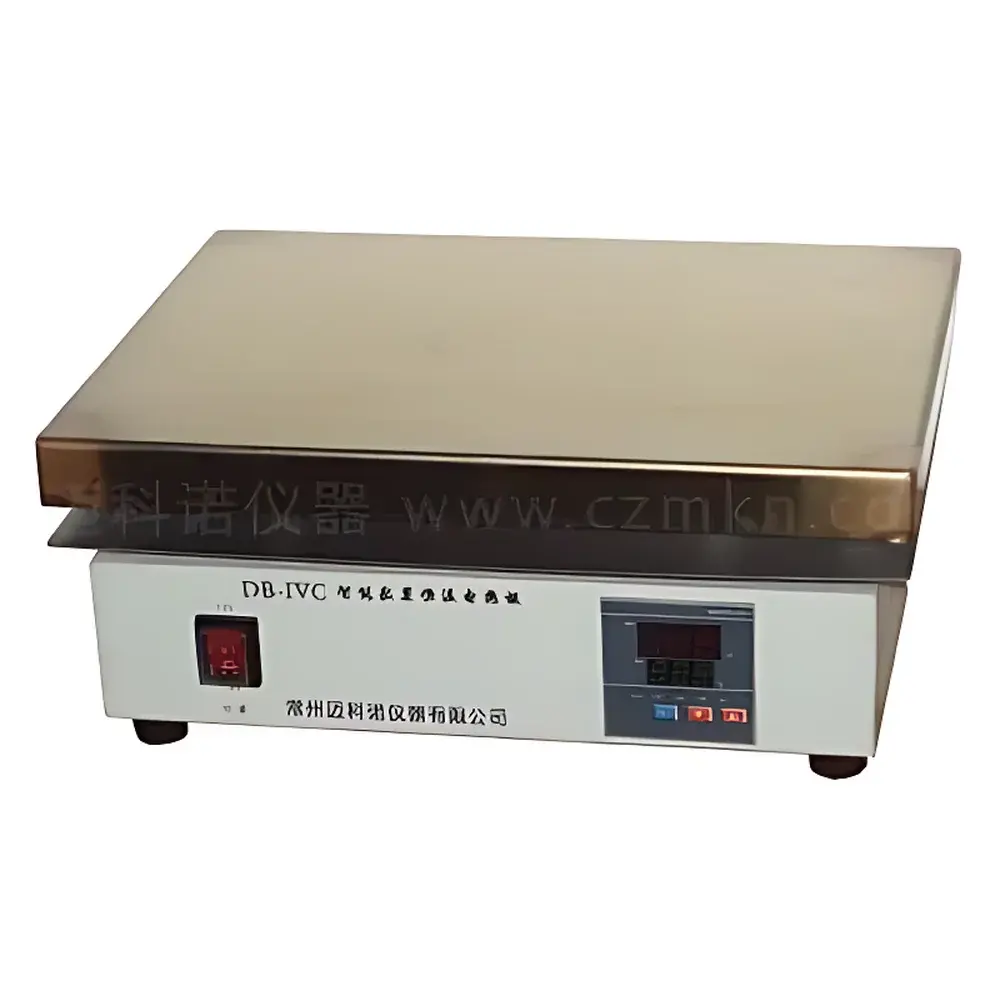
MKN DB-IVC Digital Temperature-Controlled Stainless Steel Electric Heating Plate
| Brand | MKN |
|---|---|
| Model | DB-IVC |
| Power Supply | AC 220 V, 50 Hz |
| Temperature Range | RT–300 °C |
| Temperature Accuracy | ±1 °C |
| Heating Power | 2000 W |
| Working Surface Dimensions | 40 × 30 cm |
| Material | Thickened 304 Stainless Steel |
| Heating Technology | Far-Infrared Silicon Carbide Embedded in Aluminum Cast Base |
| Compliance | CE-marked design principles (IEC 61000-6-3, IEC 61000-6-2), GLP-aligned operational traceability support |
Overview
The MKN DB-IVC Digital Temperature-Controlled Stainless Steel Electric Heating Plate is an engineered thermal platform designed for precise, stable, and repeatable heating in sample preparation, digestion, evaporation, drying, and controlled thermal conditioning workflows. It operates on far-infrared silicon carbide (SiC) heating elements embedded within a solid aluminum cast base — a configuration that delivers rapid thermal response, minimal power loss, and exceptional temperature uniformity across the entire working surface. Unlike conventional resistive coil or ceramic plate heaters, this architecture eliminates hot-spot formation and ensures consistent heat transfer to vessels (e.g., beakers, crucibles, digestion tubes) placed directly on the surface. The unit integrates a microprocessor-based PID temperature controller with digital LED display, enabling real-time monitoring and setpoint adjustment from ambient to 300 °C in 1 °C increments. Its robust mechanical construction — featuring a 5-mm-thick 304 stainless steel top plate — provides long-term resistance to chemical splashes, thermal cycling fatigue, and mechanical abrasion common in analytical and regulatory-compliant laboratories.
Key Features
- Far-infrared silicon carbide heating technology integrated into an aluminum cast base for fast warm-up (typical <15 min to 250 °C) and <±1 °C thermal stability at steady state
- Digital PID temperature controller with high-resolution LED display and intuitive push-button interface for precise setpoint entry and real-time feedback
- Thickened 304 stainless steel working surface (40 × 30 cm) offering superior corrosion resistance against acids, alkalis, and oxidizing agents used in EPA Method 3050B/3051A, ASTM D5511, and ISO 11466 digestions
- No-deformation heating element assembly — formed via high-pressure sintering and precision mounting — ensuring dimensional stability under continuous operation at maximum temperature
- Over-temperature protection circuit with independent thermal cutoff (bimetallic safety switch) activated at ≥320 °C to prevent uncontrolled thermal escalation
- Low electromagnetic emission design compliant with IEC 61000-6-3 (emission) and IEC 61000-6-2 (immunity) standards for co-location with sensitive instrumentation
Sample Compatibility & Compliance
The DB-IVC accommodates standard laboratory glassware (e.g., 100–1000 mL borosilicate beakers, quartz digestion vessels, PTFE-lined microwave digestion cups) and metal containers up to 5 kg total load. Its flat, non-porous surface supports uniform contact heating critical for gravimetric moisture analysis (ASTM D2231), ash content determination (AOAC 923.03), and open-vessel acid digestion protocols. While not certified to UL/CSA or EN 61010-1 as a standalone appliance, its electrical and thermal architecture adheres to fundamental safety principles aligned with IEC 61010-1:2010 (Ed. 3) for laboratory equipment. The unit supports Good Laboratory Practice (GLP) workflows through stable, documentable temperature control — compatible with external data loggers for audit-ready thermal records per FDA 21 CFR Part 11 requirements when paired with compliant software.
Software & Data Management
The DB-IVC operates as a stand-alone analog-digital hybrid instrument with no embedded firmware or network interface. Temperature setpoints and actual readings are displayed locally; no onboard data storage or USB/RS-232 connectivity is provided. For regulated environments requiring electronic record retention, users may integrate the unit with third-party temperature validation systems (e.g., Fluke 1524, Omega HH309A) via PT100 probe input (optional accessory port). The controller supports manual calibration offset adjustment (±5 °C range) using factory-supplied calibration certificate traceable to NIST standards. All operational parameters — including power-on duration, max temperature achieved, and dwell time — must be recorded manually or via external logging for ISO/IEC 17025-compliant testing laboratories.
Applications
- Open-beaker acid digestion of environmental soils and sediments (EPA SW-846 Method 3050B)
- Pre-concentration of aqueous samples prior to ICP-MS or AAS analysis
- Drying of filter papers in suspended solids (TSS) and total dissolved solids (TDS) assays (APHA 2540B)
- Controlled evaporation of organic solvents in residue analysis (e.g., pesticide screening per EU SANTE/11312/2021)
- Thermal conditioning of calibration standards and reference materials prior to weighing or dissolution
- Heating baths for viscosity measurement cells and density pycnometers requiring stable thermal environment
FAQ
What is the maximum recommended continuous operating temperature?
The DB-IVC is rated for continuous operation up to 300 °C. Sustained use above 280 °C may accelerate surface oxidation over extended periods (>6 months); periodic visual inspection of the stainless steel plate is advised.
Can the unit be used under a fume hood?
Yes — its low electromagnetic signature and absence of volatile outgassing materials make it suitable for installation inside Class II biosafety cabinets and ducted fume hoods, provided adequate clearance (≥10 cm) is maintained around all sides for convection cooling.
Is the temperature sensor user-replaceable?
The internal PT100 sensor is factory-calibrated and sealed within the heating block; replacement requires MKN-certified service personnel and recalibration verification per ISO/IEC 17025 clause 6.5.
Does the unit support ramp-and-hold programming?
No — the DB-IVC implements only single-setpoint PID control. For multi-step thermal profiles, integration with an external programmable temperature controller (e.g., Eurotherm 2408) is required.
What maintenance is required to ensure long-term accuracy?
Monthly cleaning of the stainless steel surface with non-abrasive ethanol wipe; annual verification of temperature uniformity across the surface using a calibrated infrared thermometer or thermocouple array per ASTM E220.



