
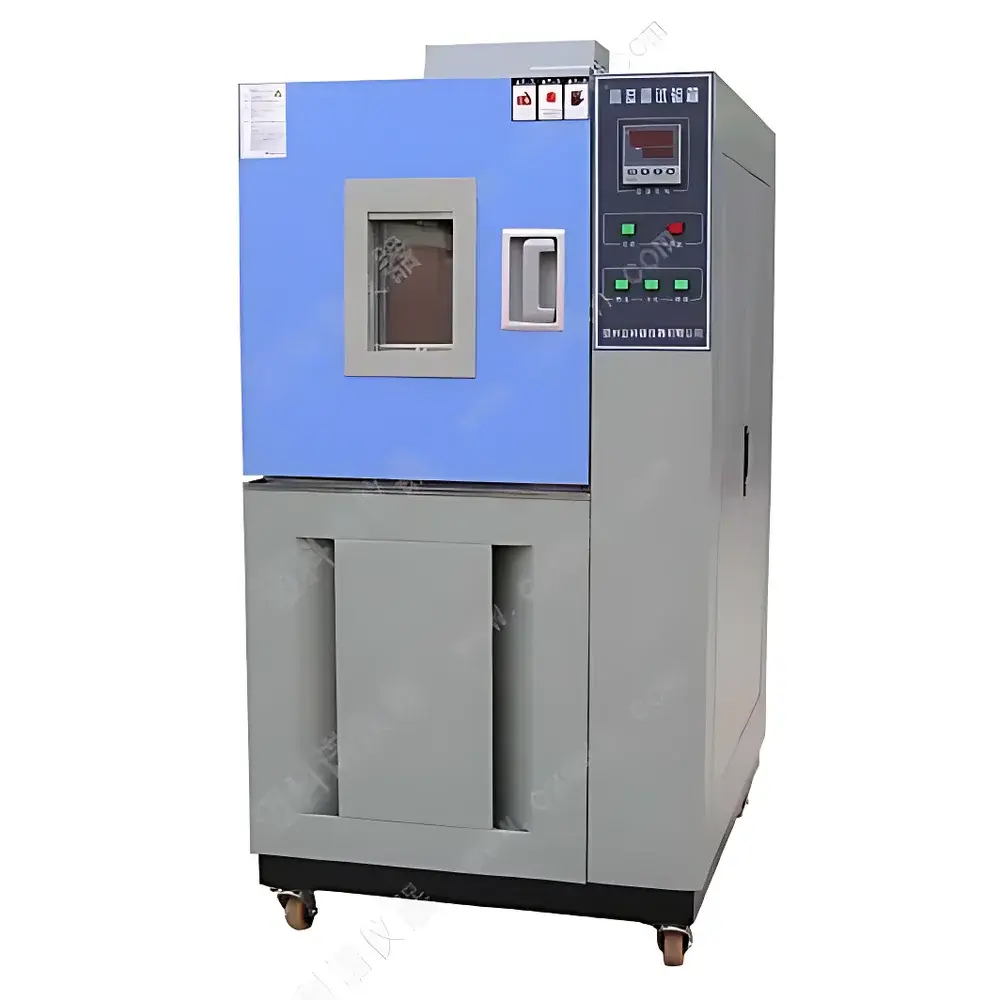
MKN GDW Series Environmental Test Chamber
| Brand | MKN |
|---|---|
| Model | GDW Series |
| Temperature Range | -60 °C to 200 °C |
| Temperature Uniformity | ±2 °C |
| Temperature Fluctuation | ±0.5 °C |
| Ramp Rate | 0.7–1.0 °C/min |
| Interior Dimensions (L×W×H) | 400×500×500 mm to 1000×1000×1000 mm |
| Construction | SUS304 Stainless Steel Interior, Powder-Coated Steel Exterior |
| Control System | PID-Based Digital Touchscreen Controller (RKC or Fuji optional) |
| Sensor | PT100 Platinum Resistance Thermometer |
| Compressor | Hermetic French Tecumseh Unit |
| Safety Protections | Over-Temperature, Over-Pressure, Phase Failure, Leakage Current, and Overload Protection |
Overview
The MKN GDW Series Environmental Test Chamber is a precision-engineered thermal stress testing system designed for rigorous evaluation of material and product performance under controlled extreme temperature conditions. Operating on the principle of forced-air convection with dual-stage refrigeration and resistive heating, the chamber delivers stable, repeatable thermal profiles across a wide operational envelope—from cryogenic lows of –60 °C to elevated temperatures up to 200 °C. It is engineered to meet the physical and metrological requirements specified in GB/T 10592–2008 (formerly GB 10592–89), GB/T 2423.1–2023 (Cold Testing), GB/T 2423.2–2023 (Dry Heat Testing), as well as military and international standards including GJB 150.3A–2009, GJB 150.4A–2009, IEC 60068-2-1, and MIL-STD-810H. Its architecture supports both steady-state conditioning and dynamic thermal cycling protocols essential for reliability validation in aerospace component qualification, automotive electronics endurance testing, consumer appliance lifecycle assessment, and materials science research.
Key Features
- Robust dual-zone thermal management: Independent high-efficiency refrigeration circuit (Tecumseh hermetic compressor) coupled with calibrated resistive heating elements ensures precise thermal control without overshoot or hysteresis.
- High-integrity chamber construction: Interior chamber walls and floor fabricated from brushed SUS304 stainless steel; exterior housing formed from cold-rolled steel with electrostatic powder coating for corrosion resistance and structural rigidity.
- Optimized airflow design: Multi-directional centrifugal blower system with adjustable vane diffusers guarantees uniform temperature distribution (±2 °C) and minimal gradient deviation across the full working volume.
- Advanced process control: Programmable digital touchscreen controller with adaptive PID algorithm—compatible with RKC (Japan) or Fuji (Japan) OEM modules—enables ramp-soak-hold profiles, real-time deviation tracking, and manual override capability.
- Integrated safety infrastructure: Comprehensive protection suite includes over-temperature cut-off, high-pressure switch, phase failure detection, earth leakage monitoring, and motor overload relays—all independently wired and certified per IEC 61000-4 series EMC requirements.
- Functional ergonomics: Tempered, double-glazed observation window with embedded heating element and LED illumination prevents condensation and enables continuous visual monitoring; standard Ø50 mm cable port with silicone gasket ensures electrical integrity during in-situ testing.
Sample Compatibility & Compliance
The GDW Series accommodates a broad range of test specimens—from printed circuit assemblies (PCBAs) and lithium-ion battery modules to polymer composites and sealed electronic enclosures—within configurable internal volumes ranging from 0.1 m³ to 1.0 m³. All models comply with national and international environmental test standardization frameworks governing test method validity, instrumentation traceability, and reporting fidelity. The chamber’s temperature stability (±0.5 °C) and uniformity (±2 °C) satisfy calibration traceability requirements under ISO/IEC 17025-accredited laboratories. For regulated industries, optional audit-ready data logging—complete with user authentication, timestamped event logs, and electronic signature support—can be configured to align with FDA 21 CFR Part 11 and GLP/GMP documentation expectations.
Software & Data Management
Standard operation utilizes an embedded microcontroller-based interface supporting up to 99 programmable segments per test profile, each with individually defined ramp rates, dwell durations, and setpoint targets. Optional PC-based software (MKN-ChamberLink™) provides remote supervision via Ethernet or RS485, real-time graphical trend visualization, automated report generation (PDF/CSV), and raw data export compatible with MATLAB, Python (Pandas), and LabVIEW environments. All recorded temperature data are time-stamped with millisecond resolution and stored internally with non-volatile memory backup. Configuration changes, alarm events, and operator logins are archived with immutable timestamps—supporting internal quality audits and external regulatory review.
Applications
- Aerospace: Thermal vacuum pre-screening of avionics housings and sensor assemblies per DO-160 Section 4 and RTCA/DO-160G.
- Automotive: Validation of ECUs, ADAS cameras, and powertrain control units against ISO 16750-4 and SAE J2223 thermal shock profiles.
- Electronics Manufacturing: Conformance testing of PCBs and semiconductor packages per JEDEC JESD22-A104 and IPC-9701A.
- Materials Science: Accelerated aging studies of elastomers, adhesives, and thermoplastics under cyclic thermal stress.
- Quality Assurance Labs: Routine verification of storage and transport condition compliance for medical devices (ISO 11607) and pharmaceutical packaging (ICH Q1A–Q1E).
FAQ
What standards does the GDW Series chamber comply with?
It meets GB/T 10592–2008, GB/T 2423.1–2023, GB/T 2423.2–2023, GJB 150.3A–2009, GJB 150.4A–2009, IEC 60068-2-1, and MIL-STD-810H.
Can the chamber perform thermal cycling between –40 °C and +85 °C?
Yes—programmable ramp rates (0.7–1.0 °C/min) and precise PID control enable reproducible multi-step thermal cycling protocols.
Is the temperature sensor traceable to national standards?
The integrated PT100 Class A sensor is factory-calibrated and supplied with a NIST-traceable certificate of calibration upon request.
What maintenance intervals are recommended for long-term reliability?
Compressor oil and refrigerant levels should be verified annually; air filter cleaning is required every 90 days; full system performance verification is advised biannually per ISO/IEC 17025 guidelines.
Does the system support third-party integration into a lab-wide MES or SCADA network?
Yes—Modbus TCP and OPC UA communication protocols are available as optional firmware upgrades for enterprise-level interoperability.



