
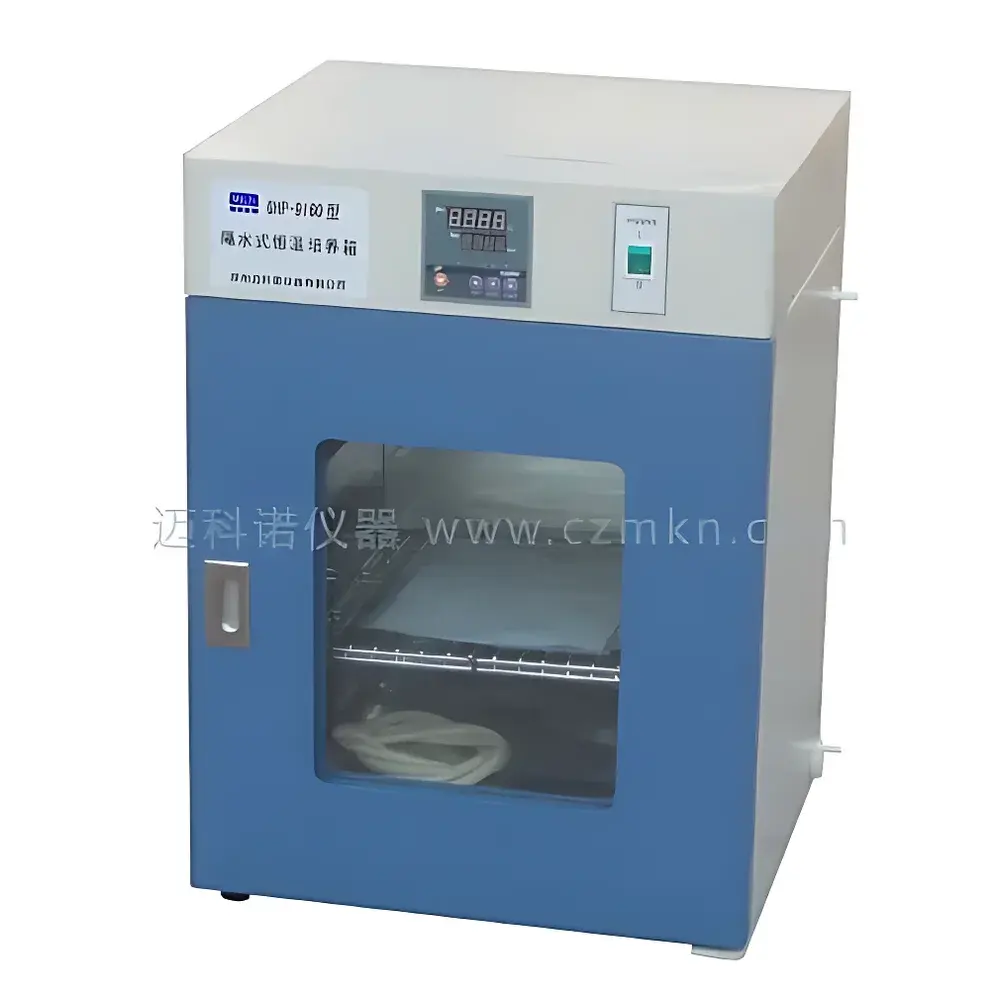
MKN GHP-80 Water-Jacketed Constant Temperature Incubator
| Brand | MKN |
|---|---|
| Origin | Jiangsu, China |
| Model | GHP-80 |
| Price | USD 780 (FOB) |
| Heating Method | External water-jacketed electric heating |
| Temperature Range | Ambient +5°C to 65°C |
| Temperature Uniformity | ±0.3°C at 37°C |
| Temperature Stability | ±0.2°C at 37°C |
| Chamber Volume | 80 L |
| Construction | Stainless steel inner chamber & welded stainless steel water jacket |
| Door | Double-layer tempered glass with silicone rubber seal |
| Control System | Microprocessor-based digital PID controller with LED display |
| Safety Features | Over-temperature alarm, low/high water-level alarm, audible/visual alert |
| Compliance | Meets GB/T 11158–2012 (Chinese National Standard for Electrically Heated Incubators), ISO 13485 design principles for medical device support equipment |
Overview
The MKN GHP-80 Water-Jacketed Constant Temperature Incubator is a precision-engineered laboratory incubation system designed for stable, uniform thermal environments essential in microbiological culture, cell propagation, enzyme activity studies, and long-term biological storage. Unlike forced-air incubators, the GHP-80 employs a passive, thermally buffered water-jacket architecture—where heated water circulates continuously around the inner chamber—delivering exceptional temperature homogeneity and minimal fluctuation (<±0.2°C at setpoint) even during door openings or ambient lab temperature shifts. This principle of thermal mass stabilization aligns with ISO 13485-aligned design practices for devices supporting in vitro diagnostic workflows and GLP-compliant microbial preservation. The unit operates within a validated range of ambient +5°C to 65°C, making it suitable for both mesophilic bacterial cultivation (e.g., E. coli at 37°C) and thermotolerant fungal or spore studies.
Key Features
- Robust double-walled construction: Inner chamber and water jacket fabricated from electropolished 304 stainless steel using argon-shielded TIG welding—resistant to corrosion, easy to sanitize, and compliant with cleanroom-compatible surface finish requirements.
- Dual-layer observation window: Tempered glass outer door with silicone rubber gasket ensures structural integrity and thermal insulation; interior visibility remains unobstructed without compromising chamber stability during routine monitoring.
- Microprocessor-based PID temperature control: Digital interface with real-time setpoint tracking, adjustable ramp rate, and auto-tuning capability—enabling reproducible thermal profiles across multiple users and shift cycles.
- Integrated safety interlocks: Simultaneous monitoring of chamber temperature deviation (>±2°C from setpoint) and water jacket level (low/high thresholds) triggers simultaneous audible buzzer and red LED alert—preventing sample desiccation or thermal shock.
- Externally mounted heating elements: Isolated from the chamber cavity to eliminate radiant hot spots, ensuring no localized overheating that could compromise sensitive cultures or reagents.
Sample Compatibility & Compliance
The GHP-80 accommodates standard Petri dishes (up to 150 mm), multi-well plates (6–96-well), culture flasks (T25–T175), and test tubes—configured on three adjustable stainless steel shelves with 60 mm vertical spacing. Its water-jacketed thermal management meets functional equivalency to ASTM E1758–22 (Standard Practice for Performance Testing of Laboratory Incubators) for temperature uniformity and recovery time. While not certified to IEC 61010-1 for hazardous locations, the unit conforms to GB/T 11158–2012 for electrical safety, thermal cut-off redundancy, and leakage current limits. It supports documentation traceability required under FDA 21 CFR Part 11 when paired with external data loggers (e.g., Vaisala viewLinc or DicksonWare), though native electronic audit trail functionality is not embedded.
Software & Data Management
The GHP-80 operates as a standalone analog-digital hybrid instrument: all control logic resides in its embedded microcontroller, with no onboard USB, Ethernet, or cloud connectivity. Temperature logging requires external Class I or II calibrated data loggers interfaced via RS-232 (optional adapter). For regulated environments, users typically integrate the incubator into facility-wide environmental monitoring systems (EMS) using 4–20 mA analog output modules (available as field-installable accessory). All alarm events are latched and displayed until manually reset—supporting basic GLP documentation needs such as daily operational checks and maintenance logs. Firmware updates are not supported; calibration verification follows manufacturer-recommended annual intervals using NIST-traceable PT100 probes.
Applications
- Microbial culture maintenance: Long-term storage of stock cultures (e.g., ATCC strains) at 4°C–37°C with minimized condensation and vibration-induced colony disruption.
- Pharmaceutical QC testing: Incubation of media fills, sterility test membranes, and endotoxin recovery assays per USP and EP 2.6.1 protocols.
- Agricultural seed germination studies: Controlled hydration and thermal cycling experiments requiring ±0.3°C spatial uniformity across 80 L volume.
- Biochemical assay incubation: Enzyme kinetics (e.g., ALP, LDH) where thermal drift >0.1°C/min invalidates Michaelis-Menten parameter derivation.
- Regulated bioburden monitoring: Environmental isolates cultivation in ISO 14644-1 Class 7 cleanrooms where air turbulence from fan-driven units must be avoided.
FAQ
What is the difference between a water-jacketed and an air-jacketed incubator?
Water-jacketed incubators use a surrounding layer of heated water to maintain chamber temperature, offering superior thermal inertia and stability—especially critical during power interruptions or frequent access. Air-jacketed units rely on convection heaters and fans, enabling faster warm-up but greater susceptibility to ambient fluctuations.
Can the GHP-80 be used for CO₂-sensitive applications?
No. The GHP-80 lacks CO₂ regulation, humidification, or gas-tight sealing. It is strictly a temperature-controlled environment—not suitable for mammalian cell culture requiring pH buffering via CO₂.
Is validation support documentation provided?
MKN supplies a Factory Acceptance Test (FAT) report including as-delivered temperature uniformity mapping (at 37°C), alarm response verification, and electrical safety certification per GB/T 11158–2012. IQ/OQ protocols are user-responsible per ISO/IEC 17025 guidelines.
What maintenance is required?
Biannual inspection of water jacket fill level and antifreeze concentration (if used in cold labs); quarterly cleaning of condensate drain port; annual verification of PID controller accuracy using external reference thermometer.
Does the unit comply with FDA 21 CFR Part 11?
The base GHP-80 does not include electronic signature, audit trail, or role-based access control. Full Part 11 compliance requires integration with validated third-party EMS platforms and procedural controls documented in site-specific SOPs.
Related Products



