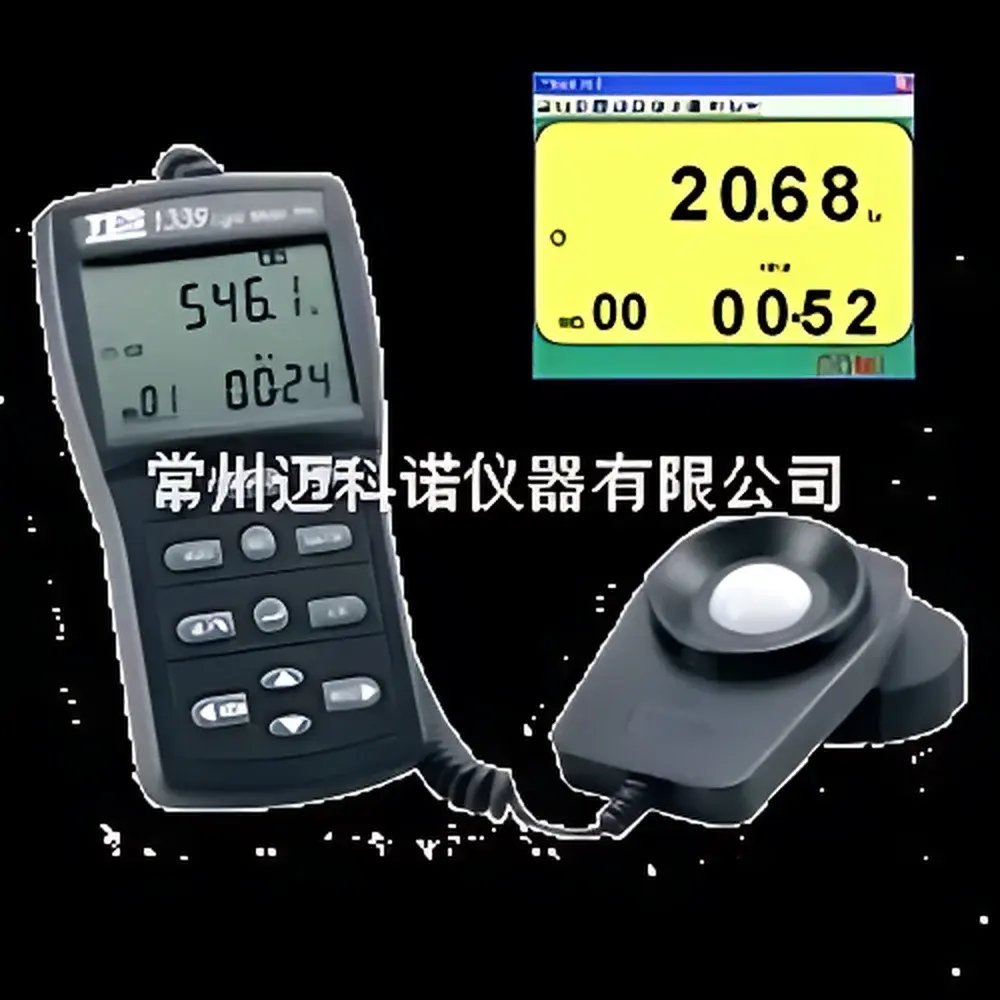
MKN TES-1339R Memory-Enabled Digital Illuminance Meter with RS232 Interface
| Brand | MKN |
|---|---|
| Origin | Zhejiang, China |
| Model | TES-1339R Memory-Enabled Digital Illuminance Meter (RS232) |
| Sensor Type | Silicon Photodiode |
| Display | 4-digit dual LCD |
| Measurement Range | 0.01–999900 Lux (5 auto-ranging scales) |
| Resolution | 0.01 Lux / 0.001 fc |
| Accuracy | ±3% of reading ±5 digits (calibrated against 2856 K standard incandescent source) |
| Temperature coefficient | ±0.1%/°C |
| Sampling rate | ~5 readings/sec |
| Manual memory capacity | 99 data points |
| Auto-logging capacity | 40,000 records |
| Operating environment | 0–50°C, <80% RH |
| Storage environment | −10–60°C, <70% RH |
| Power | 6 × AAA batteries (~100 h life) |
| Sensor cable length | 150 cm |
| Sensor dimensions | 100 × 60 × 29 mm |
| Main unit dimensions | 150 × 72 × 35 mm |
| Weight | ~320 g |
| Compliance | CNS 5119 Class II |
| Interface | RS232 |
Overview
The MKN TES-1339R is a precision-engineered digital illuminance meter designed for traceable, repeatable photometric measurements in laboratory, industrial, and facility management environments. It operates on the principle of silicon photodiode-based photometric detection, calibrated to the CIE standard photopic luminosity function V(λ), with spectral mismatch error (f′(λ)) rigorously maintained at ≤6% — meeting the stringent requirements of CNS 5119 Class II photometric instrumentation. The instrument delivers high-resolution illumination quantification across an exceptionally wide dynamic range: from 0.01 Lux to 999,900 Lux (or 0.001–92,927 fc), implemented via five-step automatic ranging to ensure optimal signal-to-noise ratio at every measurement level. Its integral cosine-corrected sensor head enables accurate angular response for diffuse and directional light sources alike, while real-time sampling at approximately 5 Hz supports transient light evaluation and stability assessment.
Key Features
- 4-digit dual-line LCD display showing simultaneous Lux and fc values or measured value plus status indicators (e.g., HOLD, AUTO, MEMORY)
- True RMS-integrated illuminance measurement with built-in photopic correction and temperature compensation (±0.1%/°C)
- Manual memory storage for up to 99 readings, directly accessible and reviewable on-device without external software
- High-capacity automatic data logging (40,000 records) with time-stamped entries, supporting long-term ambient light monitoring
- Dedicated functions including peak hold, relative deviation (%Δ) and offset (Δ) modes, stray light rejection (STRAY + LIGHT mode), timed measurement lock, and point averaging over user-defined intervals
- Configurable comparator function for pass/fail threshold evaluation against preset illuminance limits
- Auto-power-off after 15 minutes of inactivity to conserve battery life; powered by six standard AAA cells (approx. 100 h continuous operation)
- RS232 serial interface compliant with EIA/TIA-232 standards, enabling bidirectional communication with PCs for firmware updates, configuration, and bulk data export
Sample Compatibility & Compliance
The TES-1339R is optimized for measuring steady-state and quasi-stationary visible-light sources conforming to ISO/CIE spectral definitions, including incandescent, halogen, fluorescent, LED, and OLED lighting systems. Its silicon photodiode sensor features a cosine-corrected diffuser ensuring <3% angular response deviation up to ±75° incidence — critical for compliance with IESNA LM-79 and EN 13032-1 photometric testing protocols. The instrument satisfies CNS 5119 Class II accuracy classification, aligning with international metrological expectations for general-purpose illuminance verification in workplaces, educational facilities, healthcare settings, and museum conservation zones. While not certified to GLP/GMP Annex 11 or FDA 21 CFR Part 11 out-of-the-box, its RS232 interface supports integration into validated systems where audit-trail generation and electronic record integrity are managed at the host-software layer.
Software & Data Management
Included CD-ROM software provides native Windows-compatible tools for data visualization, statistical analysis (mean, min/max, SD), and report generation in PDF/CSV formats. The application supports full retrieval of both manual and auto-logged datasets, timestamp synchronization, and configurable export templates aligned with ISO/IEC 17025 documentation requirements. Firmware updates and parameter reconfiguration (e.g., sampling interval, alarm thresholds, unit preference) are performed via secure command-line or GUI-driven RS232 session. All logged data retain embedded metadata including date/time stamps, sensor ID (if assigned), and environmental context flags — facilitating traceability in quality control audits.
Applications
- Workplace lighting validation per OSHA 1910.303 and EN 12464-1 minimum illuminance requirements
- LED product development and binning verification under controlled photometric test conditions
- Architectural daylight harvesting system commissioning and seasonal performance trending
- Hospital operating room and clinical examination area luminance compliance checks
- Museum and archival storage light exposure monitoring to prevent photochemical degradation of artifacts
- Educational physics labs for photometry experiments involving inverse-square law verification and spectral power distribution correlation
- Facility energy audits assessing lighting retrofit ROI through baseline vs. post-installation lux mapping
FAQ
What calibration standard is used for factory calibration?
The TES-1339R is calibrated against a NIST-traceable 2856 K blackbody radiator (standard incandescent source) in accordance with CIE S 007/E:2020 and CNS 5119.
Does the instrument support external trigger or synchronization signals?
No — the TES-1339R operates autonomously and does not accept TTL or pulse-synchronization inputs; timing control is internal only.
Can the RS232 interface be used with modern laptops lacking serial ports?
Yes — compatibility is maintained using certified USB-to-RS232 adapters with FTDI or CH340 chipset drivers; virtual COM port assignment is required in OS settings.
Is the sensor head detachable or replaceable?
The sensor is permanently integrated with a fixed 150 cm shielded coaxial cable; replacement requires factory service and recalibration.
How is stray light compensation implemented in STRAY + LIGHT mode?
This mode performs a dual-phase measurement cycle: first capturing ambient background, then total incident light, and computing net illuminance by subtraction — minimizing interference from non-target optical paths.