
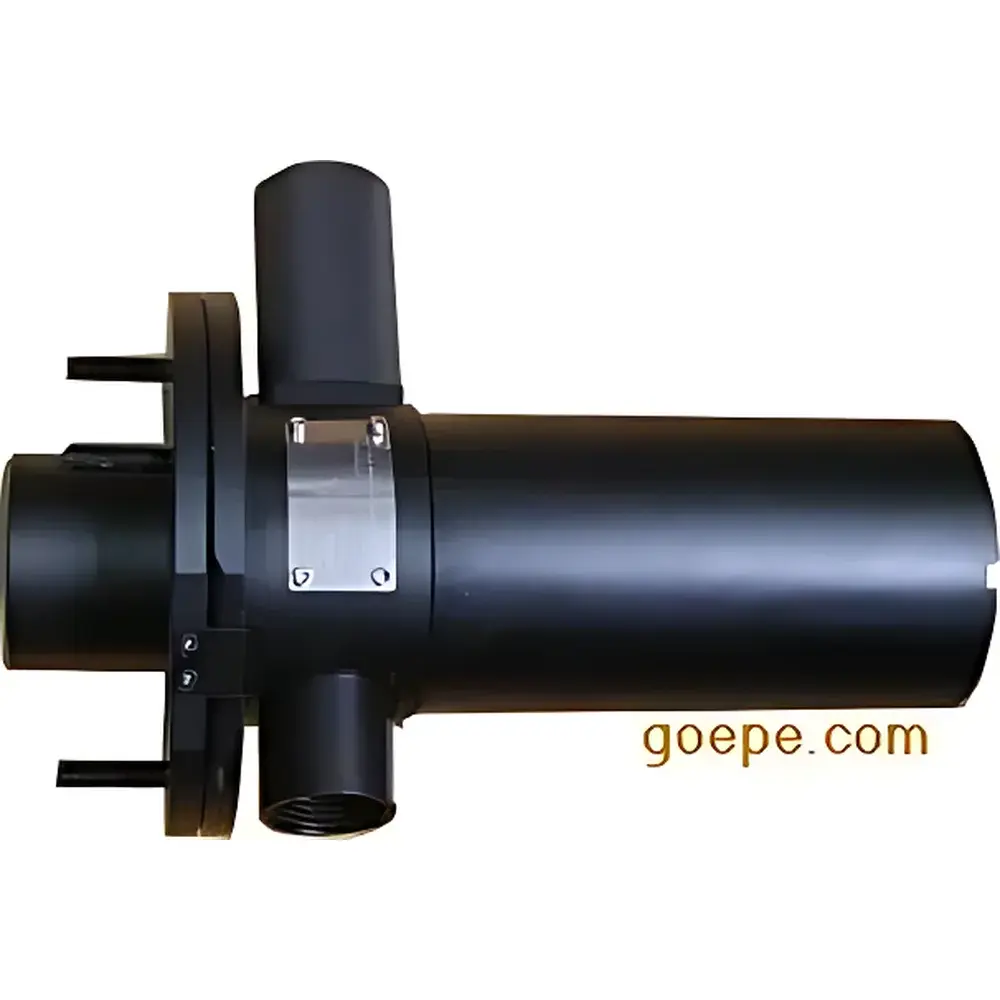
ML3600 Direct-Reading Smoke & Dust Concentration Monitor
| Origin | Beijing, China |
|---|---|
| Manufacturer Type | Authorized Distributor |
| Origin Category | Domestic (PRC) |
| Model | ML3600 |
| Price | USD 3,950 (FOB) |
| Measurement Principle | Laser Backscatter Photometry |
| Explosion-Proof Rating | Ex d IIB T4 Gb |
| Measurement Range | 0.01–200 mg/m³ and 0–10 g/m³ (dual-range selectable) |
| Resolution | 0.01 mg/m³ |
| Accuracy | ±1% of full scale |
| Relative Error | < ±2% |
| Operating Temperature | −40 °C to +65 °C |
| Humidity Range | 0–100% RH (non-condensing) |
| Max. Flue Gas Temp. | 300 °C (high-temp option available) |
| Output Signal | 4–20 mA (max. load 500 Ω) |
| Power Supply | DC 16–24 V ±10% |
| Power Consumption | ≤3 W |
| Dimensions | 160 × 160 × 250 mm |
| Weight | 4 kg |
| Flue Diameter Compatibility | ≥2000 mm (standard) |
| Sensitivity Threshold | 2 mg/m³ |
| Installation | Single-ended, tool-free mounting |
Overview
The ML3600 Direct-Reading Smoke & Dust Concentration Monitor is an industrial-grade, in-situ optical analyzer engineered for real-time, continuous measurement of particulate mass concentration in hot, humid, and turbulent flue gas streams. It operates on the principle of laser backscatter photometry — a well-established, physics-based method compliant with ISO 20028:2021 (Air quality — Performance criteria for instruments measuring particulate matter) and referenced in EPA Method 9 and EN 15267-3 for continuous emission monitoring systems (CEMS). Unlike transmissometers or beta attenuation monitors, the ML3600 employs a single-ended optical architecture: the laser emitter and photodetector are co-located within one probe housing, eliminating alignment sensitivity to mechanical vibration, thermal lensing, or refractive index gradients caused by non-uniform temperature profiles across the stack. This design ensures stable baseline performance in demanding environments such as coal-fired power plants, sintering belts in steel mills, and kiln exhausts in cement production — where conventional dual-beam systems often suffer from signal drift or false alarms.
Key Features
- Single-ended, alignment-free installation: No optical path calibration required; field deployment completed in under 10 minutes using only one screwdriver.
- Intrinsically robust explosion-proof construction (Ex d IIB T4 Gb), certified per IEC 60079-1 and GB 3836.1–2021 for use in Zone 1 hazardous areas.
- Dual-range measurement capability: Automatically switchable between high-sensitivity mode (0.01–200 mg/m³) and high-concentration mode (0–10 g/m³), supporting both regulatory compliance monitoring and process control applications.
- Low-power architecture (<3 W typical consumption) enables integration into existing CEMS cabinets without additional cooling or UPS load.
- Wide environmental tolerance: Rated for continuous operation at ambient temperatures from −40 °C to +65 °C and 0–100% RH — validated per IEC 60068-2-30 for damp heat cycling.
- Standard 4–20 mA analog output with galvanic isolation, compatible with PLCs, DCS, and SCADA systems; supports HART 7.5 protocol upon request.
Sample Compatibility & Compliance
The ML3600 is validated for use in flue gases containing fly ash, limestone dust, metal oxides, and other non-volatile suspended particulates with aerodynamic diameters >0.5 µm. It is not intended for submicron aerosols (e.g., sulfate/nitrate condensates) or sticky, hygroscopic, or highly reflective particles (e.g., fresh carbon black) without prior site-specific validation. The instrument meets CE marking requirements under the EU Measuring Instruments Directive (MID 2014/32/EU) for Class 1 dust monitors and complies with Chinese national standard HJ/T 76–2017 (Technical Specification for Continuous Emission Monitoring Systems for Flue Gas Pollutants from Thermal Power Plants). Its measurement uncertainty profile satisfies QA/QC requirements for Tier 2 CEMS under China’s “Technical Guidelines for CEMS Data Quality Control” (HJ 75–2017).
Software & Data Management
While the ML3600 operates autonomously as a stand-alone transmitter, it integrates seamlessly into centralized CEMS platforms via Modbus RTU (RS-485) or optional Ethernet/IP interface. Local configuration and diagnostics are accessible through a built-in OLED display and tactile keypad — no external PC required. All calibration events, zero/span checks, fault logs, and parameter changes are timestamped and stored onboard with non-volatile memory retention (>10 years). Audit trails comply with GLP/GMP principles and support 21 CFR Part 11 readiness when deployed with validated third-party data acquisition software. Firmware updates are performed via microSD card or secure HTTPS push.
Applications
- Regulatory CEMS for coal, biomass, and waste-to-energy boilers — meeting hourly average reporting requirements under local environmental protection bureaus (e.g., MEP Order No. 39).
- Real-time feedback control of electrostatic precipitators (ESPs), fabric filters, and wet scrubbers in iron & steel and non-ferrous metallurgy.
- Process optimization in clinker coolers, raw mill exhausts, and cement silo vents.
- Stack testing support during performance verification (PV) and relative accuracy test audits (RATA).
- Multi-point network deployment: Up to 16 units can be daisy-chained to a single data concentrator, enabling cross-sectional profiling in large-diameter stacks (up to 15 m).
FAQ
What particle size range does the ML3600 respond to?
The instrument responds primarily to particles with aerodynamic diameters ≥0.5 µm. Its Mie scattering response curve is calibrated against NIST-traceable PSL standards; effective cut-off is influenced by flue gas velocity and probe insertion depth.
Can it operate inside a 300 °C flue without cooling?
Yes — the high-temperature variant (option HT-300) includes a water-cooled probe sheath and ceramic optical window, rated for continuous exposure up to 300 °C. Standard units require flue gas cooling to <80 °C.
Is factory calibration traceable to national standards?
Yes — each unit ships with a calibration certificate traceable to CNAS-accredited laboratories (ISO/IEC 17025), including gravimetric reference values per ISO 11171 and multi-point linearity verification.
How is zero calibration performed in-situ?
Zero is established using clean, particle-free purge air (filtered to HEPA H14) injected directly into the optical path via integrated solenoid valve; no manual disassembly required.
Does the device support remote firmware updates and diagnostics?
Yes — over-the-air (OTA) updates and health monitoring are supported via optional cellular or industrial Wi-Fi gateway modules, with TLS 1.2 encryption and role-based access control.







