
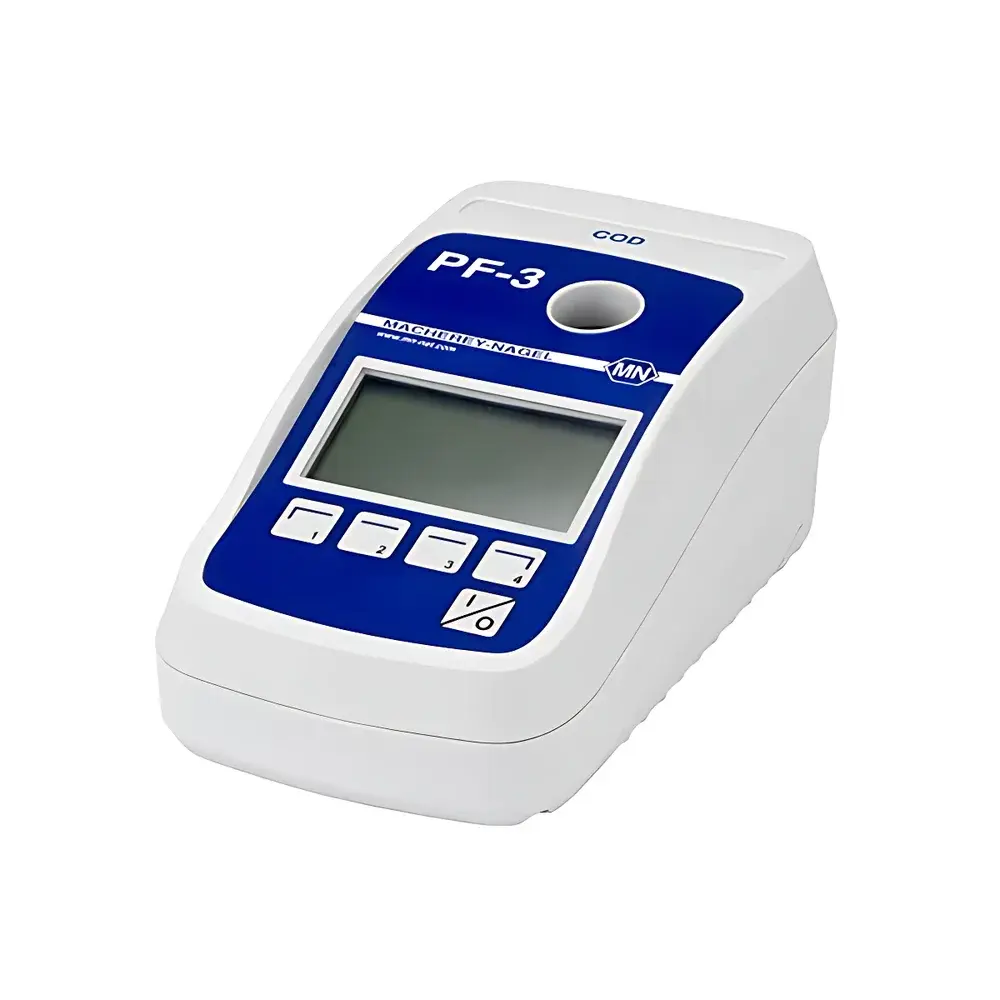
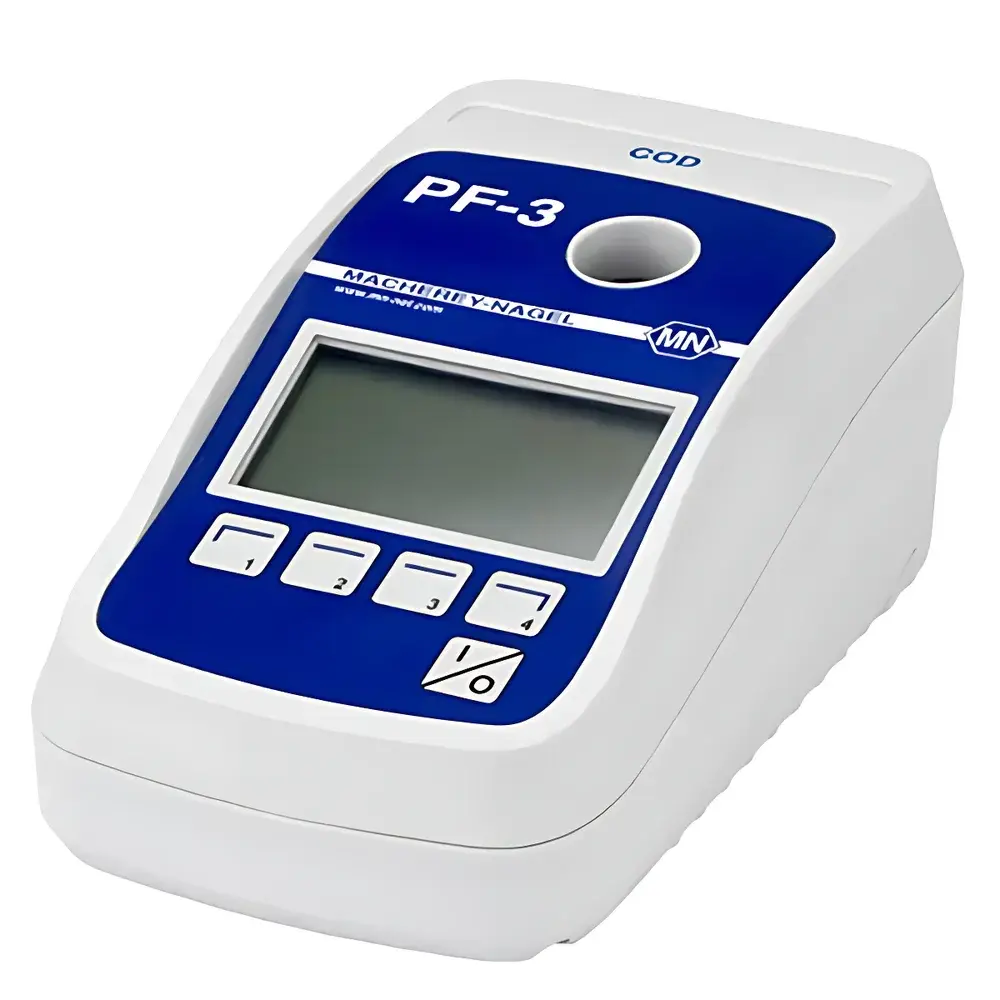
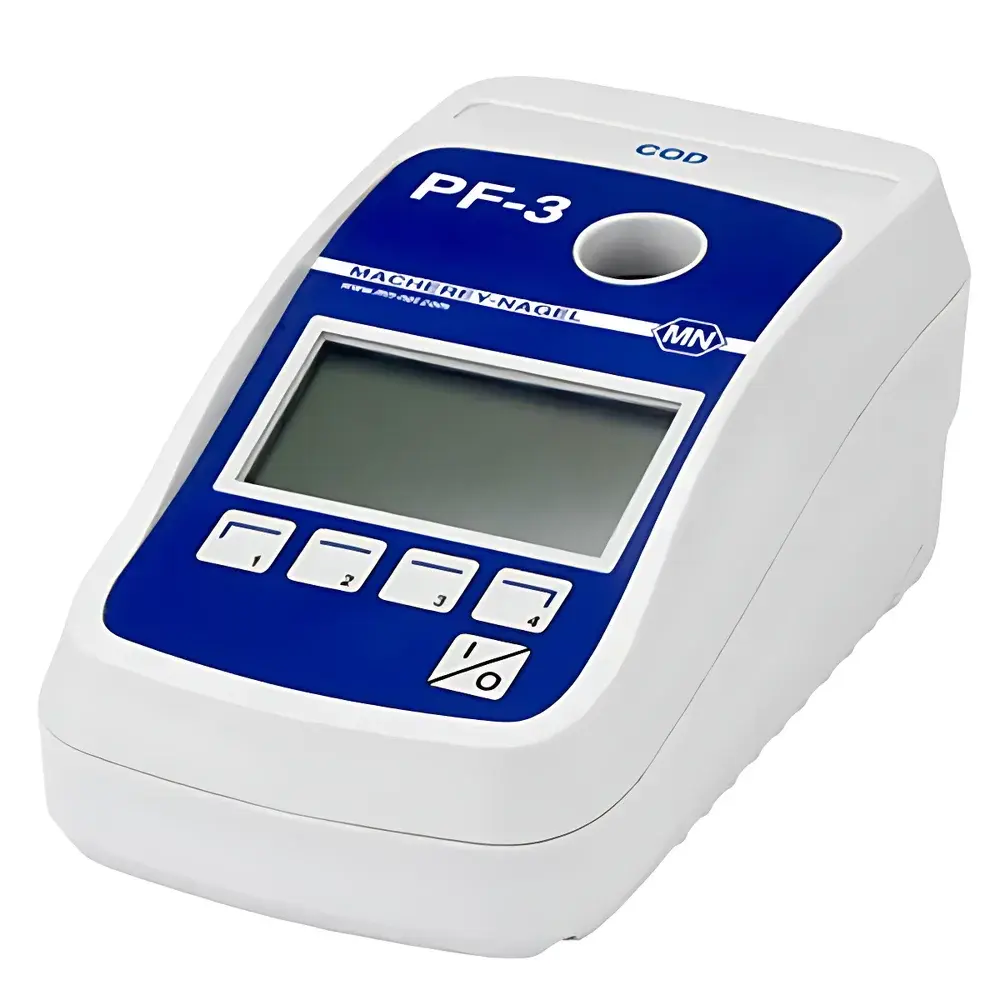
MN Macherey-Nagel PF-3 919342 Portable COD Analyzer
| Brand | Macherey-Nagel (Germany) |
|---|---|
| Origin | Germany |
| Model | PF-3 919342 |
| Instrument Type | Portable |
| Measurement Principle | UV Absorption Spectrophotometry |
| Wavelength | 365 nm |
| Measurement Range | 2–60,000 mg/L COD |
| Repeatability | High precision |
| Detection Limit | Low (optimized for high-sensitivity UV absorption) |
| Measurement Time | <5 seconds per sample |
| Sample Throughput | Single-sample mode |
| Optical System | LED-based photometer with interference filters (365/450/595 nm) |
| Wavelength Accuracy | ±2 nm |
| Bandwidth (FWHM) | 10–12 nm |
| Detector | Silicon photodiode |
| Cuvette Format | 16 mm round tubes |
| Data Storage | 50 measurement records |
| Display | Graphical LCD (64 × 128 pixels) |
| Operating Temperature | 10–40 °C |
| Relative Humidity | ≤80% RH (non-condensing) |
| Power Supply | 3×AA batteries (alkaline or rechargeable), USB bus power, optional internal rechargeable battery |
| Enclosure Rating | IP68 |
| Dimensions | 170 × 95 × 68 mm |
| Weight | 0.5 kg |
| Compliance | CE-marked |
| Warranty | 12 months |
Overview
The MN Macherey-Nagel PF-3 919342 Portable COD Analyzer is a field-deployable, LED-based UV absorption spectrophotometer engineered for rapid, on-site determination of Chemical Oxygen Demand (COD) in wastewater and surface water samples. Unlike conventional dichromate reflux methods requiring hazardous reagents and extended digestion times, the PF-3 employs direct ultraviolet absorption at 365 nm—a wavelength strongly correlated with organic carbon content in aqueous matrices. This principle enables non-destructive, reagent-free quantification across an exceptionally broad dynamic range (2–60,000 mg/L COD), making it suitable for monitoring industrial effluents, municipal sewage influents/effluents, and pretreatment validation in regulated facilities. Its compact architecture—designed to ISO 9001-compliant manufacturing standards in Düren, Germany—ensures metrological stability under variable environmental conditions while maintaining traceability to NIST-traceable UV-Vis reference standards.
Key Features
- True portable operation: Weighing only 0.5 kg with IP68-rated enclosure—fully dust-tight and submersible up to 1.5 m for 30 minutes—enabling reliable use in rain, humid industrial zones, or near open water bodies.
- Dual-power flexibility: Operates from standard AA batteries (alkaline or NiMH), USB 5 V bus power, or an optional internal Li-ion rechargeable battery—eliminating dependency on mains infrastructure during field surveys or emergency response.
- Optimized optical path: Integrated 365 nm high-intensity LED source paired with narrow-band interference filters (±2 nm accuracy, 10–12 nm FWHM) minimizes spectral interference from turbidity, nitrate, or humic substances—critical for high-accuracy COD estimation in complex wastewater matrices.
- Reagent-free methodology: Eliminates need for sulfuric acid, silver sulfate, mercury sulfate, or potassium dichromate—reducing hazardous waste generation, operator exposure risk, and disposal compliance burden per EPA Method 410.4 and ISO 6060 guidelines.
- Intuitive human interface: Graphical monochrome LCD (64 × 128 px) displays concentration value with unit, timestamp, and measurement status; menu navigation via sealed membrane keypad ensures durability in wet or dusty environments.
Sample Compatibility & Compliance
The PF-3 919342 is validated for use with standard 16 mm round glass or quartz cuvettes compliant with DIN EN ISO 3696 Grade 3 water specifications. It accommodates undiluted samples within its full 2–60,000 mg/L range and supports manual dilution protocols for out-of-range specimens. The instrument meets CE marking requirements under Directive 2014/30/EU (EMC) and 2014/35/EU (LVD). While not intended for clinical diagnostics (per manufacturer declaration), its performance aligns with ASTM D1253-22 (Standard Test Method for Total Organic Carbon in Water) and supports GLP-aligned data integrity when used with documented SOPs. Firmware updates preserve audit trail integrity and are distributed via encrypted download channels compliant with ISO/IEC 17025:2017 clause 7.7.1.
Software & Data Management
Data export and firmware updates are performed via mini-USB interface using MN’s proprietary VISOCOLOR ECO PC Suite (Windows-compatible, free download). Each stored record includes measured absorbance, calculated COD value, date/time stamp, user ID (if configured), and instrument serial number—supporting basic 21 CFR Part 11 readiness through optional password-protected user accounts and immutable local storage. Up to 50 measurements are retained onboard with automatic overwrite protection for critical datasets. Export formats include CSV and PDF reports compatible with LIMS integration via third-party middleware.
Applications
- Routine monitoring of industrial discharge points (e.g., food processing, textile dyeing, chemical synthesis) where rapid feedback informs real-time process control decisions.
- Pre-screening prior to laboratory-based reference analysis (e.g., APHA 5220D), reducing lab workload and accelerating regulatory reporting cycles.
- Field verification of biological treatment efficiency in activated sludge or MBR systems by tracking influent/effluent COD gradients.
- Educational use in environmental engineering laboratories for teaching UV-Vis principles, calibration curve development, and method validation protocols.
- Emergency spill assessment—providing quantitative COD estimates within seconds without sample preservation or transport delays.
FAQ
Is the PF-3 919342 suitable for drinking water analysis?
No—it is optimized for wastewater and polluted surface waters with elevated organic loadings; drinking water typically falls below its lower detection limit (2 mg/L) and requires alternative methods such as TOC or permanganate COD.
Does the instrument require calibration with certified COD standards?
Yes—calibration must be performed using traceable COD reference standards (e.g., potassium hydrogen phthalate solutions) prepared per ISO 6060 Annex A; factory calibration is provided but user verification is required before critical measurements.
Can the PF-3 interface with SCADA or PLC systems?
Not natively—the device lacks analog output or Modbus RTU; however, exported CSV files can be ingested into industrial data historians via scheduled script-based ingestion workflows.
What is the expected lifetime of the LED light source?
The 365 nm UV LED is rated for ≥10,000 hours of operation under typical intermittent use patterns, with no user-serviceable replacement—units are returned to MN service centers for recalibration and component refresh.
How does temperature affect measurement accuracy?
Internal thermal compensation corrects for ambient drift between 10–40 °C; measurements outside this range require pre-equilibration of samples to instrument temperature to maintain stated repeatability specifications.







