
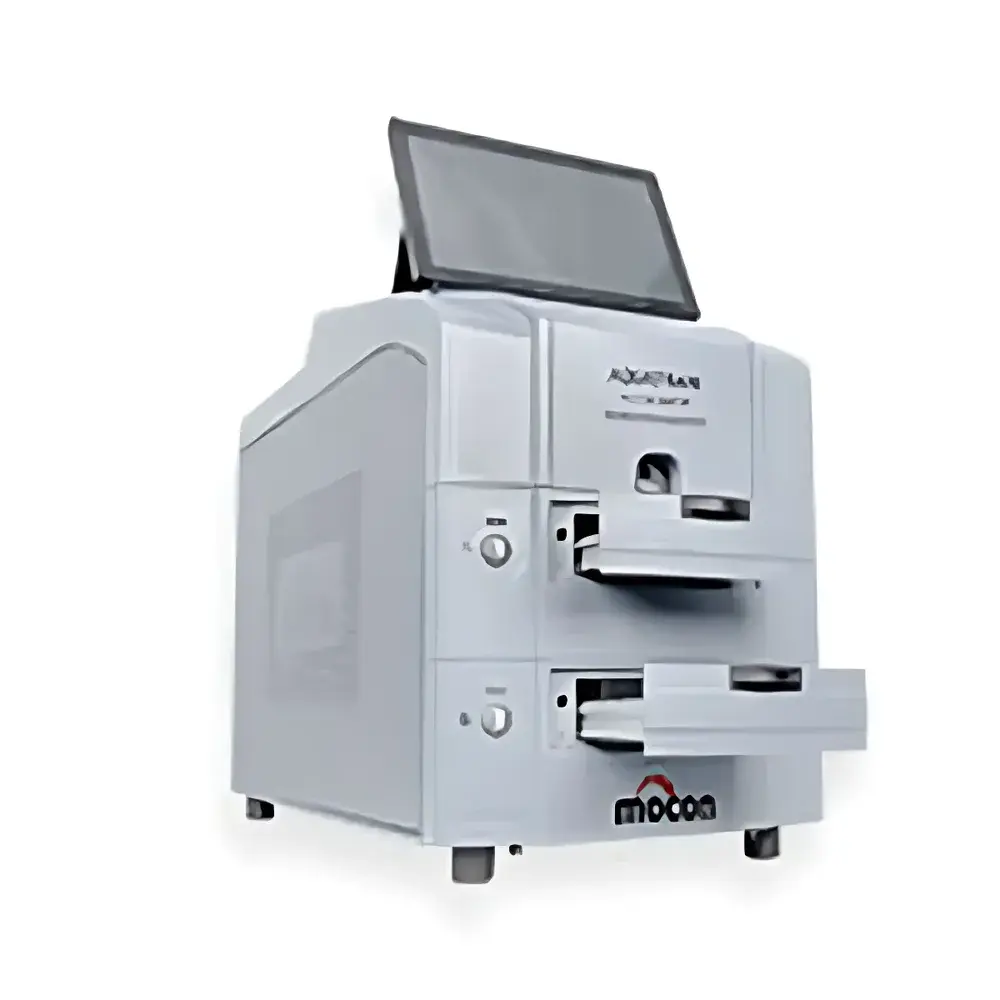
MOCON AQUATRAN 3/38 H Water Vapor Transmission Rate (WVTR) Analyzer
| Brand | MOCON |
|---|---|
| Origin | Germany |
| Model | AQUATRAN 3/38 H |
| Detection Limit | 0.05 g/(m²·day) |
| Temperature Control Range | 20–40 °C ± 0.2 °C |
| RH Control | 50–90% RH ± 3% RH & 100% RH |
| Test Area (Standard) | 50 cm² |
| Unshielded WVTR Range | 0.05–100 g/(m²·day) |
| Shielded WVTR Range | 0.5–1000 g/(m²·day) |
| Resolution | 0.02 g/(m²·day) |
| Repeatability | ±0.05 g/(m²·day) or ±2%, whichever is greater |
| Dimensions | 39.4 × 30.4 × 58.0 cm |
| Weight | 43.1 kg |
| Power | 100–240 VAC, 50/60 Hz, ≤700 VA |
Overview
The MOCON AQUATRAN 3/38 H Water Vapor Transmission Rate (WVTR) Analyzer is a high-throughput, gravimetric-infrared hybrid instrument engineered for precise and reproducible measurement of water vapor permeation through packaging films and barrier materials. It operates on the principle of modulated infrared (MIR) detection—where water vapor diffusing through a test specimen is carried by a dry carrier gas (typically nitrogen) into a long-life, temperature-stabilized MIR sensor. This optical detection method eliminates reliance on traditional coulometric or electrolytic sensors, delivering superior stability, extended calibration intervals, and immunity to interference from ambient humidity fluctuations. Designed specifically for compliance with ASTM F1249–22 (“Standard Test Method for Water Vapor Transmission Rate Through Plastic Film and Sheeting Using a Modulated Infrared Sensor”), the AQUATRAN 3/38 H supports both high- and low-barrier material characterization across pharmaceutical blister packaging, flexible food pouches, medical device pouches, and advanced battery encapsulation films.
Key Features
- Four independent test chambers enabling concurrent analysis of up to four specimens—doubling laboratory throughput without compromising data integrity.
- Modular dual-membrane horizontal test cell design: fully removable for rapid sample loading, cleaning, and cross-contamination prevention; accommodates standard 4″ × 4″ (10.2 × 10.2 cm) films up to 20 mil (508 µm) thick.
- TruSeal nitrogen curtain technology: actively seals the perimeter of the test cell to suppress edge diffusion artifacts and eliminate the need for frequent zero-point calibration—reducing total test cycle time by up to 30%.
- Automated environmental control: integrated PID-regulated heating, cooling, and humidification systems maintain temperature within ±0.2 °C and relative humidity at ±3% RH across 50–90% RH and 100% RH setpoints.
- User-configurable test protocols with one-touch initiation, real-time graphical overlay of measured WVTR against user-defined specification limits, and automatic pass/fail flagging per ASTM F1249 acceptance criteria.
- High-resolution MIR sensor with 0.02 g/(m²·day) detection capability and repeatability of ±0.05 g/(m²·day) or ±2% (whichever is greater), validated over a dynamic range spanning 0.05–1000 g/(m²·day).
Sample Compatibility & Compliance
The AQUATRAN 3/38 H accepts rigid and flexible substrates—including PET, ALU, SiOx-coated PET, PVDC-laminates, EVOH blends, metallized foils, and emerging bio-based barrier films. Two test area configurations are supported: unshielded mode (50 cm² nominal area) for low-to-medium barrier materials (0.05–100 g/(m²·day)), and shielded mode (5 cm² effective area) for ultra-high-barrier applications such as OLED encapsulation or sterile medical packaging (0.5–1000 g/(m²·day)). All hardware and firmware comply with ISO/IEC 17025 requirements for testing laboratories, and system validation documentation supports GLP and GMP audit readiness. Full traceability—including environmental logs, sensor diagnostics, and raw signal timestamps—is retained in accordance with FDA 21 CFR Part 11-compliant electronic record architecture.
Software & Data Management
Control and analysis are managed via MOCON’s proprietary AQUATRAN Software Suite (v5.2+), a Windows-based application featuring role-based user access, configurable audit trails, and automated report generation in PDF and CSV formats. The software implements full 21 CFR Part 11 compliance—including electronic signatures, operator authentication, and immutable change logs—with optional integration into LIMS environments via OPC UA or RESTful API. Real-time trending graphs display cumulative transmission curves, derivative rate analysis, and statistical process control (SPC) charts aligned to internal QC thresholds. All raw sensor voltage outputs, temperature/humidity profiles, and flow-rate telemetry are archived with metadata tags (operator ID, batch number, material grade, test duration) to support root-cause investigations and regulatory submissions.
Applications
- Quality assurance of pharmaceutical blister lidding foils and cold-form foil laminates per USP and Ph. Eur. 5.3.
- Development and qualification of sustainable mono-material pouches for shelf-stable food products.
- Barrier performance benchmarking of thin-film encapsulation layers in flexible electronics manufacturing.
- Accelerated aging studies correlating WVTR drift with accelerated storage conditions (e.g., 40 °C / 75% RH).
- Supplier qualification and incoming inspection of barrier-coated substrates used in diagnostic test cartridges and implantable device packaging.
FAQ
What standards does the AQUATRAN 3/38 H comply with?
It is fully compliant with ASTM F1249–22 and supports method adaptation for ISO 15106-3, DIN 53122-2, and JIS Z 0217.
Can the instrument measure oxygen transmission rate (OTR) as well?
No—the AQUATRAN 3/38 H is dedicated exclusively to water vapor transmission analysis. For OTR, MOCON’s OX-TRAN series is recommended.
Is remote monitoring or network connectivity supported?
Yes—Ethernet-enabled operation allows secure remote access via VPN, and optional MOCON Cloud Sync enables encrypted offsite backup of method files and historical datasets.
How often does the MIR sensor require recalibration?
Under routine use and proper maintenance, the factory-calibrated MIR sensor maintains accuracy for ≥12 months; annual verification using NIST-traceable reference films is recommended.
Does the system support custom test atmospheres beyond nitrogen?
The carrier gas is optimized for ultra-dry nitrogen (dew point ≤ –70 °C); alternative gases (e.g., argon) may be used but require revalidation of sensitivity and linearity per ASTM F1249 Annex A3.





