
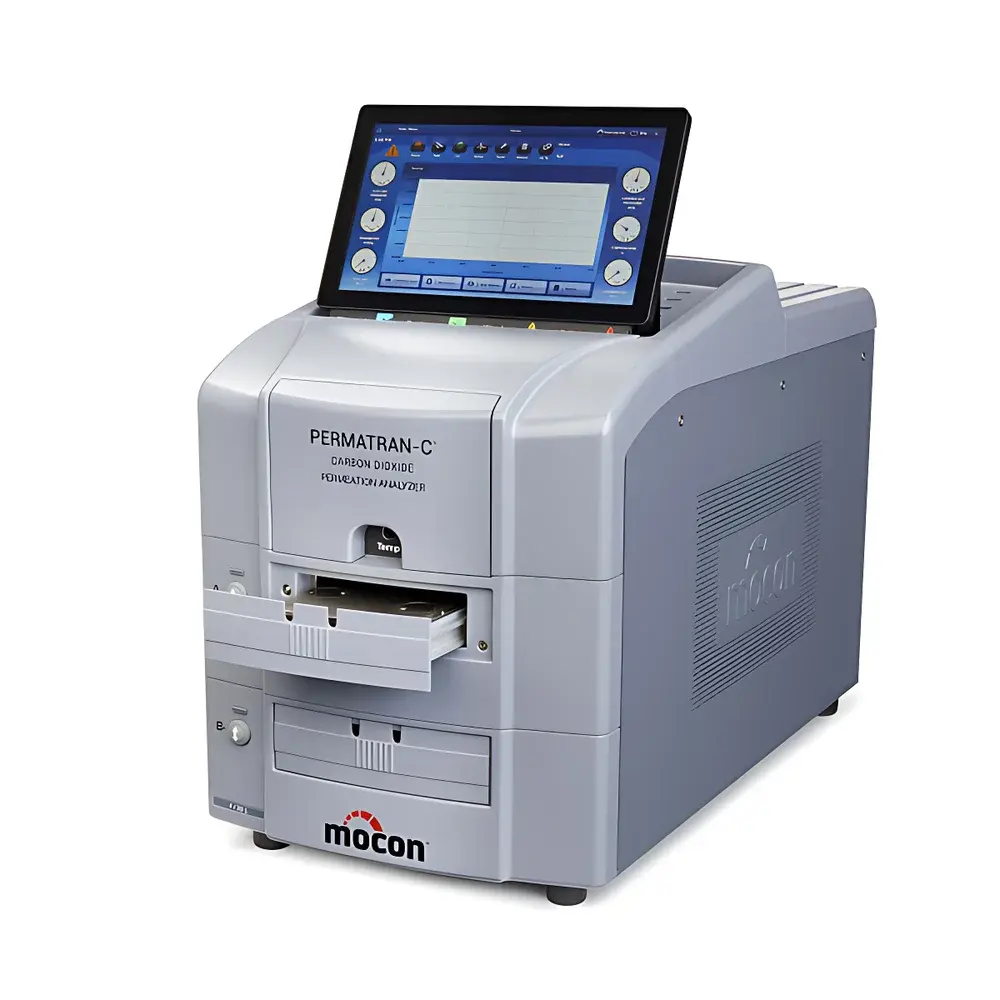
MOCON PERMATRAN-C® 4/30 Carbon Dioxide Permeability Analyzer
| Brand | MOCON |
|---|---|
| Origin | USA |
| Model | PERMATRAN-C® 4/30 |
| Detection Limit | 0.5 cm³/(m²·day) |
| Measurement Principle | Modulated Infrared Spectroscopy |
| Compliance | ASTM F2476 |
| Test Chamber | Dual independent horizontal chambers with interchangeable fixtures |
| Temperature Control | Automated, ±0.1 °C stability |
| Flow Control | Fully automated mass flow regulation |
| Throughput | High—real-time CO₂ concentration monitoring enables rapid equilibrium detection |
| Sample Types | Films, laminates, pouches, trays, bottles, and rigid containers |
| Range | 0.5–8,000 cm³/(m²·day), extendable to ~72,000 cm³/(m²·day) via area reduction factor (×9) |
Overview
The MOCON PERMATRAN-C® 4/30 Carbon Dioxide Permeability Analyzer is a precision-engineered instrument designed for quantitative measurement of carbon dioxide transmission rate (CO₂TR) through packaging materials and barrier films. It operates on the principle of modulated infrared (IR) spectroscopy—a proprietary, non-destructive optical detection method that continuously monitors CO₂ partial pressure in real time across a defined test area under controlled temperature and carrier gas flow conditions. Unlike traditional manometric or Zahm-Nagel methods—which rely on indirect pressure buildup or colorimetric endpoint detection—the PERMATRAN-C 4/30 delivers direct, continuous, and trace-level CO₂ quantification with inherent high signal-to-noise ratio and minimal baseline drift. Its dual-chamber architecture supports parallel testing of dissimilar samples or replicate runs under identical environmental parameters, enhancing statistical rigor and laboratory throughput. The system is validated per ASTM F2476, the industry-standard test method for CO₂ permeability of plastic film and sheeting used in food and pharmaceutical packaging.
Key Features
- Dual independent horizontal test chambers with quick-release, tool-free fixture interchangeability—enabling seamless transition between flat film, formed tray, bottle, and pouch configurations.
- Patented MOCON modulated infrared sensor with sub-ppm CO₂ detection sensitivity and a certified lower detection limit of 0.5 cm³/(m²·day), ensuring reliable quantification even for ultra-high-barrier materials (e.g., SiOₓ-coated PET, AlOₓ-laminates).
- TruSeal nitrogen curtain sealing technology eliminates the need for absolute zero-point calibration, reducing preconditioning time and mitigating edge leakage artifacts common in conventional diffusion-cell designs.
- Automated environmental control: integrated PID-regulated temperature module (range: 5–45 °C, stability ±0.1 °C) and precision mass flow controllers for both carrier (N₂) and sweep (CO₂) gases—ensuring reproducible test conditions compliant with GLP and ISO/IEC 17025 requirements.
- Intuitive 10.1″ capacitive touchscreen interface with preloaded, editable test methods—including user-defined ramp profiles, multi-step equilibration protocols, and pass/fail criteria based on USP or internal QC specifications.
Sample Compatibility & Compliance
The PERMATRAN-C 4/30 accommodates a broad spectrum of sample geometries without modification: standard flat films (up to 100 cm²), thermoformed trays, aluminum-lidded cups, PET bottles (up to 500 mL), and flexible stand-up pouches. Optional accessories—including mini-film cells (9× area reduction), custom gasket kits, and bottle adapters—extend applicability to R&D-scale prototyping and regulatory submission batches. All hardware and firmware comply with ASTM F2476, ISO 15105-2 (for comparative CO₂ permeability reporting), and FDA 21 CFR Part 11 requirements when paired with MOCON’s Traceable™ software suite. Audit trails, electronic signatures, and role-based access control support full GMP/GLP documentation integrity.
Software & Data Management
Traceable™ v5.2 software provides comprehensive instrument control, real-time data visualization, and automated report generation. Each test record includes timestamped raw IR absorbance values, calculated CO₂TR curves with confidence intervals (±2σ), and metadata capture (operator ID, chamber ID, ambient RH, calibration history). Data exports conform to ASTM E2877-compliant CSV and PDF formats; optional integration with LIMS via HL7 or OPC UA enables seamless alignment with enterprise quality systems. All software modules undergo annual validation per IQ/OQ/PQ protocols and retain full revision history for regulatory inspection readiness.
Applications
- Accelerated shelf-life modeling for carbonated beverage containers and modified-atmosphere packaging (MAP) systems.
- QC verification of barrier coatings on metallized BOPP, PVDC-coated PE, and EVOH-based multilayer structures.
- Comparative evaluation of biopolymer films (PLA, PHA) versus petrochemical alternatives under accelerated aging conditions (40 °C/75% RH).
- Regulatory dossier preparation for FDA Food Contact Notification (FCN) or EFSA migration assessments requiring CO₂TR data.
- Root-cause analysis of package failure modes—e.g., seal integrity loss, coating delamination, or polymer crystallinity shifts induced by thermal processing.
FAQ
Does the PERMATRAN-C 4/30 require external calibration gases?
No—its modulated IR sensor is factory-calibrated using NIST-traceable CO₂ standards and maintains calibration stability for ≥12 months under routine use. Optional quarterly verification kits are available.
Can it measure CO₂TR through opaque or multilayer packaging?
Yes—unlike optical methods requiring transparency, the modulated IR system detects CO₂ diffusing through the entire cross-section, regardless of substrate opacity or layer composition.
How does it handle high-permeability samples (>8,000 cm³/(m²·day))?
By deploying the mini-film cell (reducing effective test area by 9×), the effective upper range extends to ~72,000 cm³/(m²·day) while preserving resolution and repeatability.
Is compliance with 21 CFR Part 11 achievable out-of-the-box?
Yes—when configured with Traceable™ software, encrypted audit logs, electronic signatures, and system access controls, the platform meets all technical and procedural requirements for Part 11 compliance.
What maintenance is required beyond routine sensor verification?
Annual preventive maintenance includes flow path inspection, seal replacement, and thermocouple recalibration—performed by MOCON-certified field service engineers with documented calibration certificates.





