
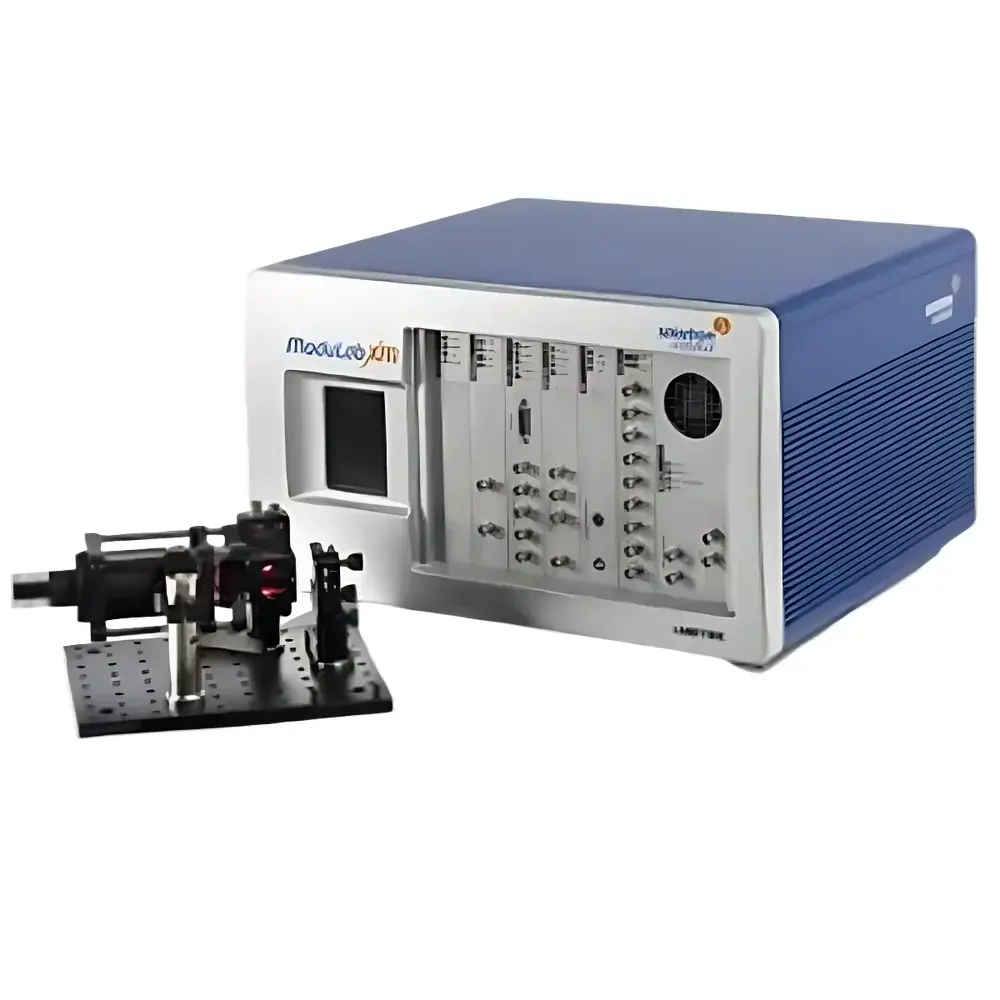
Modulab XM PhotoEchem Electrochemical Workstation with Integrated Photovoltaic Characterization Capability
| Brand | Teledyne Princeton Instruments |
|---|---|
| Origin | UK |
| Model | Modulab XM PhotoEchem |
| Instrument Type | Electrochemical Workstation |
| Current Range | ±300 mA |
| Current Accuracy | 0.1% reading + 0.05% range + 30 fA |
| Potential Accuracy | 0.1% reading + 0.05% range + 100 µV |
| Potentiostatic Range | ±8 V |
| AC Impedance Frequency Range | 10 µHz – 1 MHz |
Overview
The Modulab XM PhotoEchem is a fully integrated electrochemical workstation engineered for advanced photoelectrochemical (PEC) and photovoltaic (PV) characterization. Designed around a dual-domain architecture—simultaneously supporting high-fidelity potentiostatic/galvanostatic control and precision optical stimulation—the system enables rigorous, time-resolved investigation of light-driven interfacial charge transfer processes. Its core measurement principle combines potentiostatic control with synchronized optical excitation (via calibrated broadband or monochromatic sources), enabling quantitative analysis of photocurrent generation, charge separation efficiency, recombination kinetics, and surface state dynamics under controlled illumination conditions. The platform is particularly suited for research on dye-sensitized solar cells (DSSCs), perovskite photovoltaics, metal oxide photoanodes (e.g., Fe₂O₃ for water oxidation), quantum dot sensitized systems, and organic photovoltaic materials. Unlike generic electrochemical workstations, the Modulab XM PhotoEchem embeds optical actuation and detection as first-class experimental variables—not add-ons—ensuring phase-coherent, artifact-minimized acquisition in techniques such as intensity-modulated photocurrent/photovoltage spectroscopy (IMPS/IMVS).
Key Features
- Integrated high-irradiance optical path delivering collimated, uniform illumination exceeding 100 mW/cm² (≥0.1 Sun) at sample plane, with NIST-traceable calibration certificate for absolute irradiance reproducibility
- Synchronous dual-channel reference detection architecture eliminating phase lag and amplitude distortion in high-frequency IMPS/IMVS measurements up to 1 MHz
- Comprehensive built-in test modules: IMPS/IMVS, light-intensity-controlled EIS (with programmable bias light), charge extraction (CE), open-circuit voltage decay (OCVD), and full I–V curve acquisition including fill factor, power conversion efficiency (PCE), and incident photon-to-current efficiency (IPCE) calculation
- Dedicated neutral-density filter wheel for low-light PEC studies (e.g., sub-1 mW/cm² IPCE mapping)
- Standard white-light bias source for steady-state photocurrent quantification under realistic PV operating conditions
- Modular hardware design supporting future expansion with optional accessories: temperature-controlled electrochemical cells, quartz cuvettes with optical windows, and fiber-coupled monochromators
Sample Compatibility & Compliance
The Modulab XM PhotoEchem supports standard three-electrode electrochemical cells (working, counter, and reference electrodes) as well as custom optically transparent configurations—including thin-film photoelectrodes on conductive glass (FTO/ITO), rotating disk electrodes (RDE), and flow cells compatible with in situ spectroelectrochemistry. All optical components comply with ISO 9022-3 (optical instrument environmental testing) and are housed in a light-tight enclosure to minimize stray-light interference. The system meets IEC 61000-4-3 (EMC immunity) and carries CE marking for laboratory use in EU member states. Data integrity protocols align with GLP and GMP requirements, supporting audit-ready operation when configured with optional 21 CFR Part 11-compliant software modules.
Software & Data Management
Operation is managed via the ModuLab Control Suite—a Windows-based application offering two distinct user pathways: a guided “One-Click Workflow” interface for novice users (e.g., DSSC full-characterization sequence executed in ≤3 mouse clicks) and an advanced scripting environment (ModuLab Scripter) for expert users to define custom pulse sequences, multi-step illumination protocols, and real-time data conditioning. Raw data are stored in HDF5 format with embedded metadata (timestamp, instrument configuration, calibration history, ambient conditions). Post-acquisition analysis includes automated baseline correction, Kramers–Kronig validation for EIS, IPCE spectral deconvolution, and kinetic modeling (e.g., distributed time-constant analysis for OCVD). Export options include CSV, MATLAB (.mat), and standardized ASTM E2848-13 report templates.
Applications
- Quantitative evaluation of photoanode/cathode performance in solar fuel devices (e.g., photoelectrochemical water splitting using α-Fe₂O₃, BiVO₄, or Ta₃N₅)
- Charge transport and recombination lifetime mapping in perovskite thin films via IMPS/IMVS under variable light bias
- Stability assessment of organic photovoltaics under simultaneous illumination and electrical stress (ISOS-L-2 compliant protocols)
- Photoelectrocatalytic CO₂ reduction mechanism studies using in situ EIS coupled with product quantification
- Development and validation of novel redox mediators for DSSCs through light-intensity-dependent electron lifetime analysis
- IPCE action spectra acquisition across UV–Vis–NIR (300–1100 nm) with spectral responsivity correction
FAQ
Is the light source NIST-traceable and field-calibratable?
Yes—the integrated xenon-arc or LED-based source ships with a NIST-traceable irradiance calibration certificate and includes a removable reference photodiode for routine in-lab verification.
Can the system perform transient photocurrent measurements with microsecond resolution?
Yes—using the high-speed analog output mode and external digitizer integration, temporal resolution down to 100 ns is achievable for pump-probe experiments.
Does the software support automated IPCE mapping across multiple wavelengths?
Yes—ModuLab Scripter enables wavelength-stepped IPCE acquisition with auto-scaling of light intensity to maintain constant photon flux, generating full spectral response curves with uncertainty propagation.
Is compliance with FDA 21 CFR Part 11 available?
Optional Part 11 compliance package includes electronic signatures, audit trails, role-based access control, and secure data archiving—validated per IQ/OQ protocols.
What electrode configurations are supported for solid-state PV devices?
The system accommodates both liquid-electrolyte and solid-state configurations, including hole-transport-layer (HTL)/electron-transport-layer (ETL) stacks mounted on conductive substrates with edge-contact wiring or shadow-mask-defined active areas.




